James Sowerby ran what was, in effect, a publishing system. Over three decades he produced serial works on British plants, fungi, minerals and fossils, each built from the same parts: one subject per plate, a pale page, careful line, hand-applied colour and a short name. The look is modest, yet it stayed consistent across many thousands of images. For designers who build icon sets, product catalogues or long-running editorial series, that consistency is the lesson.
Who was James Sowerby?
The Dictionary of National Biography (1898) and the Complete Dictionary of Scientific Biography agree that he was born in London in March 1757; the former gives the day as 21 March. Both record that he studied at the Royal Academy, and the Dictionary of National Biography adds that he was an articled pupil of the marine painter Richard Wright. According to that entry he first worked as a drawing teacher and portrait painter before turning to flowers, which led him to botany.
His botanical career began with commissions. The Dictionary of National Biography records plates for the French botanist Charles-Louis L’Héritier in 1786–87 and work for William Curtis on the Botanical Magazine in 1787. The University of Glasgow’s special collections add that he worked on Curtis’s Flora Londinensis and drew the plate that opened the Botanical Magazine, and that he stopped working for Curtis in 1790. In 1788 he published a teaching book, An Easy Introduction to Drawing Flowers According to Nature, according to the same dictionary.
He died at his home in Lambeth on 25 October 1822, as the Dictionary of National Biography, the Dictionary of Scientific Biography and the Linda Hall Library all record. The Linda Hall Library notes that he trained his three sons, James de Carle, George and Charles, as artists and engravers, and the Dictionary of Scientific Biography records that the family continued the work after his death.
James Sowerby and English Botany
English Botany is the project that carried his name. The Linda Hall Library and the University of Glasgow both date it 1790–1814 in 36 volumes, and the Linda Hall Library describes several thousand hand-coloured engravings. The text was written by the botanist James Edward Smith, whose name, the Dictionary of Scientific Biography notes, was at first withheld at his request, so the set became known as “Sowerby’s Botany”.
What makes the plates useful to designers is their discipline:
- One subject, one page. Each plate is given to a single species, set on an unprinted ground. Nothing else competes.
- A compact format. The University of Glasgow describes the work as a serial, and the Linda Hall Library counts 36 volumes, so every plate had to read clearly at the same modest page size.
- Line first, then colour. The engraved outline carries the structure; hand-applied colour sits inside it in thin, even washes. The colour identifies the plant rather than dramatising it.
- Details where needed. Where identification depends on a small part, such as a flower or seed, a plate can add it as a separate detail beside the main figure, a convention shared across the botanical illustration of the period.
The Dictionary of Scientific Biography records that in 1859 the British Museum (Natural History) bought his herbarium and more than 2,500 original watercolour drawings for English Botany.
What to look at in a Sowerby drawing
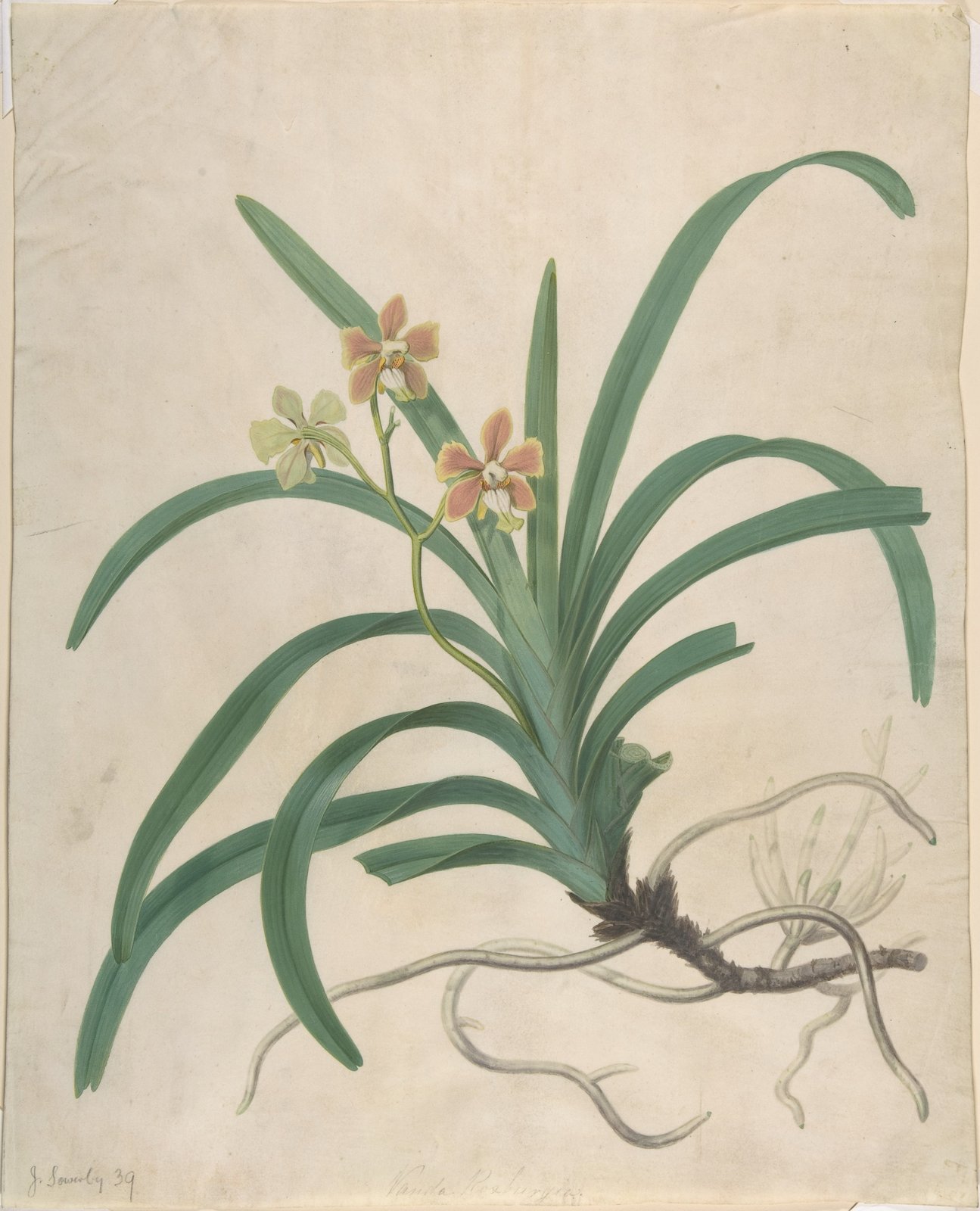
The Metropolitan Museum of Art holds two of his botanical studies, both catalogued as watercolour and gouache over graphite and dated before 1822. They show the working drawing behind a printed plate.
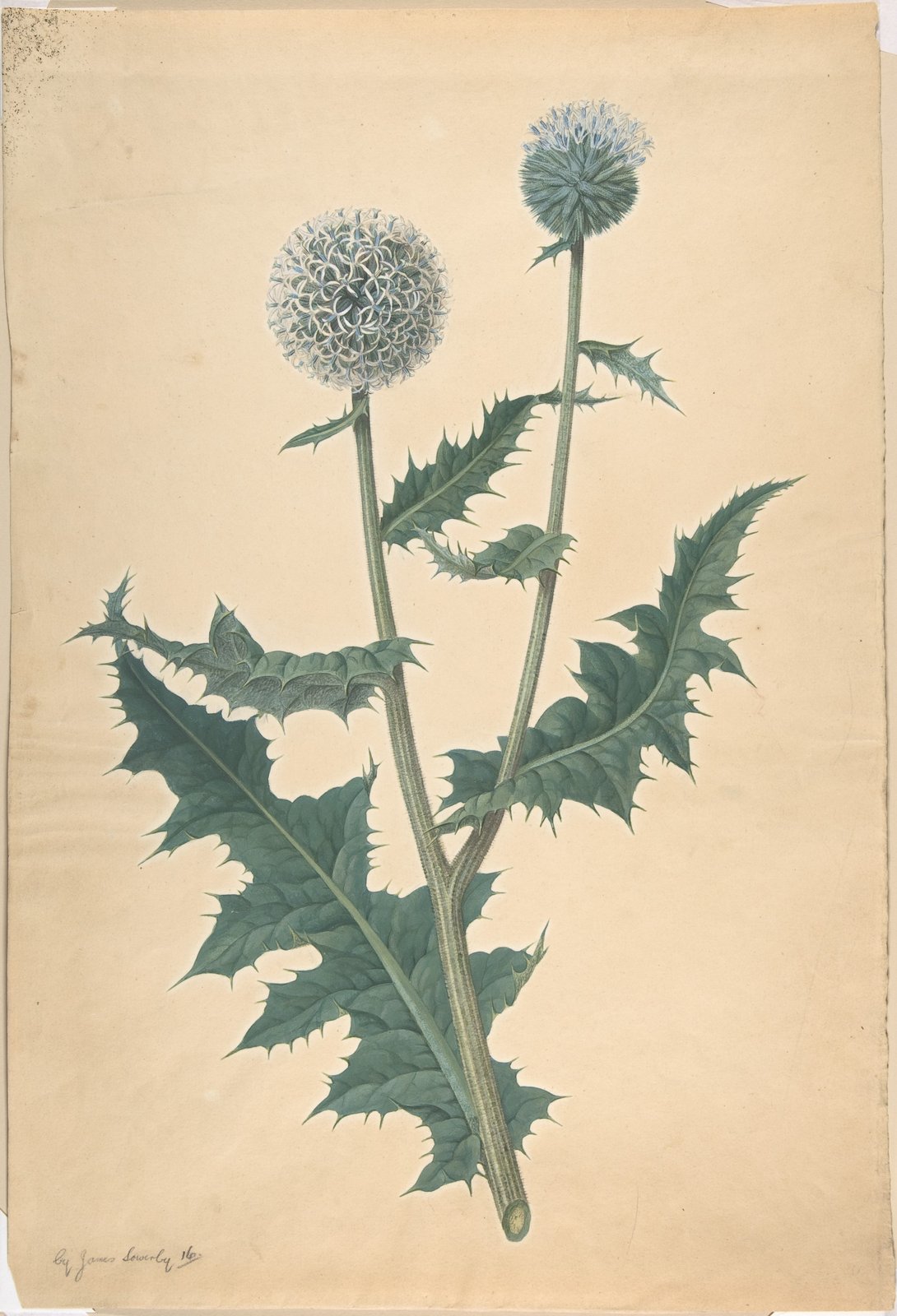
- Silhouette. The thistle is drawn so that its outline alone identifies it: two round heads on bare stems, spiny leaves fanning out below. Strong silhouettes are what make an icon readable at small sizes.
- A narrow, cool palette. Measured from the museum’s scan of the thistle sheet, the leaves sit around #5b6d61 and #718172 against a buff paper of about #f1dbbc. The orchid study uses a similar range, with leaves near #5d6e58 and #6f8269 on a paper tone near #e5d6c3. Two greens and a paper colour do almost all the work.
- Roots and growth habit. The orchid includes its white aerial roots, because how the plant grows is part of its identity. In product imagery, the equivalent is showing how something is used, not only how it looks.
- Bodycolour for highlights. The Met lists gouache (bodycolour) as well as watercolour. Opaque touches let pale details sit on top of darker washes, much as a light text layer sits on a tinted panel.
Fungi, minerals and fossils: one system, many subjects
Sowerby carried the English Botany format into new fields.
- Coloured Figures of English Fungi or Mushrooms was begun in 1797 and finished in 1815, according to the Dictionary of National Biography; library catalogues give varying end dates for the supplements. The University of Glasgow notes that he made 440 drawings for it, and both sources record that he also made models of fungi, which the Glasgow page says were meant to help people tell edible from poisonous species.
- British Mineralogy appeared in parts, from 1802 according to the Dictionary of Scientific Biography; the Linda Hall Library gives 1804–17.
- The Mineral Conchology of Great Britain, a catalogue of fossil shells, was issued in parts from 1812 and continued after his death by his sons, as both the Dictionary of Scientific Biography and the Linda Hall Library record.
Across all three, the visual grammar stays the same: specimen centred, plain ground, outline and flat colour, short name. The subjects range from soft mushrooms to crystals and shells, yet each series is recognisably his. That is the strength of a well-defined system.
A New Elucidation of Colours (1809)
A natural history painter depends on naming colours precisely, and Sowerby tried to systematise them. The Dictionary of National Biography and the Royal Society both date A New Elucidation of Colours, Original Prismatic, and Material to 1809. The Royal Society, which holds a print of its chart, describes a nomenclature for 63 colours built from three primaries, yellow, blue and red, and notes that the chart plate is inscribed 1 October 1807. According to the Royal Society, Sowerby singled out gamboge, carmine and Prussian blue as the purest pigments for each primary.
For a designer, the book is an early example of what we now call a colour system: a small set of named base colours, mixed in defined steps, so that everyone working on a series describes and reproduces colour the same way.
How designers can borrow from James Sowerby
- Fix the format before the content. Decide the frame, margins, scale and label position once, then apply them to every item. Sowerby’s plants, fungi and fossils all fit one template.
- Design for silhouette. Test icons and illustrations as solid shapes. If the outline alone identifies the subject, colour and detail become a bonus.
- Use a short, named palette. Choose three base colours and a paper tone, name them, and mix only from those. Start from the greens and buff measured above and build out in our colour palette generator.
- Show the useful detail. Add one magnified part only where it helps someone identify or choose, as Sowerby did with roots and flower sections.
- Keep the ground plain. Off-white or buff backgrounds give a series calm and make every subject easy to compare.
For the wider tradition, see our guide to botanical illustration, and compare Sowerby’s serial plates with the microscope-led drawings of his contemporary at Kew, Franz Bauer. More cleared plant imagery is in the botanical theme of the MGD museum inspiration collection.
Frequently asked questions
What is James Sowerby known for?
He is known for the hand-coloured engraved plates of English Botany (1790–1814), written by James Edward Smith and popularly called “Sowerby’s Botany”, and for illustrated works on fungi, minerals and fossil shells.
Did James Sowerby write English Botany?
He produced the illustrations and published the work, but the text was by James Edward Smith, whose name was at first withheld at his request, according to the Dictionary of Scientific Biography.
What was Sowerby’s colour chart?
It is a plate from A New Elucidation of Colours (1809), which the Royal Society describes as a nomenclature for 63 colours derived from yellow, blue and red.
Can I use these James Sowerby images?
The two drawings shown here are flagged public domain by the Metropolitan Museum of Art in its open-access data. Check the museum’s terms on each object page before reuse.