ASK Italian Brand Guidelines
The Kaye brothers’ initials, renamed for Italy in 2010.
Aa
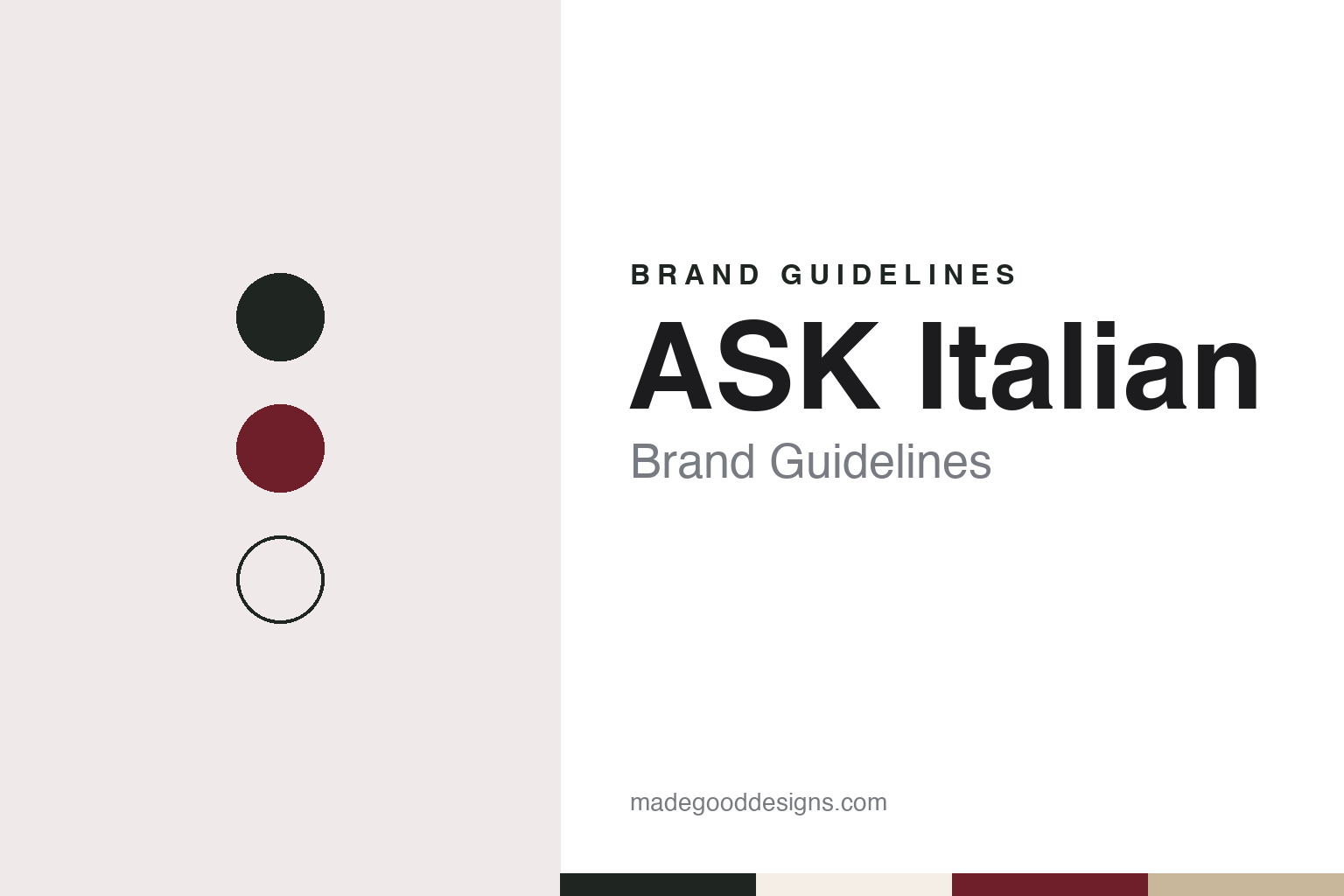
Two constants: a green-black, claret and cream palette and an Italianate serif register. Abstract homage — not an ASK Italian asset; no logo, menu or artwork is reproduced.
Two brothers’ initials
Not an acronym, but a pair of names.
ASK was founded in 1993 by the brothers Adam and Samuel Kaye. English Wikipedia says the name is made up of the founders’ initials, and notes that it is often taken for an acronym for “Authentic Sicilian Kitchen,” which it is not. The chain served Italian food from the start and floated on the Alternative Investment Market in 1995, English Wikipedia says. Six years after founding ASK, the same brothers opened Zizzi in Chiswick, and Restaurant magazine later described the two as twin chains.
The founders’ era ended in 2004. English Wikipedia describes a public-to-private deal that year, after which ASK was brought together with Pizza Express in Gondola Holdings; Restaurant magazine, reporting in December 2011, also dated ASK’s sale to Gondola to 2004. Under Gondola, ASK sat alongside PizzaExpress, Zizzi and, later, the burger chain Byron.
Within that group, ASK was the brand most in need of attention by the end of the 2000s. In a January 2013 profile, Restaurant magazine described it from the outside as something of a “problem child” at Gondola, with PizzaExpress as the flagship and Zizzi seen as the cooler sibling. Steve Holmes, who had moved over from PizzaExpress as operations director and became managing director, told the magazine that customers knew the name but were not using it, and that the food, service and restaurants had become forgettable. The old restaurants carried what the magazine called a “distinctive but dated spindly red logo.”
Colour
A new name, a new chef and Bluewater.
The answer was a new name and a new look. The chain began calling itself ASK Italian in 2010, English Wikipedia says, and Restaurant magazine dated the opening of the earliest restaurant in the new livery to summer 2010, on Spring Street in Paddington, London. In December 2011 the magazine described the change as a major overhaul: a more modern interior with brighter colours and low-hanging lighting, new staff uniforms and closer links with Italian suppliers. ASK was the last of Gondola’s Italian chains to be refreshed, after revamps of Zizzi and PizzaExpress earlier that year.
The food changed with the rooms. The chef Theo Randall, of the InterContinental hotel on Park Lane, began advising ASK in 2010, and his premium “prima” pizzas reached the menu in 2011, with the rest of the menu under his direction from spring 2012, according to Restaurant. The Italian food and wine writer Carla Capalbo and Master of Wine Adrian Garforth built an all-Italian wine list, and Capalbo co-wrote The ASK Italian Cookbook, published in 2012. Managers went on training trips to Italy.
The early redesigns did not fully satisfy the company. Restaurant reported in January 2013 that 50 of the 118 restaurants had been rebranded between mid-2010 and mid-2012, but that only the 11 reopened since that summer, including Bromley, Norwich and Horsham, were ones Holmes was truly happy with. The model for these was a new 145-cover restaurant at Bluewater in Kent, which the magazine described as bright, busy and layered: Italianate tiled floors mixed with light wooden boards, patterned wallpaper used as an accent, a large wine-rack feature over the bar, pastel leather banquettes, cooking utensils and stovetop coffee makers placed around the room as “kitchenalia,” and an “Italian wall” of images. The plan then was to convert about 20 more restaurants a year.
Today the company says many of its restaurants carry bespoke artwork made to reflect the local community and to draw on an Italian counterpart, so that each one looks different.
Typography
British Italian dining.
Britain’s Italian restaurant chains tend to tell their stories through a room and an oven. Pizza Express traces itself to a single pizzeria on Wardour Street in Soho, opened in 1965 with an oven brought from Italy, according to accounts in MCA and Restaurant Online in 2018. Franco Manca, which began in Brixton Market in 2008, says its founders built their own oven there before opening anywhere else.
Menus and naming are usually plain. Dishes are listed by ingredient and region rather than by invented brand names, and some chains publish where those ingredients come from: Franco Manca’s pages run through its flour, tomatoes, cheeses and coffee one by one. Restaurant names lean on a founder, a place or a simple description; Franco Manca, the company says, means “Franco is missing,” after the man who ran the market pizzeria before it.
The corporate pages tell a second story, about owners. Many of these chains have passed between founders, stock-market listings and investment firms. In 2014 City A.M. noted that the private equity firm Cinven’s Gondola group ran Pizza Express alongside Zizzi and ASK Italian; Franco Manca was bought by the listed group Fulham Shore in 2015, and Fulham Shore by the Tokyo-listed Toridoll in 2023.
Restructurings are part of that record too. Company voluntary arrangements, which let a business close restaurants and reset its leases with creditors’ approval, were used by Pizza Express in 2020 and announced by Franco Manca’s owner in 2026, according to trade press reports. Each guide in this series sets out what can be checked about a chain, who founded it, who owns it and what has changed, and marks what rests on the company’s own word.
Aa
An Italianate serif for a renamed high-street chain. (Specimen set in Playfair Display, a serif STAND-IN; NOT the ASK Italian logo.)
ASK Italian
From Gondola to Azzurri.
Gondola sold ASK Italian and Zizzi together to the private equity firm Bridgepoint in December 2014, The Caterer and Restaurant magazine reported; ASK then had 109 restaurants. The sale completed in early 2015, with English Wikipedia giving February 2015, and Steve Holmes stayed as chief executive of both chains. The new owner took the name Azzurri Group. Theo Randall took a minority stake in it in 2015, The Caterer reported that July, when ASK had 112 outlets; in August 2016 the magazine reported three new ASK Italian openings, including Newcastle’s Eldon Square and Milton Keynes, adding to a chain of more than 110 restaurants. In September 2015 Azzurri said it would stop taking an 8 per cent administration fee from tips paid by card, from that November, The Caterer reported.
The group was restructured in 2020. KPMG was appointed administrator of Azzurri Group on 17 July 2020, and the next day the business was sold in a pre-pack deal to TowerBrook Capital Partners, The Caterer reported. Across ASK Italian and Zizzi, 75 restaurants closed, while 225 venues continued trading under the new owner.
Azzurri has since widened its range. It bought the Belfast burrito chain Boojum in June 2023, The Caterer reported, and by November 2025 it also ran the US chain Dave’s Hot Chicken in Britain. In that year’s results, reported by Restaurant magazine in November 2025, the group said it had launched an ASK Perks app and planned to keep strengthening the ASK and Zizzi brands. ASK Italian continues to trade under Azzurri, with restaurants across the UK.
For a design guide, ASK Italian shows how a renamed chain can rebuild itself around rooms and menus rather than a new mark alone, and how an early round of redesigns can be revised. Compare Zizzi, its sister chain from the same founders, and Pizza Express, its former partner in Gondola. For this guide we use bottle green-black, wine-rack claret and tile cream with a serif, an unofficial interpretation; no product or logo is reproduced.
Explore & save
Keep ASK Italian’s identity on hand — save it to a board in the Made Good inspiration library.
ASK Italian identity set
Pin the ASK Italian green-black, claret and cream palette and the Italianate serif register to your own board.