Bangkok Design Week Brand Guidelines
A city-wide design festival rooted in the old districts along the river.
Aa
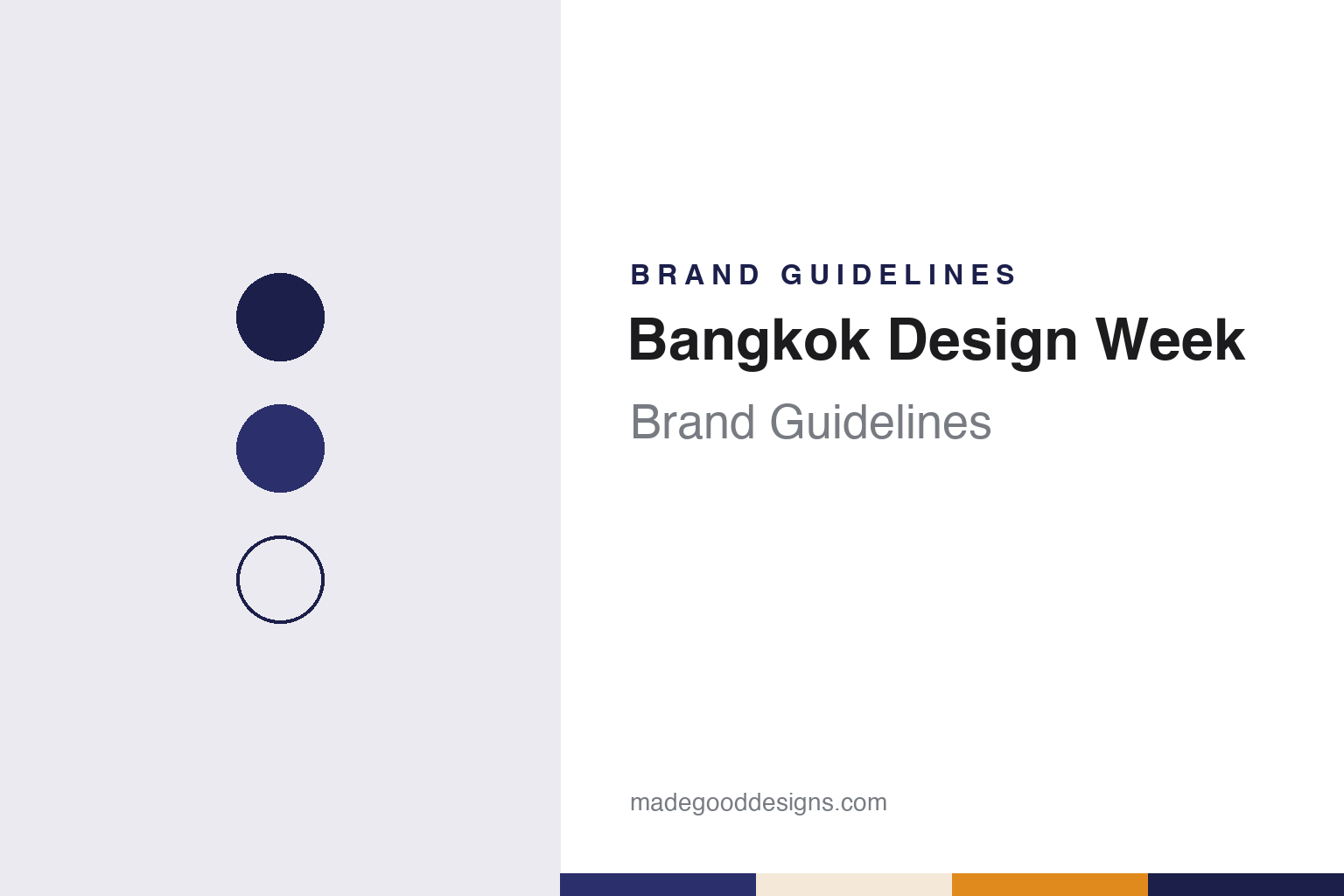
Two constants: an indigo, rice-paper and marigold palette and a humanist sans register. Abstract homage — not a Bangkok Design Week asset; no logo, poster or key visual is reproduced.
The New-ist Vibes
A first edition run from the Grand Postal Building.
Bangkok Design Week opened for the first time on 27 January 2018 and ran until 4 February. The Bangkok Post reported on 26 January 2018 that it was organised by the Thailand Creative & Design Center (TCDC), the team behind Chiang Mai Design Week, and that it was the city’s first such event. English Wikipedia says TCDC opened in November 2005 as a public design resource centre and is based in the Grand Postal Building on Charoenkrung Road in Bang Rak.
Time Out Bangkok, writing on 24 January 2018, described the opening edition as a nine-day festival under the theme “The New-ist Vibes”, organised as a collaboration between TCDC, the Bangkok Metropolitan Administration and the Thailand Convention and Exhibition Bureau. Its venues were spread across several neighbourhoods: Charoenkrung, Klongsan, Wongwian 22, Rama 1 and Sukhumvit. The programme was framed around three ideas, city and living, well-being and gastronomy, and creative business. Among the highlights the magazine picked out was a Floating Park by the landscape architecture firm Shma, which turned a sand carrier ship into a small floating park to draw attention to the shortage of green space in the city.
The Nation set out the 2018 structure on 30 January 2018. The festival was divided into six categories, among them a Creative District Project, showcases and exhibitions, symposiums and talks, and a creative market of a hundred booths. The district project was a pilot in Charoen Krung that worked on signage, green and public space, play and art, with the stated aim of improving daily life in the area and drawing visitors.
The organiser changed shape later in 2018. The festival’s own site says the Creative Economy Agency (Public Organization), or CEA, was established on 14 August 2018 and that the organisation formerly known as TCDC now operates as CEA, under the supervision of the Office of the Prime Minister. English Wikipedia describes TCDC today as a centre run by CEA.
Colour
Themes, districts and a festival map.
English Wikipedia lists the 2024 edition under the theme “Livable Scape: The More We Act, the Better Our City” and the 2025 edition under “Design Up+Rising”, and notes that CEA also runs Chiang Mai Design Week, first held in December 2014, and Pakk Taii Design Week, launched in Songkhla in 2023.
The 2026 edition, the ninth, ran from 29 January to 8 February 2026 under the theme “DESIGN S/O/S”. The festival’s site spells out the letters as Secure Domestic, Outreach Opportunities and Sustainable Future, and presents the theme as a declaration of design as a tool for getting through hard times rather than a call for help. Time Out Bangkok reported on 14 November 2025 that the festival would run for eleven days with free admission, across districts including Charoen Krung–Talat Noi, Phra Nakhon, Pak Khlong Talat, Yaowarat, Bang Lamphu–Khao San and Phra Khanong–Bang Na, with further exhibitions in neighbourhoods across the city run by artists, studios, shops and venues that had signed up.
Thairath reported on 28 January 2026 that CEA was concentrating that year on four main districts, Charoen Krung–Talad Noi, Pak Khlong Talat, Phra Nakhon and Banglamphu–Khao San, with designers taking part from seventeen countries. The paper described LongiPark in Captain Bush Alley as a public experimental space rather than a photo spot, and a BKK Book District project linking reading-related areas such as Phra Athit and Nang Loeng within walking distance of each other.
The festival’s site says each edition is organised by CEA together with state agencies, public organisations, universities and international institutions, and the organiser says the festival draws an estimated 400,000 visitors.
Typography
Design weeks and biennials.
Design weeks and design biennials usually take their names from the place that holds them. Most combine a city with the words “design week,” “design festival” or “biennale,” sometimes in the local language and sometimes shortened to an acronym or a single coined word, so that the name works as a date in the calendar as much as a title.
The bodies behind them vary. Some are run by national or regional design councils and city agencies acting in an institutional role; others by cultural foundations, design schools, trade-fair companies or communication agencies. Several are timed to a trade fair in the same city, and grew up as a public programme around it, while others stand alone.
What they share is a programme spread across a city rather than gathered in one hall. Districts, showrooms, shops, galleries, schools, museums and temporary venues open for exhibitions, installations, talks and open studios, and the organisers publish maps, guides and listings to hold the pieces together. Biennials tend to work with a curator and a smaller set of venues; design weeks often depend on many independent hosts.
Visual identity follows the same pattern. A steady wordmark or name carries from year to year, while each edition adds its own theme, key visual or poster, often by a different designer or studio. This guide describes each event from its own first edition, using dated sources for organisers, venues, dates and themes, and sets an unofficial palette and type stand-in beside it; no logo or key visual is reproduced.
Aa
A humanist sans for a festival of districts. (Specimen set in Bai Jamjuree, a sans STAND-IN; NOT the Bangkok Design Week logo.)
BKKDW
One name in two languages, plus an edition tag.
The festival appears under a Thai name, เทศกาลงานออกแบบกรุงเทพฯ, which translates roughly as “Bangkok design festival”, under its English name and under the short form BKKDW. Each edition carries that short form with its year, as in BKKDW2026, and the festival’s site keeps past editions online under those tags, marking them as past festivals.
Each year’s theme works as a second layer on top of the steady festival name. “The New-ist Vibes” in 2018, “Livable Scape” in 2024 and “DESIGN S/O/S” in 2026 each came with their own wording, while the bilingual name and the BKKDW tag stayed the same. The 2026 theme, with its three spelled-out letters, shows how an edition title can double as a programme structure, giving each strand a name that can appear on signs, maps and listings.
The sources used here do not describe the festival’s wordmark, typeface or colours, or name the designers of its identity, so this guide does not attribute any of them. The documented constants are a public organiser, a hub in the Grand Postal Building on Charoenkrung Road, a season at the turn of January and February, and a map of named districts that changes in detail from year to year. A design system for this kind of event has to work in two scripts at once and stay readable on street signs in narrow lanes as well as on a festival map.
For a design guide, Bangkok Design Week shows how a festival can tie its identity to districts and a yearly theme while keeping one bilingual name. Compare Singapore Design Week, another Southeast Asian design week run by a public agency, and Business of Design Week, organised by the Hong Kong Design Centre. For this guide we use a river indigo, a rice-paper cream and a marigold accent with a sans, an unofficial interpretation; no product or logo is reproduced.
Explore & save
Keep Bangkok Design Week’s identity on hand — save it to a board in the Made Good inspiration library.
Bangkok Design Week identity set
Pin the Bangkok Design Week indigo, rice paper and marigold palette and the humanist sans register to your own board.
Source & notes
Frequently Asked Questions
What font can I use to match the Bangkok Design Week look?
This guide describes Bangkok Design Week’s type as “A humanist sans for a festival of districts”. Its type specimen is set in Bai Jamjuree from Google Fonts as a stand-in; Bai Jamjuree is not Bangkok Design Week’s own lettering.
What colours are in the Bangkok Design Week palette?
This guide’s Bangkok Design Week palette is River indigo #2B2F6B, Night canal #1C1F4A, Rice paper #F4E9D8, Marigold #E08A1E and Paper #FBF8F3. The tones are the guide’s own unofficial interpretation, not official Bangkok Design Week hex codes.