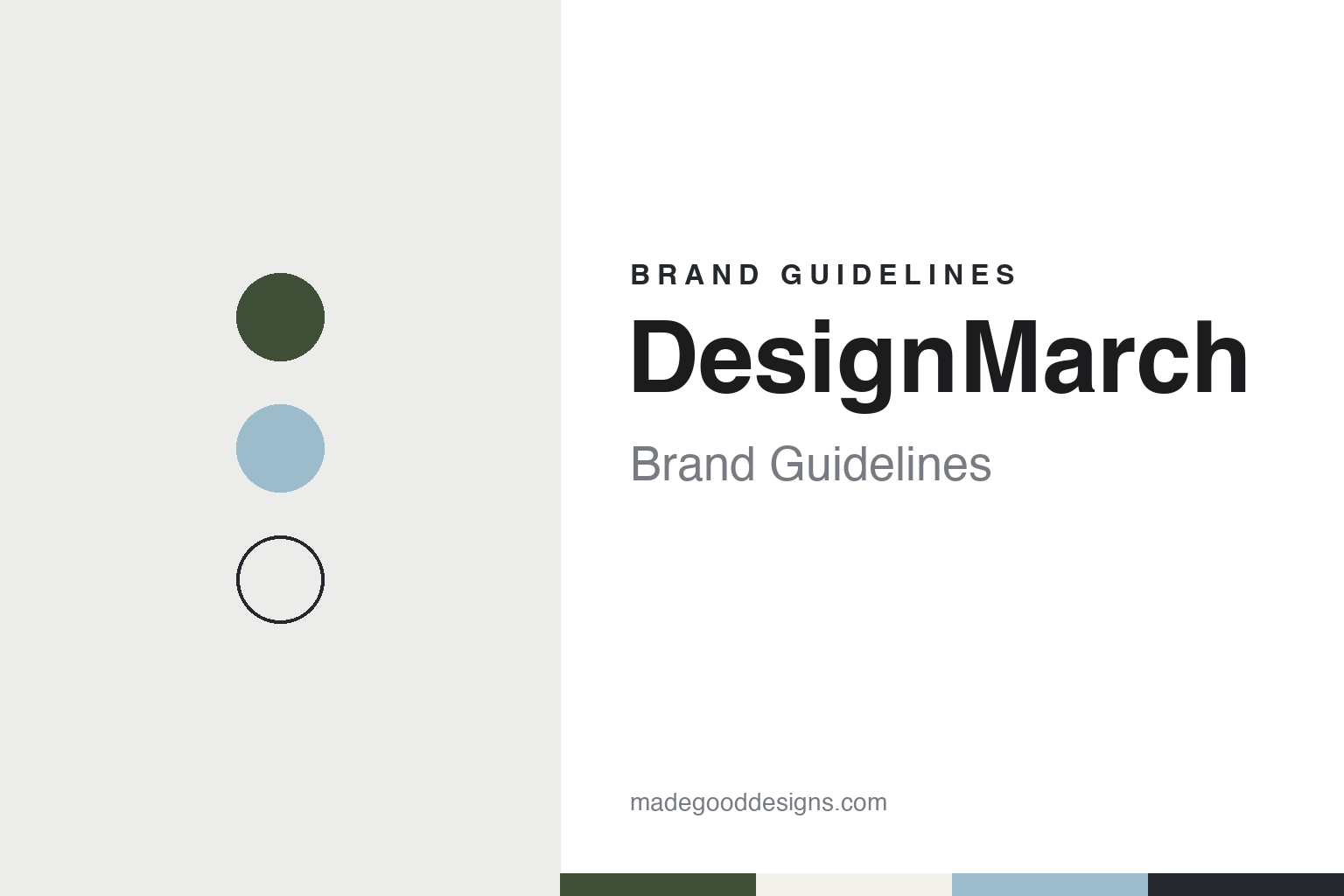
DesignMarch Brand Guidelines
Reykjavík’s design festival, named after a month it has outgrown.
Aa
Two constants: a moss green, basalt and glacier blue palette and a northern grotesque register. Abstract homage — not a DesignMarch asset; no logo, poster or festival graphic is reproduced.
A festival run by the design professions
Held every year since 2009.
DesignMarch, HönnunarMars in Icelandic, is the annual design festival of Reykjavík. Its organiser, Iceland Design and Architecture (Miðstöð hönnunar og arkitektúrs), says it has been held every year since 2009, and the edition numbers fit that date: the organiser called the 2020 festival the 12th, and Dezeen called the 2025 festival the 17th and the 2026 festival the 18th edition. Writing in 2020, the organiser described DesignMarch as a festival born in the middle of the financial crisis.
The organiser is a design body owned by the professions it represents. Iceland Design and Architecture says it is owned by nine associations, among them those of Icelandic architects, landscape architects, product and industrial designers, fashion designers, graphic designers and ceramic artists, and that it is funded by the ministry responsible for culture and business. It says it owns and produces DesignMarch and the DesignTalks conference, along with a design fund and HA magazine. Its offices are in Gróska, a building in Reykjavík that was also one of the festival’s venues in 2026.
The festival is a city-wide programme rather than a fair in one hall. The organiser’s FAQ says exhibitors find their own venues across Reykjavík and the capital area, and that a selection committee reviews applications and chooses the exhibitions and events that appear in the programme. The organiser presents the festival as a platform where Icelandic and international design meet, spanning experimental projects, recycling, craft traditions and architecture.
In 2026 the City of Reykjavík listed DesignMarch among its city festivals and named venues including the Reykjavík Art Museum, the Museum of Design and Applied Art, the Nordic House, Gróska, Ásmundarsalur and the National Museum of Iceland, as well as the Vesturbæjarlaug swimming pool, a gym and the geothermal beach at Nauthólsvík; three restaurants in the city centre ran programmes of their own. The city counted more than 100 exhibitions and 150 events that year, with about 400 participants.
Colour
From March to the longer days.
The name comes from the month in which the festival was held for its first eleven editions. “DesignMarch, given the name, has always been held in March,” the organiser wrote in 2020, when that year’s festival, first set for the end of March, took place instead from 24 to 28 June under the theme “New World – New Ways,” with over 100 shows and over 80 exhibitors, the organiser said. The festival’s director at the time was Þórey Einarsdóttir. The board then set the 2021 festival for 19 to 23 May.
The festival has stayed in spring since then rather than returning to March. Dezeen reported that the 2025 festival took place over five days in early April under the theme “Source,” with designers working with Iceland’s lava, algae, wool and clay. The 2026 festival ran from 6 to 10 May under the theme “Connections,” according to the organiser, the City of Reykjavík and Dezeen; the organiser said the theme addressed the human need to connect in a world that is both hyper-connected and disconnected.
DesignTalks opens the week. The organiser describes the one-day international conference as the festival’s signature event since 2009 and says that in recent years it has been held in Silfurberg, a hall in the Harpa concert building, with a different theme each year. In 2026 it took place there on 6 May, the day before the official opening at Gamla Bíó, the city said. It is curated by Hlín Helga Guðlaugsdóttir, according to the organiser. Core77, photographing the 2015 festival in March that year, showed the talks at Harpa and a lunch break taken from a ship docked nearby.
Other formats return each year, the organiser’s FAQ says. Design Diplomacy sees ambassadors in Reykjavík open their residences for informal conversations between designers from their own countries and Icelandic designers, guided by question cards; the organiser says the concept belongs to Helsinki Design Week. DesignMatch arranges a day of short meetings between local designers and international producers, retailers, curators and journalists. The organiser says the programme is presented to local and foreign media in collaboration with Business Iceland.
Typography
Design weeks and design biennials.
Design weeks and design biennials usually take their names from the place that holds them. Most combine a city with the words “design week,” “design festival” or “biennale,” sometimes in the local language and sometimes shortened to an acronym or a single coined word, so that the name works as a date in the calendar as much as a title.
The bodies behind them vary. Some are run by national or regional design councils and city agencies acting in an institutional role; others by cultural foundations, design schools, trade-fair companies or communication agencies. Several are timed to a trade fair in the same city, and grew up as a public programme around it, while others stand alone.
What they share is a programme spread across a city rather than gathered in one hall. Districts, showrooms, shops, galleries, schools, museums and temporary venues open for exhibitions, installations, talks and open studios, and the organisers publish maps, guides and listings to hold the pieces together. Biennials tend to work with a curator and a smaller set of venues; design weeks often depend on many independent hosts.
Visual identity follows the same pattern. A steady wordmark or name carries from year to year, while each edition adds its own theme, key visual or poster, often by a different designer or studio. This guide describes each event from its own first edition, using dated sources for organisers, venues, dates and themes, and sets an unofficial palette and type stand-in beside it; no logo or key visual is reproduced.
Aa
A sturdy northern grotesque for a festival name built from two words. (Specimen set in Archivo, a sans STAND-IN; NOT the DesignMarch logo.)
DesignMarch
A name that joins two words.
The 2026 edition gave a picture of the festival’s range. Dezeen reported in May 2026 that the director was Helga Ólafsdóttir and that the 18th edition brought together architecture, design and fashion in more than 100 exhibitions. The magazine’s picks included a harbourside show from the product design department of the Iceland University of the Arts on giving value to overlooked local materials, a tour of an experimental housing block on Frakkastígur clad in reclaimed road barriers, and the fifth Hæ/Hi exhibition, a collaboration between design studios in Iceland and Seattle that focused that year on the bedroom. In 2025 the same exhibition series, then in its fourth edition, showed objects for hosting guests, Dezeen reported.
The festival’s look changes with each edition. Core77 showed in 2015 a colourful mural, based on that year’s DesignMarch visual identity, being finished before the festival opened. Today participants receive shared promotional material, posters and access to software developed by Strik Studio that reflects the festival theme and lets them make promotional material from their own images, the organiser says. The name itself joins two words into one: design and March in English, and hönnun, design, and mars, March, in Icelandic.
Both names stayed in use after the dates moved. In 2026 the organiser’s English pages called the festival DesignMarch and its Icelandic pages HönnunarMars, though the festival was held in May.
For a design guide, DesignMarch shows how an event can keep a name tied to a date it no longer keeps, with a steady name and a theme and look that change each year. Compare Helsinki Design Week, whose Design Diplomacy format DesignMarch uses, and Stockholm Design Week, another Nordic design week. For this guide we use moss green, basalt and a glacier blue with a sans, an unofficial interpretation; no product or logo is reproduced.
Explore & save
Keep DesignMarch’s identity on hand — save it to a board in the Made Good inspiration library.
DesignMarch identity set
Pin the DesignMarch moss green, basalt and glacier blue palette and the northern grotesque register to your own board.
Source & notes
Frequently Asked Questions
What font can I use to match the DesignMarch look?
This guide describes DesignMarch’s type as “A sturdy northern grotesque for a festival name built from two words”. Its type specimen is set in Archivo from Google Fonts as a stand-in; Archivo is not DesignMarch’s own lettering.
What colours are in the DesignMarch palette?
This guide’s DesignMarch palette is Moss green #3E4E37, Basalt #24282C, Glacier blue #9DBCCB, Lupine violet #6A4F86 and Paper #F2F1EC. The tones are the guide’s own unofficial interpretation, not official DesignMarch hex codes.
When was DesignMarch founded?
DesignMarch was founded in 2009, in Reykjavík, Iceland.