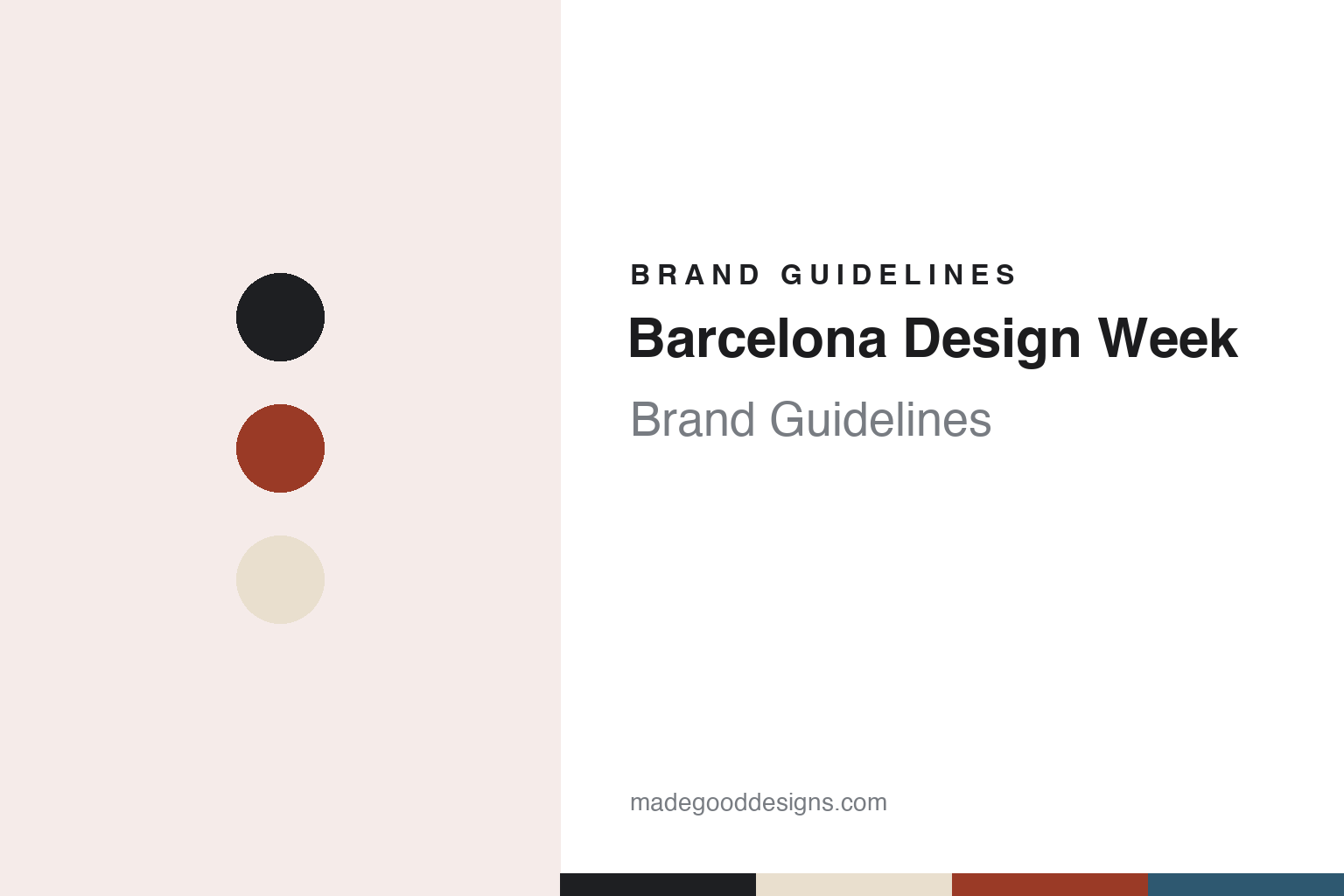
Barcelona Design Week Brand Guidelines
A city-wide design week run from a hub on the Glòries square.
Aa
Two constants: a graphite, sketch red and harbour blue palette and a grotesque sans register. Abstract homage — not a Barcelona Design Week mark; no logo, poster or exhibited object is reproduced.
A week begun in 2006
A design centre’s yearly programme for the city.
Barcelona Design Week, often shortened to BDW, was created in 2006, according to its organiser’s website. At a press conference for the 2025 edition, reported by the Fuorisalone.it magazine in October 2025, the organisation’s president also dated the week to 2006. For almost two decades it was run by BCD Barcelona Centre de Disseny, which the Gran Enciclopèdia Catalana describes as an organisation devoted to promoting the use of design and innovation in it, and the 2013 edition was still billed as BCN Design Week in the Spanish trade press.
The organiser is older than the week. The encyclopaedia says BCD began its activities in 1973 with a permanent exhibition of products in an inflatable pavilion set up on the Diagonal, the avenue that crosses the city. In 1976 the BCD foundation was formally constituted and moved to the passeig de Gràcia; in 1985 it opened a centre for computer-aided design. Since December 2013, the encyclopaedia says, it has been based in the Disseny Hub Barcelona on the plaça de les Glòries, the building that has since served as the week’s centre.
In January 2025 the organiser changed its name. A notice on its website dated 9 January 2025 announced that, after more than 50 years, the Barcelona Design Centre was beginning a new phase as the Barcelona Creativity & Design Foundation, with a new corporate identity and a new president, Enric Jové. The foundation’s website lists Barcelona Design Week and the Inspired in Barcelona programme among its activities, and the week’s own website says it is organised by the foundation and promoted by Barcelona City Council and the Disseny Hub Barcelona, in collaboration with FAD, the arts and design association.
The week has also changed its place in the calendar. The trade site Interempresas reported in July 2013 that the eighth edition, held from 11 to 21 June 2013, was the first to take place in June, ran for eleven days and opened the third Barcelona Design Festival; it coincided with BCD’s 40th anniversary and ran under the slogan Design Vision 2050. The same report said much of the programme took place in the newly opened Disseny Hub and that the organiser counted more than 6,000 attendees.
Colour
Talks, circuits and open studios.
Barcelona City Council’s culture listings describe the June years in some detail. The ninth edition ran from 2 to 14 June 2014, with conferences, exhibitions, workshops and a Design Circuit Poblenou, a walking route through architecture and design studios in the Sant Martí district that opened their doors for the week. The tenth, from 8 to 14 June 2015, was held at the Disseny Hub under the banner Design is here! and offered more than 70 activities; to mark its first decade the organisers invited the creative directors of design festivals from ten cities, among them Beijing, Eindhoven, Helsinki, Istanbul, London and Vienna, to speak in a series called the International Design Week Talks.
The 2016 edition ran from 2 to 12 June. The council’s listing described it as organised by Barcelona Centre de Disseny and divided into three forums, Design is Future Congresstival, Design4Food and Workshops BDW, with the Disseny Hub again at its centre. Around it ran Open Design Studios and BDW City, a format for activities across the city aimed at a wider public, and design circuits that took visitors into the offices of architects and designers.
By the mid-2020s the week had moved to October. Fuorisalone.it reported that the nineteenth edition, from 16 to 26 October 2024, offered more than 140 activities under the theme Design for Human Future, with a particular focus on water, and was curated by Alessandro Manetti. Five exhibitions were held at the Disseny Hub. The main one, Inspired in Barcelona: Terra Rossa, explored the relationship between design and territory through a pyramid of 80 clay jugs altered by 16 creatives, and had first been shown that April during the Fuorisalone in Milan. The number of associated venues around the city, the magazine said, had doubled from the previous year to 15.
The twentieth edition ran until 17 October 2025 under the theme of “design with purpose,” with more than 130 activities over ten days, Fuorisalone.it reported. The opening took place at the Roca Barcelona Gallery; other strands included Design in Diagonal, a public circuit of shops, showrooms and partner spaces along the Avinguda Diagonal, and Underground BDW, a collective fair and exhibition in an underground gallery with 26 exhibitors, from companies to design schools. A further 57 parallel activities by independent organisers ran under the name OFF BDW.
Typography
How design weeks present themselves.
Design weeks and design biennials usually take their names from the place that holds them. Most combine a city with the words “design week,” “design festival” or “biennale,” sometimes in the local language and sometimes shortened to an acronym or a single coined word, so that the name works as a date in the calendar as much as a title.
The bodies behind them vary. Some are run by national or regional design councils and city agencies acting in an institutional role; others by cultural foundations, design schools, trade-fair companies or communication agencies. Several are timed to a trade fair in the same city, and grew up as a public programme around it, while others stand alone.
What they share is a programme spread across a city rather than gathered in one hall. Districts, showrooms, shops, galleries, schools, museums and temporary venues open for exhibitions, installations, talks and open studios, and the organisers publish maps, guides and listings to hold the pieces together. Biennials tend to work with a curator and a smaller set of venues; design weeks often depend on many independent hosts.
Visual identity follows the same pattern. A steady wordmark or name carries from year to year, while each edition adds its own theme, key visual or poster, often by a different designer or studio. This guide describes each event from its own first edition, using dated sources for organisers, venues, dates and themes, and sets an unofficial palette and type stand-in beside it; no logo or key visual is reproduced.
Aa
A sturdy grotesque for a programme that is built around a central hub. (Specimen set in Archivo, a sans STAND-IN; NOT the Barcelona Design Week logo.)
A theme and an identity each year
In 2026, an identity drawn by hand.
Each edition now carries its own theme and its own graphic campaign. For the 21st edition, the organiser’s website gives the dates as 14 to 25 October 2026, the theme as PRO-TEST: Prototyping and Testing and the curator as Alessandro Manetti. The theme, it says, centres on process, experimentation and testing as parts of creative practice, and treats the prototype as a tool for exploring rather than only a step towards a final object. The organiser presented the theme in June 2026 and placed it in dialogue with Barcelona’s year as World Capital of Architecture.
The 2026 visual identity was created by the creative studio Abuela, the week’s website announced in July 2026. Instead of a single fixed image, the campaign is built from hand-drawn first sketches contributed by architects, designers, illustrators, students and invited creatives, with the pencil as its guiding thread. The organiser describes the result as an open identity that grows as more drawings are added, and named about twenty studios and individuals who took part in the first phase, together with students from two of the city’s design schools.
The constants sit beneath these yearly changes: the name, the BDW short form, the Disseny Hub on the Glòries square as the main venue, and a programme that spreads outwards through associated venues, showrooms and studio circuits. The week’s website also says BDW is a member of World Design Weeks, a Barcelona-based network that it describes as bringing together more than 40 design and creativity events. The palette and type in this guide are our own interpretation and do not reproduce any campaign.
For a design guide, Barcelona Design Week shows how a design-promotion body can turn its yearly programme into a city-wide week with a fresh theme and identity each autumn. Compare the Fuorisalone in Milan, where the 2024 Barcelona exhibition was first shown, and Dutch Design Week in Eindhoven, one of the cities invited to the 2015 talks. For this guide we use graphite, a sketch red, a harbour blue and sandstone with a sans, an unofficial interpretation; no product or logo is reproduced.
Explore & save
Keep Barcelona Design Week’s identity on hand — save it to a board in the Made Good inspiration library.
Barcelona Design Week identity set
Pin the graphite, sketch red and harbour blue palette and the grotesque sans register to your own board.
Source & notes
Frequently Asked Questions
What font can I use to match the Barcelona Design Week look?
This guide describes Barcelona Design Week’s type as “A sturdy grotesque for a programme that is built around a central hub”. Its type specimen is set in Archivo from Google Fonts as a stand-in; Archivo is not Barcelona Design Week’s own lettering.
What colours are in the Barcelona Design Week palette?
This guide’s Barcelona Design Week palette is Graphite #1E1F22, Sketch red #9A3A26, Harbour blue #2E5870, Sandstone #E9DFCE and Paper #FAF8F4. The tones are the guide’s own unofficial interpretation, not official Barcelona Design Week hex codes.
When was Barcelona Design Week founded?
Barcelona Design Week was founded in 2006, in Barcelona, Spain.