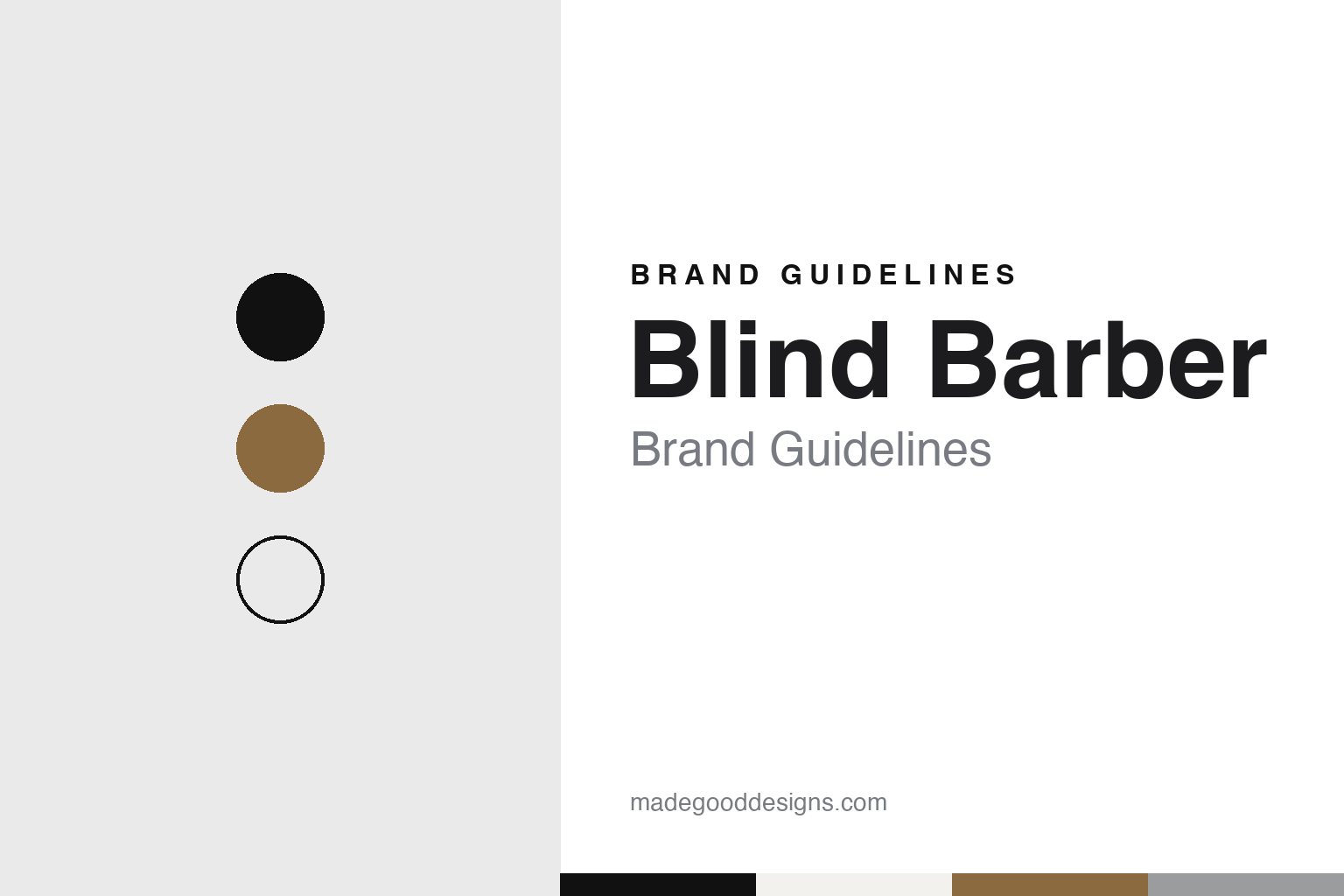
Blind Barber Brand Guidelines
The East Village barbershop with a bar behind it.
Aa
Two constants: a black, white and brass palette and a condensed sans register. Abstract homage — not a Blind Barber product or mark; no sign, pack or logo is reproduced.
A barbershop with a secret
Two chairs and a bar behind the last one.
Blind Barber began as a barbershop with a bar behind it in New York’s East Village. A Time Out New York listing dated June 2010 describes the bar owner Joshua Boyd teaming up with Jeff Laub, a former manager at the Ted Gibson salon, and Adam Kirsch to open a dual-purpose barbershop and lounge; in a December 2019 interview with The Philadelphia Inquirer, Laub named his partners as Boyd and Adam Kirschenbaum. Sources differ on the opening date: Laub told the Inquirer that the first Blind Barber opened in June 2009, while the company’s own story says it set up shop in 2010, as a two-chair barbershop with “a secret tucked behind the last chair.”
Laub described the route there to the Inquirer. After studying at NYU and working as a paralegal, he had answered phones in salons, including Ted Gibson’s, and enrolled at cosmetology school before leaving to write a business plan for a place that combined a haircut with a drink. A lawyer told him that in New York a barbershop and a bar could share a liquor licence if the two spaces were divided. Through Boyd, a friend of Kirschenbaum, he found a bar in the East Village that Boyd had planned to sell; instead, Laub said, they knocked down walls and turned it into the first Blind Barber.
The name comes from the speakeasy. Laub told the Inquirer that he read that illicit bars were also called blind pigs and blind tigers, settled on Blind Barber and registered it as a trademark. A fourth partner, Matt Breen, joined about two years in with a retail background; in 2019 Laub described Breen as chief executive, himself as chief marketing officer, Kirschenbaum as chief operating officer and Boyd as chief business development officer, handling the build-outs. Laub also described the business then as self-funded, without outside investors.
Colour
Cuts by day, a back room by night.
Each shop described in the press follows the same plan: a working barbershop at the front and a bar reached through it. Time Out’s 2010 listing described an old-time barbershop for men’s cuts and shaves in front, and a back room with couches and a bar serving themed cocktails, one of them named the Sweeney Todd. In Philadelphia, the Inquirer reported in December 2019, the new shop at Juniper and Sansom Streets had three barber chairs, a bar on the ground floor and a second bar upstairs among lounge spaces, with a cocktail included with a cut and grilled cheese sandwiches served in the evening.
The shops spread over a decade. Time Out Chicago reported in March 2017 that a shop in Fulton Market would open that summer, adding to three locations in New York and one in Los Angeles. In 2018 Time Out Los Angeles visited the new shop on Figueroa in Highland Park; co-owner Boyd said its look drew on 1970s and mid-century Southern California, beginning with a fish tank, and the magazine described it as the first location the owners had designed themselves. The same piece said the New York and Culver City shops leaned on Prohibition-era style, while Chicago took the form of a 1970s basement rec room. In September 2019 Miami New Times reported a shop inside the Nautilus by Arlo hotel in Miami Beach, the fourth city, and described Blind Barber’s “signature achromatic aesthetic paired with white barber chairs,” here with a lounge of pink and green seating, copper walls and terrazzo tables.
By December 2019 the Inquirer counted five cities. In November 2026 the company’s locations page lists seven shops: the East Village, which it calls the first; Culver City, its second and first in the West; a barbershop inside the Moxy hotel in Times Square; Highland Park; Chicago; Philadelphia; and Nashville, described as its newest.
Typography
Signs, poles and shopfronts.
Barbershop chains and men’s grooming salons sell a service that happens in a chair, so most of their identity is built in the shop itself. The name on the sign does a great deal of the work: some chains use a person’s name in the possessive, as a neighbourhood barber would, while others pair a short, memorable word with a plain descriptive line that says what happens inside. Lettering on windows and fascias, and in many shops a striped barber pole, place the business in a long tradition before a customer has opened the door.
Inside, the materials tell the story. Franchise announcements and press reports describe interiors built from leather chairs, wood-toned stations, posters, televisions and music, and the chair itself is often the most photographed object in the room. Uniforms, towels and the service board on the wall carry the same colours and type as the sign, and a list of cuts, shaves and beard services is set out like a menu.
Many chains also sell their own products under the shop’s name, so the identity has to work on a small bottle or tin as well as on a storefront. Packaging tends to borrow from the interior: the same palette, the same lettering and the same tone of voice.
Behind the shopfront, ownership varies widely. Some chains are still run by the people who founded them; others are franchise systems in which independent owners operate shops under a central brand, and some belong to larger salon groups that hold several names at once. This guide sets out who founded each brand, who owns it today and how its shops are described in dated sources, and marks clearly what rests only on the company’s own word.
Aa
A condensed sans, in the spirit of a bar sign on a black wall. (Specimen set in Oswald, a condensed sans STAND-IN; NOT the Blind Barber logo.)
Blind Barber
A grooming line numbered in proof.
The shops led to a product line. Laub told the Inquirer that, after a visitor from Singapore said a Blind Barber cut was one of two things he wanted to do in New York, the partners decided to make a “calling card” people could take home. They launched with four products and approached stores including Barneys, Mr Porter and Birchbox; by 2019, Laub said, the line was sold in about 500 Target stores in the United States and distributed in Japan, Europe and Southeast Asia, as well as through the shops and online.
The company says its formulas were developed with its barbers and use ingredients drawn from spirits, such as hops and juniper berry. The naming follows the bar: its styling products are numbered in proof, from 30 Proof Styling Cream to 90 Proof Pomade and 151 Proof Thickening Style Gel, and its fragrances carry names such as Speakeasy and Shinjuku Mood. The website lists hair styling, hair care, beard, shave and body ranges alongside the shops.
The identity therefore runs on one idea carried into every part: a speakeasy hidden behind a barbershop. The name borrows bar slang, the products borrow the proof scale, and the shops pair a plain front room with a darker back room whose decoration changes from city to city. Miami New Times called the black-and-white look with white chairs a signature, while Time Out Los Angeles showed how each back room took a local theme.
For a design guide, Blind Barber shows how a hospitality idea can organise a barbershop brand, from its name to its product labels. Compare Fellow Barber, another American barbershop group, and Hammer & Nails, a men’s grooming-shop franchise. For this guide we use black, charcoal, tile white, a chrome grey and an aged brass with a condensed sans, an unofficial interpretation; no product or logo is reproduced.
Explore & save
Keep Blind Barber’s identity on hand — save it to a board in the Made Good inspiration library.
Blind Barber identity set
Pin the Blind Barber black, white and brass palette and the condensed sans register to your own board.
Source & notes
Frequently Asked Questions
What font can I use to match the Blind Barber look?
This guide describes Blind Barber’s type as “A condensed sans, in the spirit of a bar sign on a black wall”. Its type specimen is set in Oswald from Google Fonts as a stand-in; Oswald is not Blind Barber’s own lettering.
What colours are in the Blind Barber palette?
This guide’s Blind Barber palette is Back-room black #111111, Charcoal #2B2B2B, Tile white #F2F1EE, Chrome grey #9A9C9E and Aged brass #8C6A3F. The tones are the guide’s own unofficial interpretation, not official Blind Barber hex codes.
When was Blind Barber founded?
Blind Barber was founded in 2009–2010, in East Village, New York.
Who founded Blind Barber?
Blind Barber was founded by Jeff Laub, Joshua Boyd and Adam Kirschenbaum in 2009–2010.