Ruffians Brand Guidelines
The Edinburgh barbershop with blue chairs and oak tables.
Aa
Two constants: a slate, chair blue and citron palette and a display serif register. Abstract homage — not a Ruffians asset or mark; no logo, pack or shop interior is reproduced.
A barbershop in the West End
Edinburgh, March 2012.
Ruffians opened in Edinburgh in March 2012. A June 2012 report on the design news site Dexigner, describing the new shop and its interior, gives that date and names the founder as Andrew Cannon, whom it calls a retail expert. The company’s own history places the first shop in the city’s West End and says that in 2012 Edinburgh had no shortage of places to get a haircut, which made another barbershop look like a bold move. The Rake, in a November 2016 profile, also gives Edinburgh and 2012 as the founding place and year. The company records behind the business are older than the shop: Ruffians Group Ltd, first registered as Ruffians Holdings Ltd, and the companies Ruffians Barbers Ltd and Ruffians Products Ltd were all incorporated in June 2011, according to Companies House.
The idea came from a customer’s view rather than a hairdresser’s. In Dexigner’s 2012 account, Cannon said he was not a hairdresser and had approached the concept from the customer’s side, after noticing that most barbers sat either inside salons that felt too feminine or in tired back-street shops. He wanted a visit to the barber to feel enjoyable rather than a chore, and so set up a grooming concept for men only. Speaking to The Rake four years later, he said he wanted a barbers with the skills and standing of a top hair salon but the attitude of traditional barbering.
He named three influences in that interview: the sociable American barber shops of the 1950s, the formal service of the traditional London barbers of Jermyn Street and St James’s, and the quick, skilled technique of Turkish barbers. The company’s own history puts the aim more simply, as a more tailored, personal service with the laid-back, community feel of British barbershops.
Colour
Graven Images, blue chairs and a workbench.
The first shop’s look was designed by the design studio Graven Images. Dexigner’s 2012 report calls the approach masculine yet refined, with simple materials. There was no reception desk. Instead, customers waited at high tables fitted for tablets, with a cup of coffee, while the shaving area was laid out with tiled floors and industrial light fittings that could be pulled out for closer work. Geometric patterns ran through the space.
The furniture carried the identity. The report describes traditional barber chairs by Takara Belmont finished in a special Ruffians blue, set against darker tones and rough timber. The main cutting area was painted grey with warm timber panelling, and its centre was a solid oak cutting table made in the style of a craftsman’s workbench. Unlike the usual salon layout, the chairs faced each other rather than the wall. Mirrors were hidden inside the central table and rose to reveal leather-lined compartments for products and tools, and a vacuum system built into the side cleared hair from the floor.
Those choices stayed with the brand as it moved south. Time Out, reviewing the Shoreditch shop in October 2016, said each branch had similarly slick decor, with exposed brick, wooden countertops and Edison light bulbs, without being carbon copies of one another. The Rake described customised Belmont chairs in a signature petroleum blue and a lounge furnished with coffee-table books, magazines and tablets, and said customers were offered a drink on arrival, from coffee to a dram of Scotch or the shop’s own pale ale.
The colour carried into the packs. The Rake reported that the shop’s own range came in the signature petroleum blue with a bright neon yellow, and quoted Cannon as saying he wanted the packs to be contemporary without looking too futuristic, balancing the classic and the traditional. The magazine said he had developed the products himself and had studied biochemistry at university.
Typography
How barbershop chains present themselves.
Barbershop chains and men’s grooming salons sell a service that happens in a chair, so most of their identity is built in the shop itself. The name on the sign does a great deal of the work: some chains use a person’s name in the possessive, as a neighbourhood barber would, while others pair a short, memorable word with a plain descriptive line that says what happens inside. Lettering on windows and fascias, and in many shops a striped barber pole, place the business in a long tradition before a customer has opened the door.
Inside, the materials tell the story. Franchise announcements and press reports describe interiors built from leather chairs, wood-toned stations, posters, televisions and music, and the chair itself is often the most photographed object in the room. Uniforms, towels and the service board on the wall carry the same colours and type as the sign, and a list of cuts, shaves and beard services is set out like a menu.
Many chains also sell their own products under the shop’s name, so the identity has to work on a small bottle or tin as well as on a storefront. Packaging tends to borrow from the interior: the same palette, the same lettering and the same tone of voice.
Behind the shopfront, ownership varies widely. Some chains are still run by the people who founded them; others are franchise systems in which independent owners operate shops under a central brand, and some belong to larger salon groups that hold several names at once. This guide sets out who founded each brand, who owns it today and how its shops are described in dated sources, and marks clearly what rests only on the company’s own word.
Aa
A high-contrast display serif, shop-sign scale. (Specimen set in DM Serif Display, a serif STAND-IN; NOT the Ruffians logo.)
Ruffians
From Edinburgh to three London shops.
The first London shop opened in Covent Garden. Time Out dated it to January 2014 in its 2016 review, while the company’s own staff page says its first London outpost opened in 2013. A shop in Marylebone followed in January 2016, and nine months later a third, in Shoreditch, according to Time Out. The magazine found the Shoreditch branch a little less buttoned-down than the other two, suited to the professionals who work in the area, with a friendly, informal feel.
The Rake drew the same map in November 2016, saying the brand had moved south and opened three London shops: Marylebone, Covent Garden and Shoreditch. It described each as aimed at a different crowd, from the younger Shoreditch customer to the mixed trade of Covent Garden and the older client in Marylebone. The company’s website, under the name Ruffians Group Ltd, lists four shops today: Covent Garden, Marylebone, Shoreditch and Edinburgh.
The shops sit alongside a retail range. The website sells its own hair and beard products, including Matt Clay, Hybrid Pomade, Beach Salt Spray and Beard Balm, with gift sets and travel sizes, and the range is sold online as well as in the shops. The services offered in Edinburgh, according to the shop’s page, include haircuts, beard trims and cut-throat razor shaves, each beginning with a consultation. Time Out described a 45-minute haircut session in which the customer talks through what he wants with the barber.
For a design guide, Ruffians shows how a barbershop can build an identity from furniture and finish: chairs in one strong blue, an oak workbench at the centre, tile and timber, and packaging that carries the same blue with a sharp yellow. Compare the London barbering of Murdock London and the St James’s tradition of Truefitt & Hill. For this guide we use slate, a deep chair blue and citron with a display serif, an unofficial interpretation; no product or logo is reproduced.
Explore & save
Keep Ruffians’s identity on hand — save it to a board in the Made Good inspiration library.
Ruffians identity set
Pin the Ruffians slate, chair blue and citron palette and the display serif register to your own board.
Source & notes
Frequently Asked Questions
What font can I use to match the Ruffians look?
This guide describes Ruffians’ type as “A high-contrast display serif, shop-sign scale”. Its type specimen is set in DM Serif Display from Google Fonts as a stand-in; DM Serif Display is not Ruffians’ own lettering.
What colours are in the Ruffians palette?
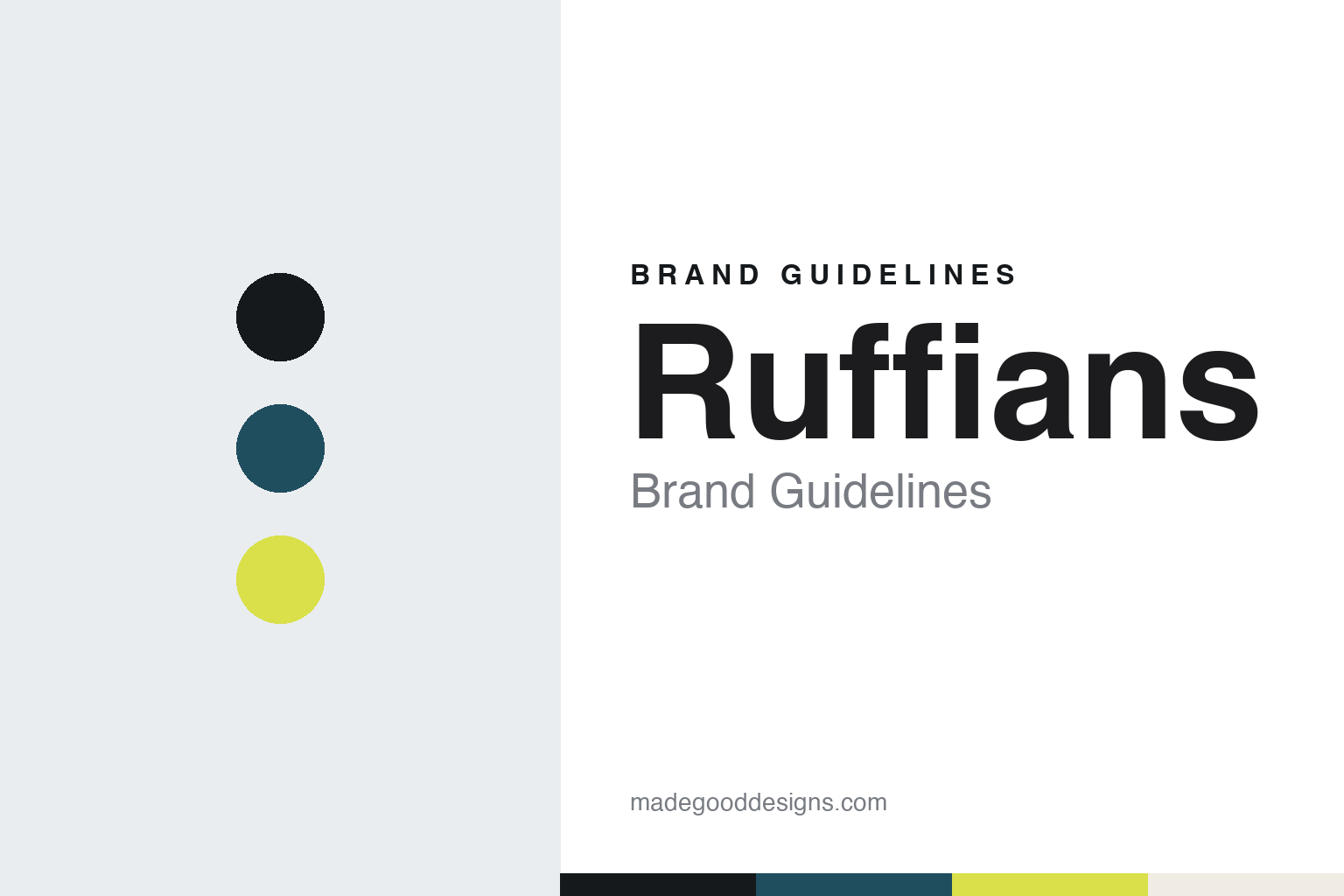
This guide’s Ruffians palette is Shop slate #16191B, Chair blue #1F4E5F, Citron #D9E04A, Oak #9C7448 and Linen #F1ECE3. The tones are the guide’s own unofficial interpretation, not official Ruffians hex codes.
When did Ruffians open?
Ruffians opened in March 2012, in Edinburgh, Scotland. Ruffians is known for Blue barber chairs, oak cutting table, own-label products.
Who founded Ruffians?
Ruffians was founded by Andrew Cannon in March 2012. Ruffians is known for Blue barber chairs, oak cutting table, own-label products.