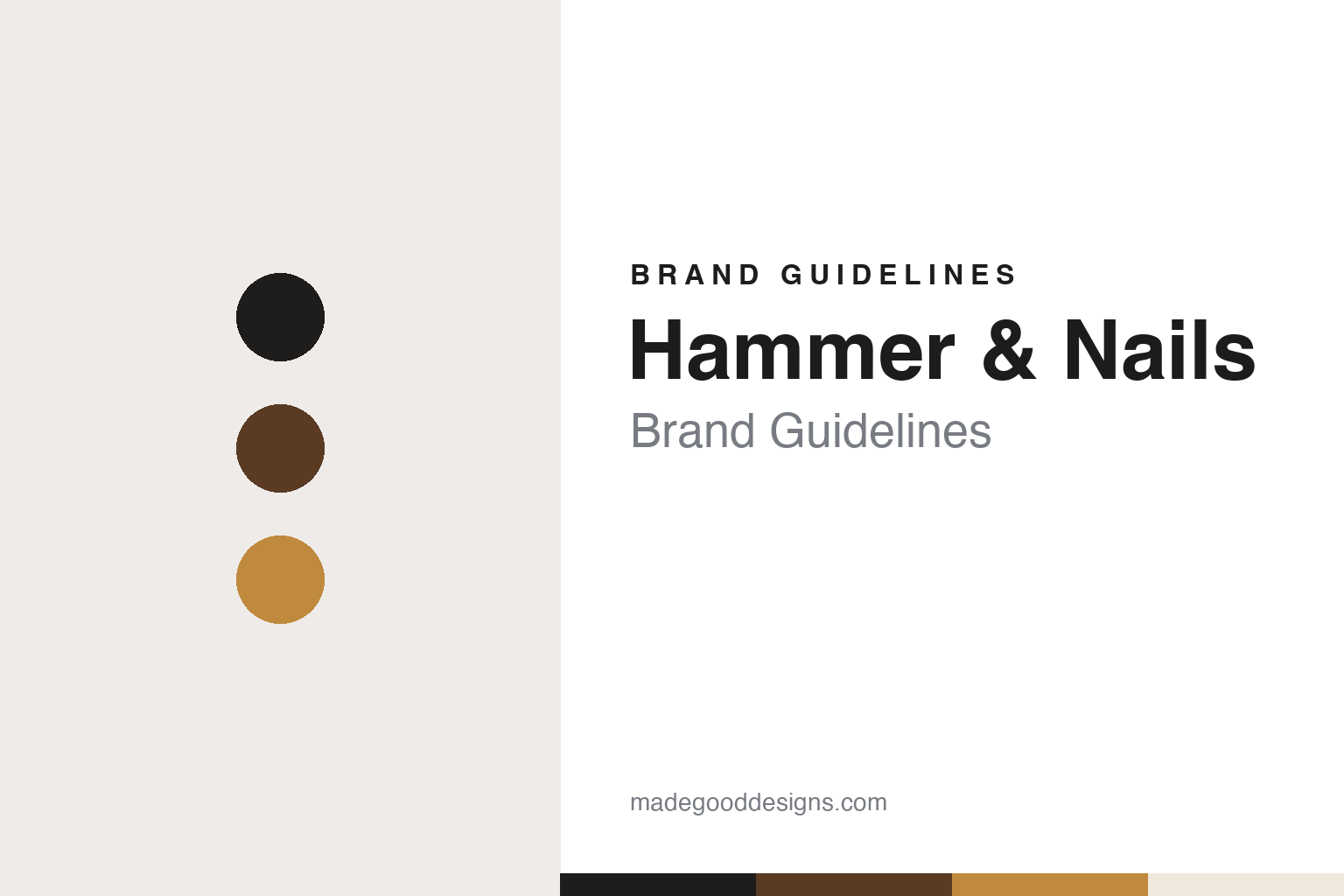
Hammer & Nails Brand Guidelines
The Los Angeles grooming shop for guys, opened on Melrose Avenue in 2013.
Aa
Two constants: a charcoal, leather and amber palette and a condensed sans register. Abstract homage — not a Hammer & Nails sign, shop or mark; no logo or interior is reproduced.
Melrose Avenue, 2013
A screenwriter, a pedicure and a shop for men.
Hammer & Nails opened on Melrose Avenue in Los Angeles in November 2013. Its founder, Michael Elliot, was a Los Angeles screenwriter. Entrepreneur, in a profile by Jason Daley published in November 2015, traced the idea to a pedicure about eight months before the opening: a friend took him to a salon full of women, and although he liked the treatment he felt out of place. The one other man in the room, the magazine reported, told him he felt the same way, and Elliot began to ask whether other men did too.
He then looked for a nail salon in the area aimed at men, Entrepreneur wrote, and found none, even though the men he spoke to said hand and foot grooming mattered to them. The result was a shop built around manicures and pedicures for men, which the magazine described as a high-end “man cave” rather than a conventional nail salon.
CBS Los Angeles, reporting in October 2016, gave the same origin in Elliot’s own words. He recalled the canary yellow walls and the strongly feminine setting of the salon he had visited, and said his aim was a place that a man who would never set foot in a nail salon would visit and want to come back to. The report added that women were welcome too, including those who came with their partners. The company still trades as Hammer & Nails Grooming Shop for Guys, the name it uses on its booking site.
Colour
Leather chairs, headphones and a drink.
The shop format has been described in much the same terms for a decade. In 2015 Entrepreneur wrote that customers sat in overstuffed leather chairs, each fitted with Beats or Sony headphones and a flat-screen television with its own remote, while technicians trimmed, filed and buffed nails; beer, whiskey and soft drinks were on offer. In 2016 CBS Los Angeles listed complimentary drinks, a personal 32-inch television with headphones at each seat, and oversized leather chairs.
The menu has widened from hands and feet. In November 2026 the company’s site grouped its services into hair care, beard care, manicures and pedicures. Named services include the Classic Cut and the Premium Cut, a colour service called the Classic Hair Camo, a classic face or head shave with warm foam and hot towels, and beard grooming. The site describes the Classic Cut as a regular maintenance cut that includes a shampoo, a conditioning scalp massage and a lavender-infused hot towel for the face; the Premium Cut adds extra time for more complex styles, a razor outline, warm foam and an aftershave massage. Partial and full waxing of the eyebrows, nose and ears are listed as separate services, as is a face treatment with aromatherapy hot towels and a mask. A company release of May 2025 named a whiskey-infused foot treatment as its signature service and described a membership model; the site sells memberships and gift cards. A company release of January 2021 said the brand had launched a product line sold on Amazon.
The franchise site presents the shop as a package. Under the heading “Your Shop in a Box,” it says fixtures, furnishings, materials and finishes are engineered and delivered to each site for installation. For a designer, that means the identity lives as much in the room as on the sign: dark leather, a screen at every chair, a drink on the side table and a menu written in a plain, joking register, from the “Hair Camo” to the tagline “Total. Man. Care.” on the home page.
Typography
How barbershop chains present themselves.
Barbershop chains and men’s grooming salons sell a service that happens in a chair, so most of their identity is built in the shop itself. The name on the sign does a great deal of the work: some chains use a person’s name in the possessive, as a neighbourhood barber would, while others pair a short, memorable word with a plain descriptive line that says what happens inside. Lettering on windows and fascias, and in many shops a striped barber pole, place the business in a long tradition before a customer has opened the door.
Inside, the materials tell the story. Franchise announcements and press reports describe interiors built from leather chairs, wood-toned stations, posters, televisions and music, and the chair itself is often the most photographed object in the room. Uniforms, towels and the service board on the wall carry the same colours and type as the sign, and a list of cuts, shaves and beard services is set out like a menu.
Many chains also sell their own products under the shop’s name, so the identity has to work on a small bottle or tin as well as on a storefront. Packaging tends to borrow from the interior: the same palette, the same lettering and the same tone of voice.
Behind the shopfront, ownership varies widely. Some chains are still run by the people who founded them; others are franchise systems in which independent owners operate shops under a central brand, and some belong to larger salon groups that hold several names at once. This guide sets out who founded each brand, who owns it today and how its shops are described in dated sources, and marks clearly what rests only on the company’s own word.
Aa
A condensed sans for a shop sign and a service menu. (Specimen set in Oswald, a sans STAND-IN; NOT the Hammer & Nails logo.)
Hammer & Nails
From one shop to a franchise system.
Franchising came quickly. Entrepreneur wrote in November 2015 that Elliot was poised to franchise nationally, and CBS Los Angeles reported in October 2016 that the company had sold 183 franchise licences in eight states that year. Those figures describe licences sold, not shops open.
The management changed as the network grew. A company release dated 12 January 2021, issued from Sacramento, said John Choi, described as the brand’s co-owner and chief executive, was becoming chairman of the board, and that Aaron Meyers, president and chief operating officer for more than two years, was becoming chief executive. The same release said a West Hollywood franchise owner had joined the corporate team to lead training and operations.
A further company release, dated 28 May 2025, said Hammer & Nails was about to open its 50th franchise location, in Nolensville, Tennessee. In November 2026 the franchise site said more than 170 licences had been sold, and the locations page listed about 80 shops taking bookings, with others marked as coming soon, in 23 states and the District of Columbia. The Los Angeles listings include West Hollywood, Echo Park, Studio City and Valencia; the network also reaches Arizona, Colorado, Texas, Virginia and New York. Each listing on that page carries the same short set of actions, to book, to join as a member or to buy a gift card, so the membership offer sits beside the booking button in every town.
For a design guide, Hammer & Nails shows how a franchise turns a single room in Los Angeles into a repeatable kit: a short two-word name, a dark and masculine interior, and service names with a dry sense of humour. Compare it with The Gents Place, a Texas men’s grooming club that also franchises, and Roosters Men’s Grooming Center. For this guide we use charcoal, a saddle-leather brown and an amber with a condensed sans, an unofficial interpretation; no product or logo is reproduced.
Explore & save
Keep Hammer & Nails’s identity on hand — save it to a board in the Made Good inspiration library.
Hammer & Nails identity set
Pin the Hammer & Nails charcoal, leather and amber palette and the condensed sans register to your own board.
Source & notes
Frequently Asked Questions
What font can I use to match the Hammer & Nails look?
This guide describes Hammer & Nails’ type as “A condensed sans for a shop sign and a service menu”. Its type specimen is set in Oswald from Google Fonts as a stand-in; Oswald is not Hammer & Nails’ own lettering.
What colours are in the Hammer & Nails palette?
This guide’s Hammer & Nails palette is Club charcoal #1F1D1B, Saddle leather #5A3A22, Amber pour #C08A3E, Linen #EFE8DC and Paper #F8F6F2. The tones are the guide’s own unofficial interpretation, not official Hammer & Nails hex codes.
When did Hammer & Nails open?
Hammer & Nails opened in November 2013, in Melrose Avenue, Los Angeles.
Who founded Hammer & Nails?
Hammer & Nails was founded by Michael Elliot in November 2013.