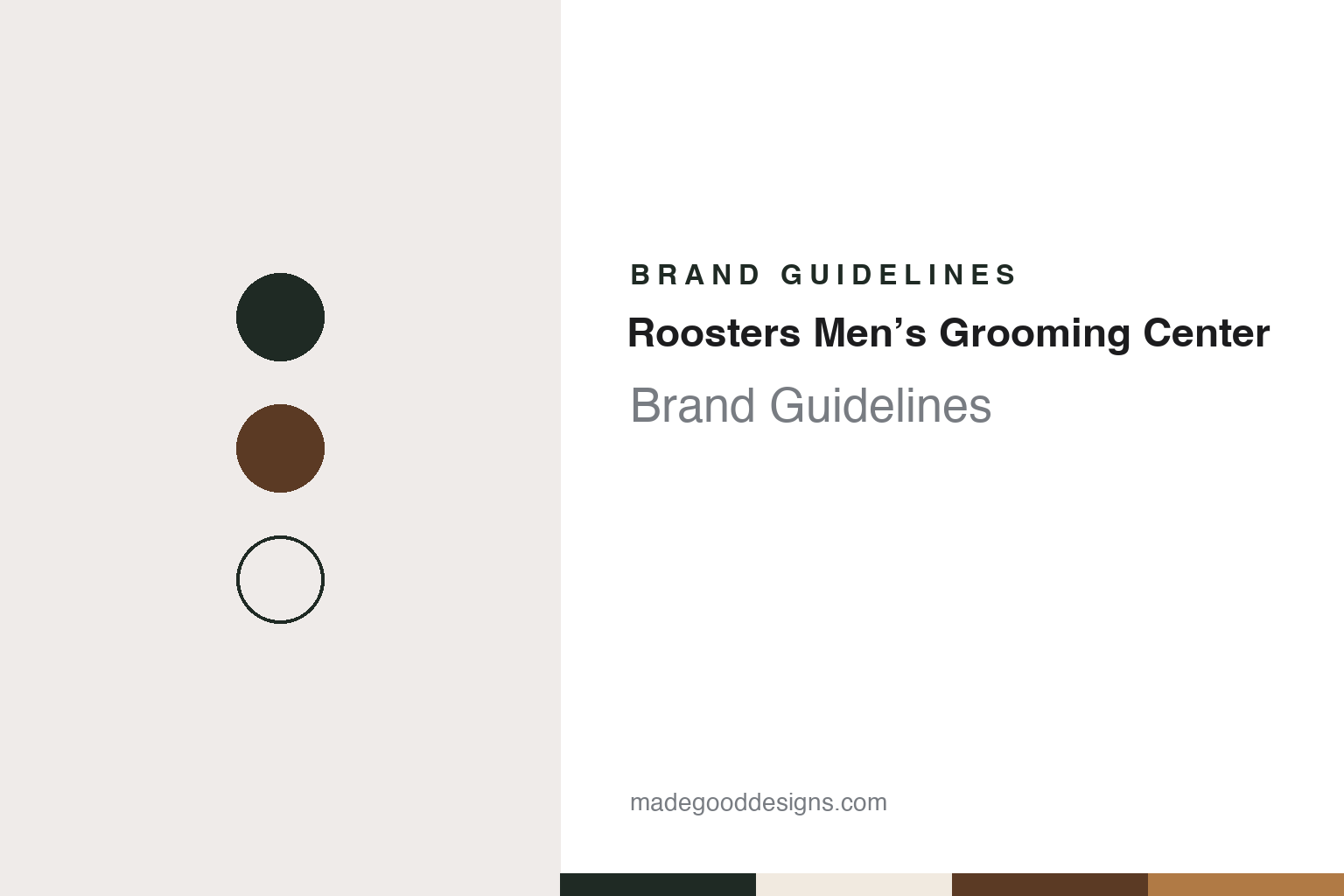
Roosters Men’s Grooming Center Brand Guidelines
A Michigan barbershop franchise of leather chairs and hot towels.
Aa
Two constants: a saddle brown, green and cream palette and a classic barbershop serif register. Abstract homage — not a Roosters Men’s Grooming Center asset; no shop, sign, logo or product is reproduced.
Lapeer, 1999
A master barber’s shop in a Michigan town.
Roosters Men’s Grooming Center began in Lapeer, Michigan, in 1999. A franchise release published on franchising.com in January 2013 says the original Roosters was opened there by master barber Joe Grondin, and the franchise directory of Entrepreneur also names Joe Grondin as the founder and 1999 as the founding year.
The business soon became a family franchise. A June 2008 announcement on franchising.com named his son Aaron Grondin as president of Roosters, said father and son had a combined fifty years of experience as professional master barbers, and counted 24 franchises open across the United States. The same announcement introduced the brand’s regional developers for Central Texas, based in Round Rock, who described the hot towels, conversation and oversized leather chairs as a reminder of the New York barbershops in their own family stories.
By 2011 the company was based in Warren, Michigan, according to the Minneapolis magazine Twin Cities Business. That report, from July 2011, named Kurt Landwehr as the founder of Roosters, so the founding credit differs between sources: Joe Grondin in the company releases and the Entrepreneur directory, and Kurt Landwehr in the 2011 magazine report.
The franchise grew steadily through these years. Twin Cities Business gave a count of 35 franchised salons in 15 states in July 2011, and the January 2013 release described the newly opened Peachtree City shop as one of three Roosters locations in Georgia and one of more than 55 franchises nationwide.
Colour
Regis takes control.
The decisive change came in 2011. On 24 July that year Twin Cities Business reported that Regis Corporation, the salon group then based in Edina, Minnesota, had announced an investment in Roosters. The transaction was completed on 1 July 2011, financial terms were not disclosed, and a Regis spokeswoman said the deal gave Regis “controlling interest in the partnership.” Roosters’ existing management team stayed in place, and Kurt Landwehr joined Regis as head of franchise development, the magazine said.
Regis set Roosters beside its other men’s concepts. At the time Regis operated more than 12,700 salons, education centres and hair-restoration centres worldwide, including franchised sites, the magazine reported, under names including Supercuts, MasterCuts and Cost Cutters.
Regis itself changed shape around Roosters. English Wikipedia records that in October 2017 it sold much of its mall-based salon business to The Beautiful Group, that in August 2019 it sold 3,108 company-owned salons to franchisees, and that in December 2024 it bought Alline Salon Group, its biggest franchisee, bringing 314 Supercuts, Cost Cutters and Holiday Hair salons in Michigan, Ohio and Pennsylvania under its direct control.
Roosters outlasted many of the older names. English Wikipedia, in its article on Regis, records that in 2019 the group announced it would cut its portfolio of about fifty brands to five: Supercuts, SmartStyle, Cost Cutters, First Choice Haircutters and Roosters. The same article lists Roosters Men’s Grooming Center among Regis’s trade names and places the group’s headquarters in Minneapolis.
The Entrepreneur franchise directory, viewed in November 2026, describes Roosters as part of Regis and says there are more than 80 franchises in the United States and several in Canada.
Typography
Signs, chairs and the shop format.
Barbershop chains and men’s grooming salons sell a service that happens in a chair, so most of their identity is built in the shop itself. The name on the sign does a great deal of the work: some chains use a person’s name in the possessive, as a neighbourhood barber would, while others pair a short, memorable word with a plain descriptive line that says what happens inside. Lettering on windows and fascias, and in many shops a striped barber pole, place the business in a long tradition before a customer has opened the door.
Inside, the materials tell the story. Franchise announcements and press reports describe interiors built from leather chairs, wood-toned stations, posters, televisions and music, and the chair itself is often the most photographed object in the room. Uniforms, towels and the service board on the wall carry the same colours and type as the sign, and a list of cuts, shaves and beard services is set out like a menu.
Many chains also sell their own products under the shop’s name, so the identity has to work on a small bottle or tin as well as on a storefront. Packaging tends to borrow from the interior: the same palette, the same lettering and the same tone of voice.
Behind the shopfront, ownership varies widely. Some chains are still run by the people who founded them; others are franchise systems in which independent owners operate shops under a central brand, and some belong to larger salon groups that hold several names at once. This guide sets out who founded each brand, who owns it today and how its shops are described in dated sources, and marks clearly what rests only on the company’s own word.
Aa
A classic bookish serif, in the spirit of a traditional barbershop sign. (Specimen set in Libre Baskerville, a serif STAND-IN; NOT the Roosters Men’s Grooming Center logo.)
The Roosters shop
Leather chairs, wood tones and a hot towel.
The Roosters format is described in much the same way across its franchise announcements. The June 2008 release said the shops combined modern grooming techniques with classic barbershop elements in an environment focused on men, and its standard description promised man-sized chairs and a complimentary drink. The January 2013 release went further: oversized leather chairs in semi-private barber stations, rich wood tones, flat-screen televisions and free beverages.
The services follow the barbershop tradition. Twin Cities Business described the range in 2011 as running from men’s haircuts to seven-step shaves with hot steam towels and a facial massage. The 2013 release listed precision haircuts, shaves with hot steam towels and Aveda products for men, and said the Peachtree City shop took both appointments and walk-ins.
The look is meant to be the same from shop to shop. According to the Entrepreneur directory profile, Regis has a construction division that has developed a design and décor package for Roosters franchisees, so that each new salon matches the others. The brand’s own website is roostersmgc.com, the address given in its franchise releases since 2008.
The name sets the tone before any interior does. Roosters is a single plural word, and the brand pairs it with a plain descriptive line, Men’s Grooming Center, that its releases often shorten to Roosters MGC. That split between a short, characterful name and a sober service line suits a franchise: the short name travels on a sign and a storefront, while the descriptive line explains what happens inside the shop.
For a design guide, Roosters Men’s Grooming Center shows how a franchise can turn the materials of an old barbershop — leather, wood, steam and a hot towel — into a package that is repeated in every location. Compare Regis, its owner, and Supercuts, a sister brand in the same group. For this guide we use a saddle brown, a deep club green and a walnut tan on cream with a serif, an unofficial interpretation; no product or logo is reproduced.
Explore & save
Keep Roosters Men’s Grooming Center’s identity on hand — save it to a board in the Made Good inspiration library.
Roosters Men’s Grooming Center identity set
Pin the Roosters saddle brown, green and cream palette and the classic barbershop serif register to your own board.
Source & notes
Frequently Asked Questions
What font can I use to match the Roosters Men’s Grooming Center look?
This guide describes Roosters Men’s Grooming Center’s type as “A classic bookish serif, in the spirit of a traditional barbershop sign”. Its type specimen is set in Libre Baskerville from Google Fonts as a stand-in; Libre Baskerville is not Roosters Men’s Grooming Center’s own lettering.
What colours are in the Roosters Men’s Grooming Center palette?
This guide’s Roosters Men’s Grooming Center palette is Saddle brown #5B3A24, Club green #1F2A24, Walnut tan #B07A45, Towel cream #F1EAE0 and Paper #F8F6F2. The tones are the guide’s own unofficial interpretation, not official Roosters Men’s Grooming Center hex codes.
When was Roosters Men’s Grooming Center founded?
Roosters Men’s Grooming Center was founded in 1999, in Lapeer, Michigan.
Who founded Roosters Men’s Grooming Center?
Roosters Men’s Grooming Center was founded by Joe Grondin (master barber) in 1999.