The Gents Place Brand Guidelines
The Texas grooming club that sells a haircut as a membership.
Aa
Two constants: a walnut, leather and felt-red palette and a club serif register. Abstract homage — not a Gents Place product or mark; no club interior, logo or sign is reproduced.
Frisco, 2008
A membership club instead of a walk-in shop.
The Gents Place opened its first club in Frisco, Texas, a suburb north of Dallas, in December 2008, Forbes reported in its issue of May 7, 2012. The founder named by Forbes and by English Wikipedia is Ben Davis; the company’s own history page names Ben and Lauren Davis together as founders. The company says they received a Small Business Administration loan two weeks before the collapse of Lehman Brothers in September 2008, and that the idea grew out of Ben Davis’s dislike of getting his hair cut. Before the club, Forbes wrote, Davis had helped build an internet-based insurance agency in Irving, Texas, after studying at the University of Texas at Austin.
The model was a club rather than a walk-in barbershop. Forbes described monthly and annual memberships that bundled regular haircuts with shaves and discounts on care products, and reported that Davis had signed up more than 5,000 clients by 2012, largely through a Facebook offer of a free haircut. The same report said Davis fined his staff a small sum each time they said “customer” instead of “client,” because he wanted the word to suggest a relationship rather than a transaction, and that he connected personally with new clients on social networks. By July 2016, English Wikipedia says, citing CNBC, the clubs had about 2,300 members.
The club spread slowly at first. English Wikipedia, citing the Dallas Business Journal and The Dallas Morning News, says Davis bought an existing men’s salon in Leawood, Kansas, in 2011 and turned it into the second Gents Place, and opened a third club in the Preston Hollow area of Dallas in 2012. Forbes, writing that spring, visited the Leawood shop and described the Dallas club as due to open that June.
Colour
Investors, a co-owner and franchising.
Outside capital arrived in 2016. In March that year Elevated Brands, a holding company set up by the principals of the San Antonio massage franchise Massage Heights, made an undisclosed investment to take The Gents Place into franchising, according to English Wikipedia, citing the San Antonio Business Journal and Franchise Times. In May 2016 the former NFL running back Emmitt Smith became a co-owner alongside Davis, Wikipedia says, citing the Dallas Business Journal and CNBC, and a national franchise programme was launched that summer.
In December 2017 the company announced a further investment from Blue Star Innovation Partners, a venture formed by the Dallas Cowboys owner Jerry Jones, the Jones family and the entrepreneur Rob Wechsler. Company announcements from that period said the brand then had three clubs in North Texas, in Dallas, Southlake and Frisco, plus Leawood, and that its first franchised club had opened in the Chicago Loop on November 30, 2017, in a space that had previously housed a venue called The 316 Club.
Growth continued around Dallas–Fort Worth. When a club opened at The Star in Frisco on October 27, 2021 — the district that also houses the Dallas Cowboys headquarters — CultureMap Dallas reported that it was the brand’s fourth location in the region, after Uptown Dallas, Southlake and Fort Worth. In November 2026 the company website listed thirteen clubs: in Texas, Austin, Dallas Uptown, Fort Worth, Frisco, Houston, Odessa, Prosper, San Antonio and Southlake; two in Bentonville, Arkansas, one of them on the Walmart campus; Deer Park, Illinois; and Summerlin, in Las Vegas. Leawood and the Chicago Loop club do not appear on that list.
Typography
How grooming chains present themselves.
Barbershop chains and men’s grooming salons sell a service that happens in a chair, so most of their identity is built in the shop itself. The name on the sign does a great deal of the work: some chains use a person’s name in the possessive, as a neighbourhood barber would, while others pair a short, memorable word with a plain descriptive line that says what happens inside. Lettering on windows and fascias, and in many shops a striped barber pole, place the business in a long tradition before a customer has opened the door.
Inside, the materials tell the story. Franchise announcements and press reports describe interiors built from leather chairs, wood-toned stations, posters, televisions and music, and the chair itself is often the most photographed object in the room. Uniforms, towels and the service board on the wall carry the same colours and type as the sign, and a list of cuts, shaves and beard services is set out like a menu.
Many chains also sell their own products under the shop’s name, so the identity has to work on a small bottle or tin as well as on a storefront. Packaging tends to borrow from the interior: the same palette, the same lettering and the same tone of voice.
Behind the shopfront, ownership varies widely. Some chains are still run by the people who founded them; others are franchise systems in which independent owners operate shops under a central brand, and some belong to larger salon groups that hold several names at once. This guide sets out who founded each brand, who owns it today and how its shops are described in dated sources, and marks clearly what rests only on the company’s own word.
Aa
A club serif for a membership brand. (Specimen set in Cormorant Garamond, a serif STAND-IN; NOT The Gents Place logo.)
The Gents Place
Dark wood, leather and a lounge.
The look is that of a private club. English Wikipedia, citing The Dallas Morning News and Men’s Journal, describes dark wood panelling, leather barber chairs, large lounge chairs and, in at least one club, a red-felt pool table; it adds that American Salon compared the atmosphere to a country club or a high-end steakhouse. The company describes its clubs as pairing an “old-world speakeasy” with an upscale country club, a phrase CultureMap Dallas repeated in 2021. Members get complimentary drinks and shoe shines, the company says, and Wikipedia mentions cigar patios at some clubs.
The service menu, as Wikipedia and the company describe it, runs from haircuts and colour to straight-razor shaves, hand and foot treatments and shoe shines. The retail shelf carries the company’s own Rascal product line next to outside brands; CultureMap Dallas named Truefitt & Hill and Lakmé among them in 2021.
Design is handled in-house. The company says Lauren Davis shaped how the clubs would look and feel from the start, including the design, space planning and construction budgets, and that as Chief Culture Officer she now manages all design and construction projects nationwide, while Ben Davis serves as president. The company uses the initials TGP in its own pages, as in its “Inside TGP” history page, and sells meeting-room bookings in its lounges as a separate service.
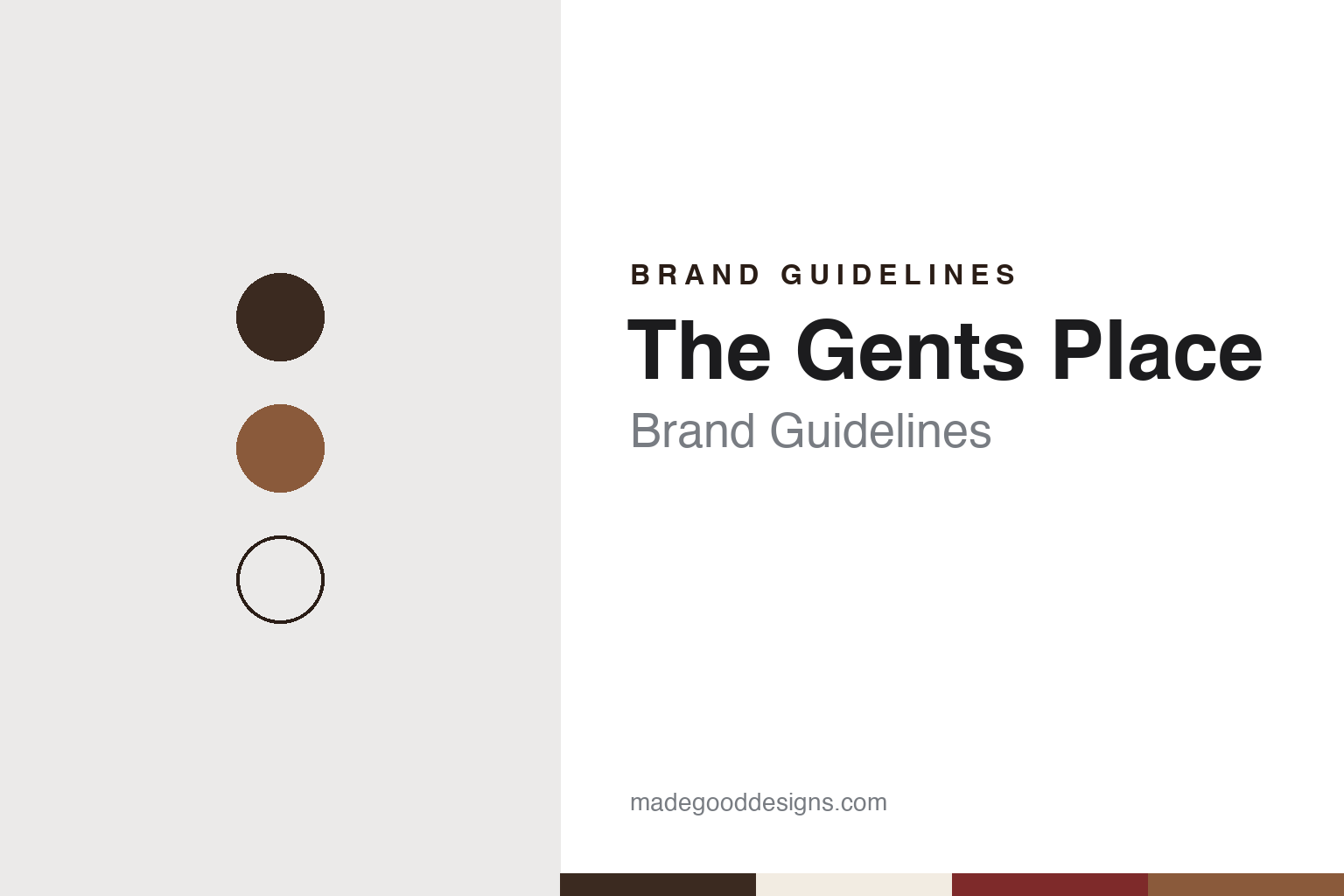
The palette in this guide takes its cue from those documented interiors rather than from any company material: a walnut brown for the panelling, a saddle tan for the leather chairs and a felt red from the pool table, set on a warm cream ground. The serif stands in for the register of a gentlemen’s club, not for any lettering the company uses.
For a design guide, The Gents Place shows how a men’s grooming brand can borrow the vocabulary of the private club — memberships, lounges, dark wood and leather — and present a haircut as a visit to a club. Compare Hammer & Nails, another US men’s grooming-shop franchise, and Truefitt & Hill, the London barber and perfumer whose products the clubs have stocked. For this guide we use walnut brown, saddle tan and a felt red with a serif, an unofficial interpretation; no product or logo is reproduced.
Explore & save
Keep The Gents Place’s identity on hand — save it to a board in the Made Good inspiration library.
The Gents Place identity set
Pin The Gents Place walnut, leather and felt-red palette and the club serif register to your own board.
Source & notes
Frequently Asked Questions
What font can I use to match the The Gents Place look?
This guide describes The Gents Place’s type as “A club serif for a membership brand”. Its type specimen is set in Cormorant Garamond from Google Fonts as a stand-in; Cormorant Garamond is not The Gents Place’s own lettering.
What colours are in the The Gents Place palette?
This guide’s The Gents Place palette is Walnut panel #3B2A20, Saddle leather #8A5A3B, Felt red #7E2A2A, Club cream #F2ECE2 and Paper #FAF8F4. The tones are the guide’s own unofficial interpretation, not official The Gents Place hex codes.
When was The Gents Place founded?
The Gents Place was founded in December 2008, in Frisco, Texas.
Who founded The Gents Place?
The Gents Place was founded by Ben Davis; Lauren Davis (company) in December 2008.