Pall Mall Barbers Brand Guidelines
The London barbershop that found its history on a business card.
Aa
Two constants: a navy, pole-red and brass palette and a heritage serif register. Abstract homage — not a Pall Mall Barbers product or mark; no shopfront, pole, logo or sign is reproduced.
The Toilet Saloon
An old shop, a business card and a date.
Pall Mall Barbers is a London barbershop group whose present business dates from 2005, when the barber Richard Marshall bought an old shop near Trafalgar Square. English Wikipedia gives 2005 as the founding year and names Marshall as founder and owner; the company says he was 28 at the time and bought the shop from the family that had owned it for decades. In a 2016 interview with the London listings site On In London, Marshall said the opportunity came through an old client after a plan for a shop in Holborn fell through, that the shop had been on the market for a long time, and that when he first walked in it looked worn out, “like it was stuck in a time warp.”
The premises have a longer story. During the renovation, the company says, Marshall found an old business card for the Pall Mall Toilet Saloon, which set him researching the shop’s past; the company and English Wikipedia date that saloon, on Whitcomb Street just off Trafalgar Square and Pall Mall, to 1896. The Daily Telegraph, in a January 2010 feature on wet shaving, described the shop as the former Pall Mall Toilet Salon, on its central London site since 1896 and “recently updated by Marshall.” The company later added photographs of the original shop to that story: it says they reached Marshall years afterwards from a woman in Australia who had found them while sorting family belongings.
Marshall came to the shop as a working barber. The company says he started in a barbershop in his home town at 12, sweeping floors and making tea, took a barbering qualification, and by 21 was cutting hair in Mayfair, near Savile Row. The company website names him as founder and chief executive.
Colour
From one shop to London and New York.
The 2005 shop became the base for a small group. English Wikipedia, citing the London fashion site LDN Fashion and the British Library’s business blog, says two more London shops opened by early 2018, one of them at King’s Cross, bringing the total to six. In December 2018 the group opened a shop outside Britain, at Rockefeller Center in New York, Wikipedia says, citing the Rockefeller Center website; the company still names that shop on its own site.
In November 2025 the company listed seven London neighbourhoods where it trades: Fitzrovia, King’s Cross, Paddington, Westminster, Oxford Circus, Liverpool Street and Trafalgar Square. In the same article it marked the approach of the shop’s 130th anniversary in 2026, and began describing the brand with the phrase “Modern Heritage.” Its shops offer haircuts, skin fades, beard trims and traditional wet shaves, the company says. In the 2016 On In London interview, Marshall said haircuts remained the most requested service, although appointments for facial-hair grooming were growing.
Alongside the shops, Pall Mall Barbers sells its own range of men’s grooming products, which the company describes as including beard oils, shaving creams, shampoos and styling products. It also takes barbering outside the shop: the company says its barbers have worked at corporate and sporting events, including Mastercard activations at UEFA Champions League finals in Milan and Cardiff, and at the tennis championships at Queen’s Club.
Typography
How grooming chains present themselves.
Barbershop chains and men’s grooming salons sell a service that happens in a chair, so most of their identity is built in the shop itself. The name on the sign does a great deal of the work: some chains use a person’s name in the possessive, as a neighbourhood barber would, while others pair a short, memorable word with a plain descriptive line that says what happens inside. Lettering on windows and fascias, and in many shops a striped barber pole, place the business in a long tradition before a customer has opened the door.
Inside, the materials tell the story. Franchise announcements and press reports describe interiors built from leather chairs, wood-toned stations, posters, televisions and music, and the chair itself is often the most photographed object in the room. Uniforms, towels and the service board on the wall carry the same colours and type as the sign, and a list of cuts, shaves and beard services is set out like a menu.
Many chains also sell their own products under the shop’s name, so the identity has to work on a small bottle or tin as well as on a storefront. Packaging tends to borrow from the interior: the same palette, the same lettering and the same tone of voice.
Behind the shopfront, ownership varies widely. Some chains are still run by the people who founded them; others are franchise systems in which independent owners operate shops under a central brand, and some belong to larger salon groups that hold several names at once. This guide sets out who founded each brand, who owns it today and how its shops are described in dated sources, and marks clearly what rests only on the company’s own word.
Aa
A heritage serif for a Victorian trade name. (Specimen set in Libre Caslon Text, a serif STAND-IN; NOT the Pall Mall Barbers logo.)
Pall Mall Barbers
A street name and a striped pole.
The brand leans on two things it can point to: the name and the pole. The company explains the name through Pall Mall itself — the street that took its name from pall-mall, a croquet-like game played there by royalty and nobility in the seventeenth century — and through the long association of Pall Mall and St James’s with outfitters, barbers, perfumers and gentlemen’s clubs. It places a red-and-white striped barber pole outside its shops, and its own pages tell the history of the pole. When the Telegraph visited in 2010, Marshall opened the conversation by explaining what the pole signified.
The Telegraph placed the shop within a revival of the traditional wet shave around 2010, with younger men moving from hairdressers to traditional barbers. The writer contrasted the old barbers, which he called gentlemen’s clubs in all but name, with newer shops furnished with retro fittings. Marshall told the paper the shop drew young men asking for 1940s and 1950s haircuts, and described its appeal as a “crossover between modern and traditional” — close to what the company now calls “Modern Heritage.” Its website carries the line “Keep Sharp, Every Day.”
The founding date is part of the identity. The company presents the business as serving Londoners since 1896, while the present company began with Marshall’s purchase in 2005; English Wikipedia records both dates, and the company tells both in its own history.
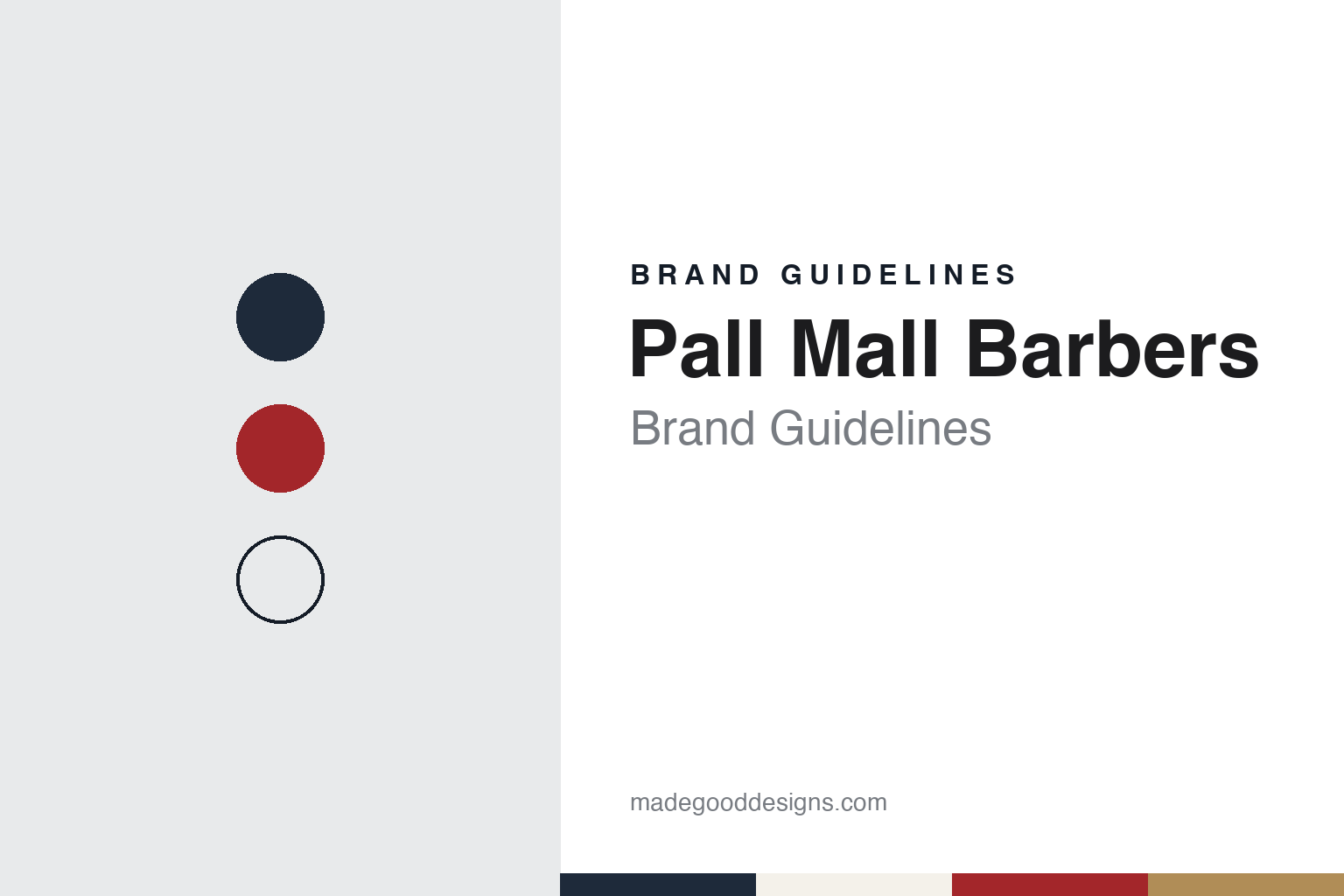
The palette in this guide is our own reading of that story rather than anything taken from the company: a deep navy for the formal London register, a pole red and a lather white from the striped pole and the wet shave, and a brass accent for shop fittings. The serif stands in for the Victorian trade name on the old business card, not for the company’s own lettering.
For a design guide, Pall Mall Barbers shows how a barbershop can build an identity on a street name and a rediscovered date: a name with roots in a royal game, a striped pole and a Victorian trade name found on a business card. Compare Geo. F. Trumper, another London gentlemen’s barber, and Ted’s Grooming Room, another London barbershop chain. For this guide we use a deep navy, a pole red and brass with a serif, an unofficial interpretation; no product or logo is reproduced.
Explore & save
Keep Pall Mall Barbers’s identity on hand — save it to a board in the Made Good inspiration library.
Pall Mall Barbers identity set
Pin the Pall Mall Barbers navy, pole-red and brass palette and the heritage serif register to your own board.
Source & notes
Frequently Asked Questions
What font can I use to match the Pall Mall Barbers look?
This guide describes Pall Mall Barbers’ type as “A heritage serif for a Victorian trade name”. Its type specimen is set in Libre Caslon Text from Google Fonts as a stand-in; Libre Caslon Text is not Pall Mall Barbers’ own lettering.
What colours are in the Pall Mall Barbers palette?
This guide’s Pall Mall Barbers palette is Deep navy #1E2A3A, Pole red #A3262A, Lather white #F4F1EA, Brass #B08D57 and Paper #FAF8F5. The tones are the guide’s own unofficial interpretation, not official Pall Mall Barbers hex codes.
When was Pall Mall Barbers founded?
Pall Mall Barbers was founded in 2005 (premises 1896), in London, England.
Who founded Pall Mall Barbers?
Pall Mall Barbers was founded by Richard Marshall in 2005 (premises 1896).