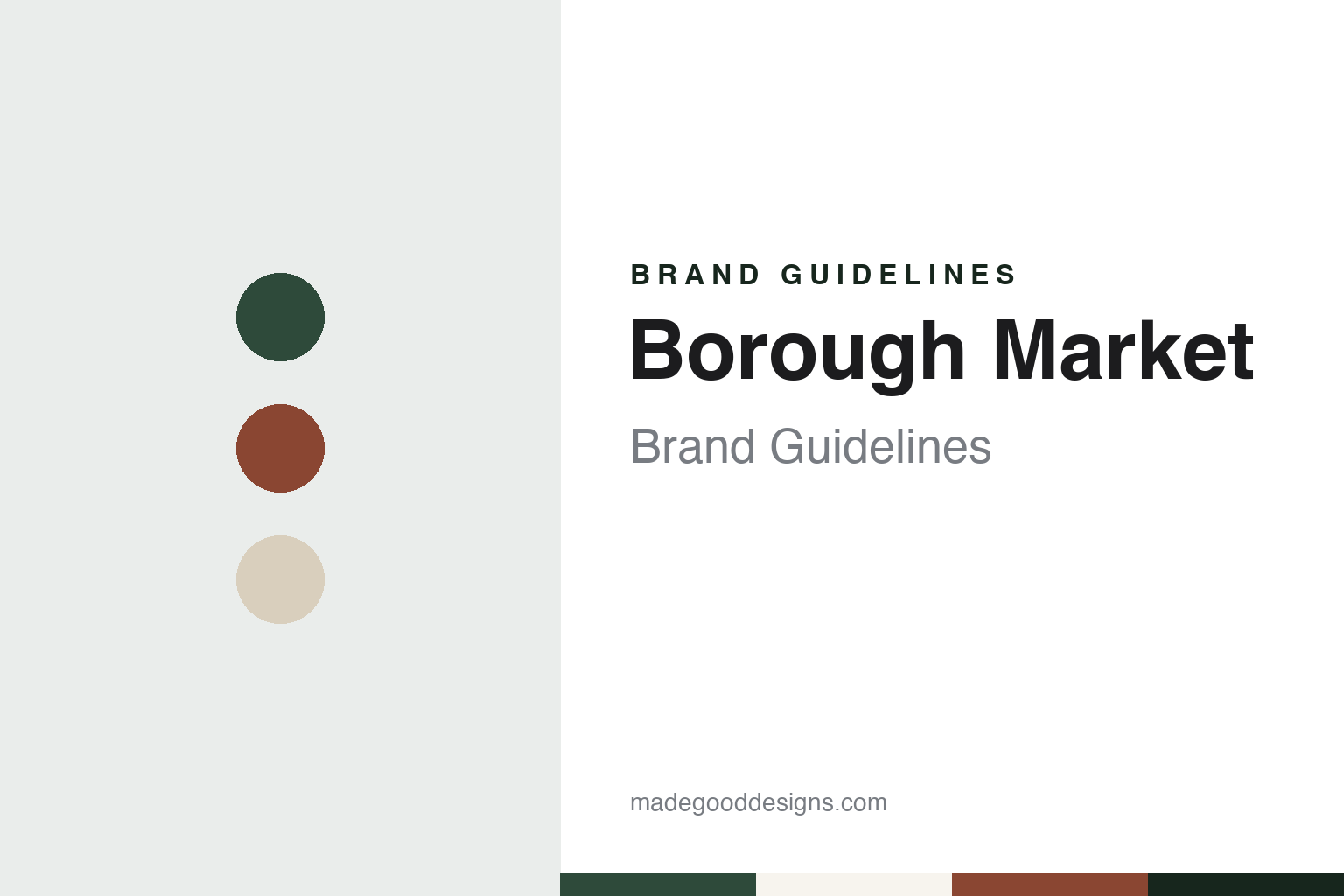
Borough Market Brand Guidelines
A market by London Bridge, a charitable trust and buildings from four centuries under one name.
Aa
Two constants: a deep green, brick red and stone palette and a Victorian market serif register. Abstract homage — not a Borough Market asset or mark; no logo, sign, photograph or wordmark is reproduced.
A market by the bridge
Medieval trade on the High Street, then a new site in 1756.
Borough Market is a food market in Southwark, on the south bank of the Thames at the southern end of London Bridge, just south of Southwark Cathedral. The market’s own history speaks of around 1,000 years of heritage, and English Wikipedia says a market has stood on the site since at least the 12th century. The London Museum, in its account “Borough Market: London’s oldest food-trading hub,” notes records of grain, fish, vegetables and cattle being sold in Southwark by 1014, and dates the earliest formal mention of a fruit and vegetable market to 1276, when it was moved to the High Street.
For centuries the trade was a matter between Southwark and the City of London across the river. The market’s timeline says the City barred its citizens from buying food in Southwark in the 1270s, and that in 1550 the City took control of the market and extended trading from two days a week to four; English Wikipedia ties that step to a royal charter of the same year, confirmed in 1671. By the 18th century the stalls lined Borough High Street itself, and the congestion brought Parliament in.
Two acts of 1755 set the course that still holds. English Wikipedia records that the first, the Southwark Market Act 1755, ended the market in the High Street, while the second allowed the parishioners of St Saviour’s, Southwark, to hold a market on a new site away from the road. Trading began there in 1756. The London Museum says local residents raised the money to buy a plot known as “The Triangle,” that the act declared the site should “remain an estate for the use and benefit of the parish forever,” and that it set up the charitable trust that still manages the market. Southwark Council’s market page gives the site as 4.5 acres and dates trading on it to 1756.
The 19th century brought the railways. The market’s timeline dates the viaduct that crosses the market to 1862 and says the growth of the railways turned Borough into a major fruit and vegetable wholesale hub. English Wikipedia explains that, because the trustees could not sell their land, the railway company was given only a flying leasehold above the market, and stalls still trade beneath the arches. The London Museum describes the market supplying greengrocers across south-east England, and records a traders’ sports day begun in 1904 with a cricket match between fruiterers and salesmen, revived by the trustees in 1930 with backing from Charlie Chaplin, who had grown up in Southwark.
Colour
Victorian iron and glass, a 1932 front and a portico from Covent Garden.
The buildings form a layered set from different periods. The London Museum says the market added iron-and-glass market buildings designed by Henry Rose in 1851, which still stand; English Wikipedia, citing a 2009 Museum of London Archaeology building survey, gives the same architect and year, with additions in the 1860s. An Art Deco entrance on Southwark Street followed in 1932, English Wikipedia says, and the London Museum puts the market’s character down to the overlap of Victorian railway arches, Gothic market halls and that 1930s entrance.
One of the newest pieces is also one of the oldest, and came from across the river. A refurbishment began in 2001, and in 2004 the South Portico of the Floral Hall, which had stood at Covent Garden, was re-erected at the market. English Wikipedia says the portico had been taken down when the Royal Opera House was reconstructed in the 1990s, and that in its new setting it was listed at Grade II in 2008. Later work on the railway viaduct for the Thameslink Programme altered several buildings around the market; English Wikipedia notes that the old glazed market roof on Stoney Street was reinstated and cleaned.
The trade changed more than the buildings. Through much of the 20th century Borough was a wholesale market selling produce in quantity to greengrocers and, with Covent Garden, a main supplier of fruit and vegetables to London’s shops, according to English Wikipedia. The market’s timeline says it remained central to that trade in the 1950s, until the growth of supermarkets in the 1980s and 1990s put its future in doubt.
The turn to retail came in the 1990s. English Wikipedia, citing a 2012 study of London’s food quarters, says the trustees decided in the mid-1990s to revive Borough as a retail rather than a wholesale market, let unused space to specialist food wholesalers from 1996 and encouraged them to open their premises to shoppers. In November 1998 the trustees invited the food writer Henrietta Green to hold a Food Lovers’ Fair, which brought in several long-term traders; the market’s timeline marks that fair as the moment Borough began to reinvent itself as a retail food market.
Typography
Food markets and market halls in Europe.
Europe’s food markets present themselves through a few recurring elements. Behind the name there is usually a public or charitable body rather than a single trader: a city council or its markets office, a charitable trust with volunteer trustees, or a company that runs a food hall inside an older building. Most give a founding date, and many separate the market’s origins, sometimes recorded centuries earlier in charters, acts of parliament or town records, from the date of the building that houses it today.
The buildings carry much of the identity. Many halls of the 19th and early 20th centuries are iron-and-glass structures: cast-iron columns, lattice beams and glazed roofs over open naves, sometimes added over an older open square when stallholders asked for cover. Entrances are often treated as set pieces, with iron arches, coloured glass, a city coat of arms or the market’s name in large lettering, and some markets have taken in parts of other buildings. Halls of the 21st century have tried other forms, such as a single arched shell or pavilions of glass.
Inside, the layout is usually described in general terms: fresh-produce stalls, fishmongers, butchers and delicatessens in rows or aisles, and, more and more, food counters with seating or a street-food area grouped in one section. Signs, clocks and painted lettering on stall fronts and gateways help visitors find their way, and often date from different periods of the same market.
Many of these markets have changed their role. Some began as, or grew into, wholesale markets supplying greengrocers and restaurants, and turned toward retail when that trade declined or moved to sites on the edge of the city. The guides in this series set out each market’s owner, buildings and dates as dated sources give them, and treat colours and type as an unofficial interpretation.
Aa
A Victorian market serif, for a market of iron, glass and brick. (Specimen set in Fraunces, a serif STAND-IN; NOT the Borough Market logo.)
Borough Market today
Three areas, six days and a trust.
Today the market describes itself as run by a charitable trust for the benefit of its community, governed by a board of volunteer trustees; English Wikipedia adds that the trustees have to live in the area. Southwark Council’s page notes an advisory food committee of stallholders and trustees. The London Museum describes a market open six days a week and still housed in its Victorian buildings, where traders sell to the public while specialist food retailers also run wholesale operations supplying restaurants and other businesses. The market’s timeline dates the start of Sunday trading, in answer to customer demand, to 2021.
On its visitor pages the market sets out three main areas: Three Crown Square, for larger producers and merchants; the Green Market, for small specialist produce traders; and Borough Market Kitchen, for street food. Time Out London reported in October 2019 that Borough Market Kitchen had opened with about 20 traders to mark 21 years of the modern retail market. The public spaces sit on a single ground-floor level, the market says, with cobbles in places, passageways from 1.5 to 4 metres wide, and restaurants, bars and shops around the edges. English Wikipedia lists the produce in general terms as fruit and vegetables, cheese, meat and game, bread and pastry, with stallholders coming from across the UK and traditional products imported from elsewhere in Europe.
The market’s look is largely the sum of what it has inherited. The London Museum describes Victorian iron and glass, brick railway arches, a 1930s Art Deco front and a portico moved from Covent Garden, each from a different period and gathered on one site that, by the terms of its 18th-century act, is held for the parish.
For a design guide, Borough Market shows how a market can carry several centuries of history through a patchwork of structures, each from its own period, under one name. Compare Old Spitalfields Market, across the river in east London, and Fortnum & Mason, a London food store. For this guide we use a deep green, a brick red and a pale stone with a serif, an unofficial interpretation; no product or logo is reproduced.
Explore & save
Keep Borough Market’s identity on hand — save it to a board in the Made Good inspiration library.
Borough Market identity set
Pin the Borough Market green, brick and stone palette and the Victorian market serif register to your own board.
Source & notes
Frequently Asked Questions
What font can I use to match the Borough Market look?
This guide describes Borough Market’s type as “A Victorian market serif, for a market of iron, glass and brick”. Its type specimen is set in Fraunces from Google Fonts as a stand-in; Fraunces is not Borough Market’s own lettering.
What colours are in the Borough Market palette?
This guide shows Borough Market’s palette as Southwark Green #2E4A3A, Viaduct Brick #8A4632, Portico Stone #D9CFBD, Arch Shadow #17261D and Paper #F7F4EE. It notes the values are approximate rather than official Borough Market codes.