Breakthrough Prize Brand Guidelines
Three sciences, a public nomination window and a ring-shaped trophy.
Aa
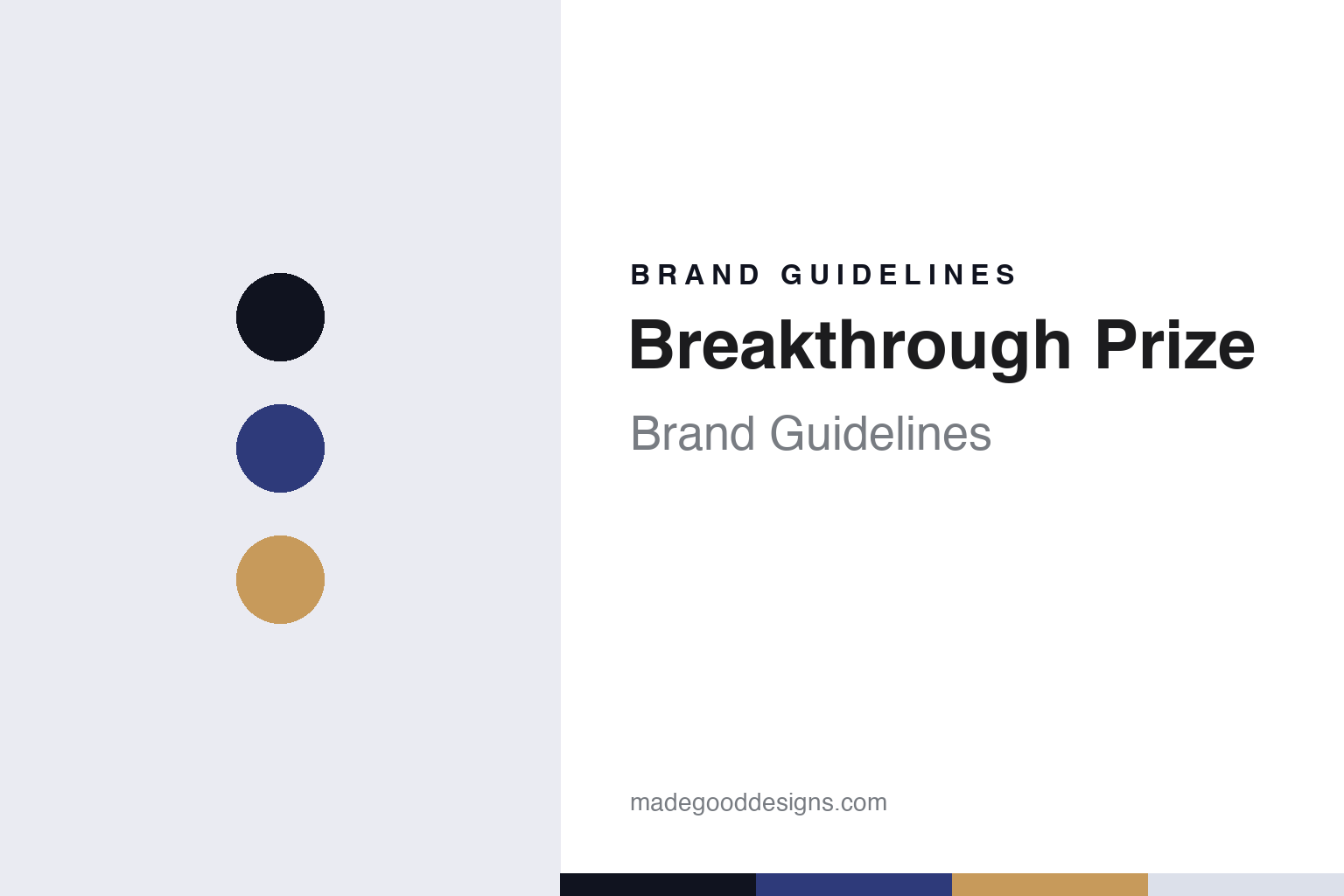
Two constants: a night ink, indigo and bronze palette and a geometric grotesque register. Abstract homage — not a Breakthrough Prize trophy, logo or mark; nothing of the programme is reproduced.
One prize, then three
A physics prize in 2012, a set of three by 2014.
The Breakthrough Prize grew out of a single award. The organiser’s own page for the Breakthrough Prize in Fundamental Physics says it was founded in 2012 by the entrepreneur Yuri Milner, open to theoretical, mathematical and experimental physicists. A second award, the Breakthrough Prize in Life Sciences, followed in 2013; the organiser lists Yuri Milner and five other co-founders behind it, and says the prizes have been sponsored by the co-founders’ personal foundations. The mathematics prizes came next. The Register reported on 10 November 2014 that the mathematics category was handed out for the first time at that year’s ceremony, and described the awards as started by Yuri Milner, who had persuaded other technology figures to back a series of prizes.
The organiser’s ceremony archive sets out how the programme took shape. The inaugural ceremony was held on 20 March 2013 in Geneva, Switzerland, and was devoted to the physics prize. The next ceremony, on 12 December 2013, moved to NASA’s Hangar 1 in Mountain View, California, the organiser says, and was produced by Vanity Fair and Don Mischer Productions and broadcast by the Science channel. That event was billed as the 2014 ceremony: for several years the prizes carried the following year’s name, so the 2015 ceremony took place on 9 November 2014 and the 2020 ceremony on 3 November 2019, all at Hangar 1 according to the archive.
Today the programme is run by the Breakthrough Prize Foundation, the name used in the organiser’s press releases of April 2026, some of which carry a San Francisco dateline. English Wikipedia describes the prizes as one of several “Breakthrough” programmes launched by a foundation co-founded by Yuri Milner, alongside Breakthrough Initiatives and the Breakthrough Junior Challenge; the prize website links to both as sister programmes. The organiser’s board page lists a Breakthrough Prize in Life Sciences Board.
Colour
Committees of past laureates, a spring gala.
The programme has three main fields: Fundamental Physics, Life Sciences and Mathematics. Around them sit awards for researchers earlier in their careers. The organiser names the New Horizons in Physics Prize and the New Horizons in Mathematics Prize, which its rules say are aimed at researchers generally no more than twelve years past their doctorate, with up to three given each year. The Maryam Mirzakhani New Frontiers Prize is for women mathematicians who completed their PhDs within the previous two years. A matching award for physics, the Vera Rubin New Frontiers Prize, was announced at the April 2026 ceremony for women physicists and astrophysicists at the same career stage, the organiser said on 22 April 2026.
Selection is set out in the published rules. Anyone may nominate a candidate during the open nomination period; self-nominations are not allowed. A valid nomination needs basic details of nominee and nominator, at least one third-party letter of recommendation and up to ten candidate citations from a specified academic publishing database. In 2026 the public nomination window ran from 22 April to 17 July. Past recipients of the prizes are invited onto the Selection Committees that choose future recipients. The physics rules add that a prize can be shared by any number of people, that there are no age limits, that a person can receive a prize more than once, and that in exceptional cases a Special Breakthrough Prize in Fundamental Physics can be awarded at any time without the nomination process.
The ceremony has changed venue. After the Hangar 1 years, the organiser says, the ninth ceremony on 15 April 2023 left “its traditional home in Silicon Valley” for the Academy Museum of Motion Pictures in Los Angeles, which also hosted the tenth on 13 April 2024. The eleventh, on 5 April 2025, was held at the Barker Hangar in Santa Monica, and the twelfth on 18 April 2026 was also in Santa Monica, in the Los Angeles area. The organiser describes the evening as a red-carpet gala with presenters from science, technology and entertainment, and says the ceremony is broadcast around the world. Symposiums and public lectures with laureates have accompanied some ceremonies, according to its events page.
Typography
How prizes present themselves.
Science, mathematics and innovation prizes present themselves through a small set of recurring elements. The first is the name behind the prize. Most are run by an institution — an academy, a foundation, a learned society, a union of national bodies or a royal foundation — and many carry a namesake as well: a scientist, a mathematician or a benefactor whose name stands in the title, sometimes alongside the initials of the society that awards it.
The second is an object. Many of these prizes hand over a medal, a sculpture or a diploma, and some describe that object in detail: its metal, its size, the figure on its face and the words of its inscription. A medal designed once and struck again for each new round can become the most stable part of a prize’s identity.
The third is the structure. Prizes are divided into fields or categories, and candidates usually reach them through nomination by invitation or by named nominators rather than open entry. A selection committee or panel then decides, as each organiser describes it, and some keep the names of their committee members private until the announcement.
Finally there is the calendar. Each prize has its own rhythm — yearly, every two years or every four — with an announcement date and a ceremony in a named city, often in the same hall or at the same congress each time. This guide looks at how each prize sets out those elements: its organiser and namesake, its fields, its process, its object and its cycle.
Aa
A geometric grotesque for a programme built around a ring-shaped trophy. (Specimen set in Space Grotesk, a sans STAND-IN; NOT the Breakthrough Prize logo.)
Breakthrough Prize
A toroid, credited to Olafur Eliasson.
The trophy is the programme’s clearest visual object. The organiser’s trophy page credits it to the artist Olafur Eliasson and describes it as a sculpture moulded into the shape of a toroid, a ring form that, in the organiser’s words, recalls shapes found from black holes and galaxies to seashells and coils of DNA. The same page quotes Eliasson saying the idea began with the question of where great ideas come from; English Wikipedia repeats the attribution and the description.
The written identity is plain. Each field has its own page and its own name, always in the form “Breakthrough Prize in” followed by the discipline, and the early-career awards keep the same pattern with “New Horizons” and “New Frontiers” in their titles. The site groups the prizes, the trophy, the board, the events and the nominations under one short navigation bar, and dates every announcement and ceremony in its news and archive pages. In 2026 the sequence ran from the announcement of laureates and the gala in April to a nomination window from April to July for the following year’s prizes.
The dating of the ceremonies is worth noting for anyone writing about the programme. Until 2019 a ceremony held late in one year carried the next year’s name; since 2023 the ceremonies have been held in April of the year they are named for, according to the organiser’s archive. The same archive counts the ceremonies, from the inaugural Geneva event of 2013 to the twelfth in 2026.
For a design guide, the Breakthrough Prize shows how a young programme can build an identity from a single sculptural object and a strict naming pattern. Compare the Abel Prize, a state-founded mathematics award with a glass plaque, and the Fields Medal. For this guide we use night ink, indigo and a warm bronze with a sans, an unofficial interpretation; no product or logo is reproduced.
Explore & save
Keep Breakthrough Prize’s identity on hand — save it to a board in the Made Good inspiration library.
Breakthrough Prize identity set
Pin the Breakthrough Prize night ink, indigo and bronze palette and the geometric grotesque register to your own board.
Source & notes
Frequently Asked Questions
What font can I use to match the Breakthrough Prize look?
This guide describes Breakthrough Prize’s type as “A geometric grotesque for a programme built around a ring-shaped trophy”. Its type specimen is set in Space Grotesk from Google Fonts as a stand-in; Space Grotesk is not Breakthrough Prize’s own lettering.
What colours are in the Breakthrough Prize palette?
This guide’s Breakthrough Prize palette is Night ink #10131F, Orbit indigo #2E3A7A, Warm bronze #C79A5B, Pale nebula #DCE0EA and Paper #F6F5F2. The tones are the guide’s own unofficial interpretation, not official Breakthrough Prize hex codes.