Abel Prize Brand Guidelines
A state-founded prize for mathematics, announced in March and awarded in May.
Aa
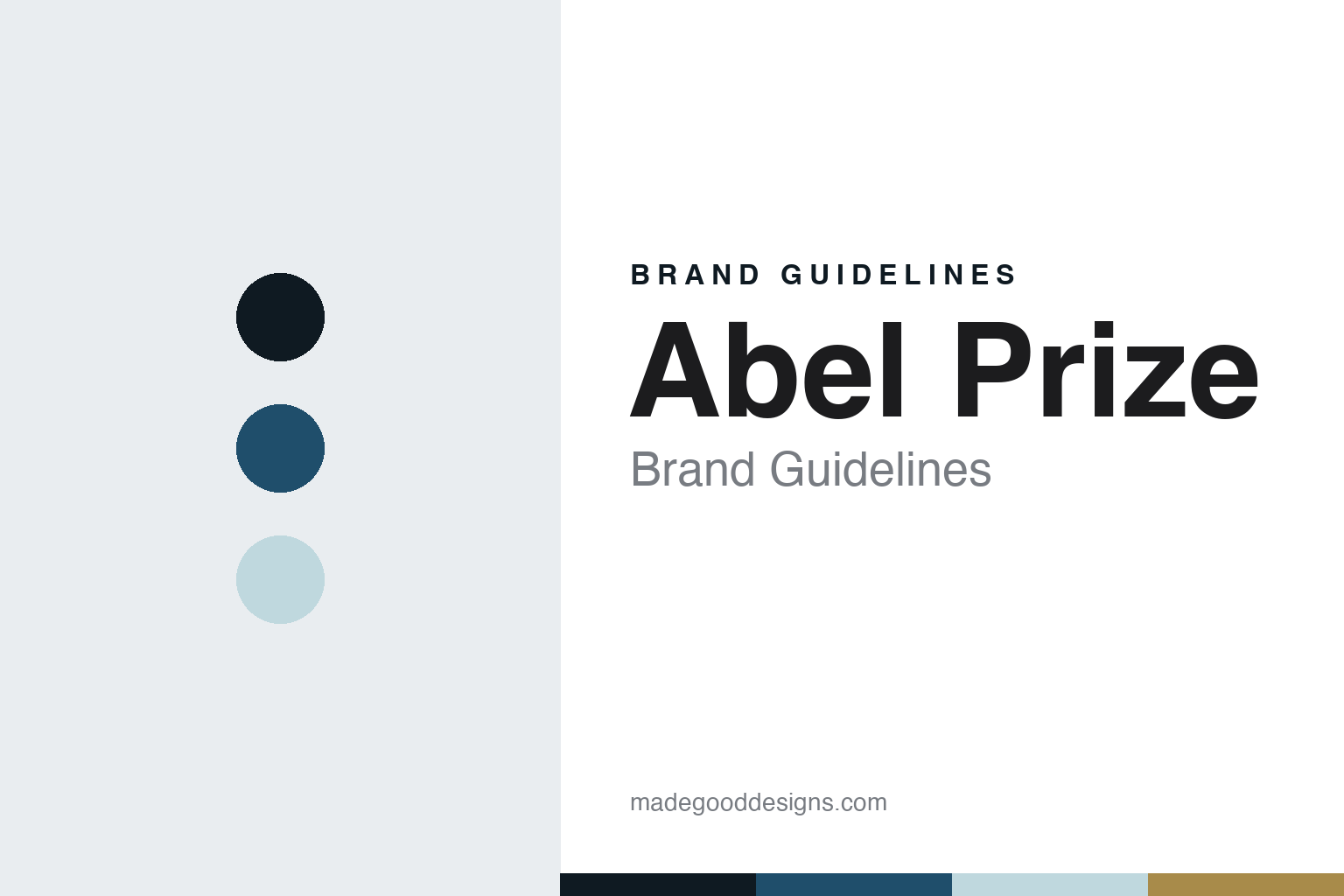
Two constants: a fjord ink, sea blue and glass mist palette and a classical serif register. Abstract homage — not the Abel Prize plaque, logo or mark; nothing of the programme is reproduced.
A century-old idea
Proposed in the 1890s, established in 2002.
The Abel Prize is a yearly prize for mathematics, named after the Norwegian mathematician Niels Henrik Abel, born in 1802. The prize’s own pages say it was established in 2002, the 200th anniversary of Abel’s birth: its frequently asked questions credit the Norwegian Parliament, the Storting, and its history page the Norwegian government, which proposed it and whose proposal the Storting accepted. It is awarded by the Norwegian Academy of Science and Letters on behalf of the government, specifically the Ministry of Education and Research, and the first prize was given in 2003.
The idea is much older. The Academy’s history page and the MacTutor history of mathematics archive at the University of St Andrews both trace it to the mathematician Sophus Lie, who in the 1890s gathered international support for a fund that would award an Abel Prize every five years, after the plans for the Nobel Prizes, made known in 1897, left out mathematics. Lie’s plan was not carried forward. A second attempt came with the centenary of Abel’s birth in 1902, when the king took an interest and, working with the Science Society of Christiania (today’s Academy), two mathematicians drew up statutes; the dissolution of the union between Sweden and Norway in 1905 ended those plans, the Academy says. English Wikipedia gives the same sequence.
Abel’s name stayed in public view. The Academy notes that he appeared on Norwegian stamps in 1929 and on Norges Bank’s 500-krone note from 1948. The modern prize began with a meeting in August 2000 between Abel’s biographer and the chief executive of Telenor. A working group formed at the University of Oslo’s Department of Mathematics in March 2001 sent its proposal to the government in May 2001, and in August 2001 the government announced an Abel Fund in a speech on the university’s Blindern campus, according to the Academy and MacTutor. The statutes were adopted by the Ministry of Education and Research on 11 April 2002 and last amended on 10 December 2013.
Colour
Open nominations, a committee of five.
The selection process is set out in the statutes and the Academy’s guidelines. Anyone may nominate a candidate, individuals and institutions alike, but self-nominations are not considered. Only living mathematicians can be nominated, nominations are confidential, and the deadline is 1 September for the following year’s prize. A nomination should come with a CV, a description of the nominee’s work and its impact, and the names of specialists who can give an independent opinion. The prize can go to one person or be shared for closely related fundamental contributions.
The Abel Committee reviews the candidates. The Academy appoints its five members, all research mathematicians, on nominations from the International Mathematical Union and the European Mathematical Society; the statutes require at least three members from outside Norway, give the chair a four-year term and the others two-year terms, renewable once. The committee sends a recommendation to the Academy, which selects the laureate. If the committee finds no worthy winner in a given year, the statutes say the prize is not awarded that year.
The year follows a fixed pattern. The Academy announces the laureate in March, usually around the middle or end of the month; for the 2026 prize the announcement came on 19 March, as the European Mathematical Society reported that day. The ceremony takes place during the Abel Prize Week in Oslo in May, a week the Academy says includes the award ceremony in the University Aula, the Abel lectures and the government’s official banquet. The 2026 ceremony was held on 26 May, opened by the Abel fanfare, with the prize presented by a member of the Norwegian royal family, according to the Academy’s event page. English Wikipedia notes that the Nobel Peace Prize was awarded in the same aula between 1947 and 1989.
A second body, the Abel Board, runs the activities around the prize. Its five members are appointed by the Academy on recommendations from the Academy’s mathematicians, the Royal Norwegian Society of Sciences and Letters and Universities Norway. The board is responsible for mathematical events linked to the prize and for work aimed at children and young people, which the Academy says includes mathematics competitions and a prize for mathematics teachers. English Wikipedia adds an Abel Symposium, administered by the Norwegian Mathematical Society.
Typography
How prizes present themselves.
Science, mathematics and innovation prizes present themselves through a small set of recurring elements. The first is the name behind the prize. Most are run by an institution — an academy, a foundation, a learned society, a union of national bodies or a royal foundation — and many carry a namesake as well: a scientist, a mathematician or a benefactor whose name stands in the title, sometimes alongside the initials of the society that awards it.
The second is an object. Many of these prizes hand over a medal, a sculpture or a diploma, and some describe that object in detail: its metal, its size, the figure on its face and the words of its inscription. A medal designed once and struck again for each new round can become the most stable part of a prize’s identity.
The third is the structure. Prizes are divided into fields or categories, and candidates usually reach them through nomination by invitation or by named nominators rather than open entry. A selection committee or panel then decides, as each organiser describes it, and some keep the names of their committee members private until the announcement.
Finally there is the calendar. Each prize has its own rhythm — yearly, every two years or every four — with an announcement date and a ceremony in a named city, often in the same hall or at the same congress each time. This guide looks at how each prize sets out those elements: its organiser and namesake, its fields, its process, its object and its cycle.
Aa
A classical serif for a prize rooted in nineteenth-century mathematics. (Specimen set in EB Garamond, a serif STAND-IN; NOT the Abel Prize logo.)
Abel Prize
A glass plaque by Henrik Haugan.
The physical award is a glass plaque. The Academy’s answers to frequently asked questions say the prize consists of a glass plaque designed by the Norwegian artist Henrik Haugan, together with the prize itself; English Wikipedia describes it as a commemorative trophy.
The written identity rests on the namesake. The prize’s formal name in its statutes is Niels Henrik Abel’s Prize in Mathematics, shortened everywhere else to the Abel Prize, or Abelprisen in Norwegian, and the website is bilingual. A large part of the site is given over to Abel himself, with a biography in several chapters, a scientific biography, his handwritten manuscripts and long reading lists of literature on his mathematics. The Academy also places the prize within Norway’s public institutions: the statutes say it is financed through the national budget by a grant from the Ministry of Education and Research, and that the Academy reports each year on how those funds are used.
The calendar is part of the identity too. The Academy’s pages set out the dates: the nomination deadline on 1 September, the announcement in March (for 2026, at noon Central European Time on 19 March, followed live on the prize website), and the award ceremony in May in the University Aula, within the Abel Prize Week and its lectures. Statutes, committee guidelines and an ethics document are published on the site, so the selection rules can be read in full.
For a design guide, the Abel Prize shows how a state-founded prize can build its look around one historic namesake, one building and one glass object. Compare the Fields Medal, another mathematics honour, and the Breakthrough Prize. For this guide we use a fjord ink, a deep sea blue and a misty glass tone with a serif, an unofficial interpretation; no product or logo is reproduced.
Explore & save
Keep Abel Prize’s identity on hand — save it to a board in the Made Good inspiration library.
Abel Prize identity set
Pin the Abel Prize fjord ink, sea blue and glass mist palette and the classical serif register to your own board.
Source & notes
Frequently Asked Questions
What font can I use to match the Abel Prize look?
This guide describes Abel Prize’s type as “A classical serif for a prize rooted in nineteenth-century mathematics”. Its type specimen is set in EB Garamond from Google Fonts as a stand-in; EB Garamond is not Abel Prize’s own lettering.
What colours are in the Abel Prize palette?
This guide’s Abel Prize palette is Fjord ink #0F1A22, Deep sea blue #1F4E6B, Glass mist #BFD8DE, Old brass #A88B4A and Paper #F7F6F2. The tones are the guide’s own unofficial interpretation, not official Abel Prize hex codes.
When was Abel Prize founded?
Abel Prize was founded in 2002 (first awarded 2003), in Norway.