Kavli Prize Brand Guidelines
Oslo’s biennial prize for the big, the small and the complex.
Aa
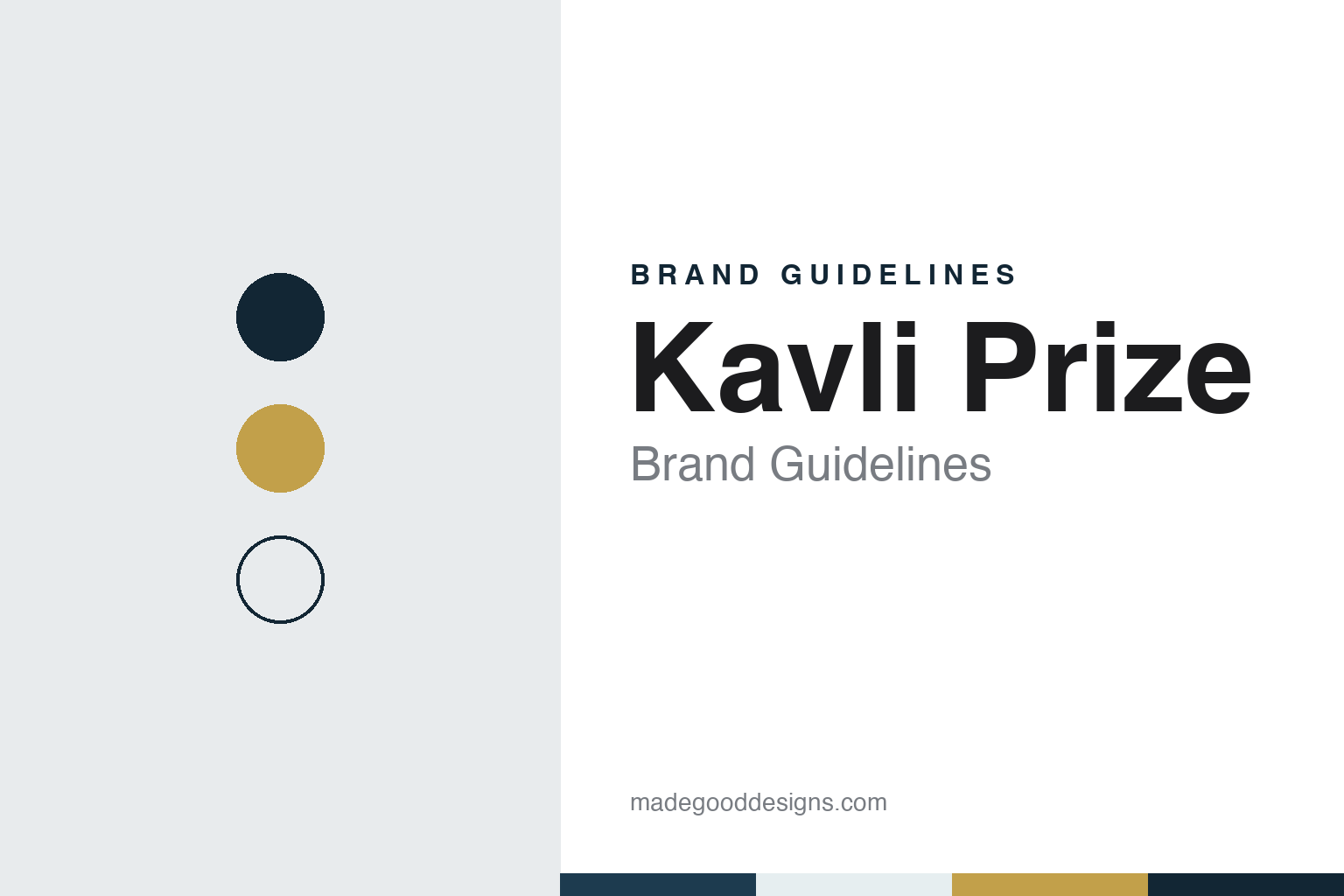
Two constants: a fjord blue, ice and gold palette and a geometric sans register. Abstract homage — not a Kavli Prize asset; no medal, logo or mark is reproduced.
Three partners
An academy, a ministry and a foundation.
The Kavli Prize was established in 2005 as a joint venture of three partners: the Norwegian Academy of Science and Letters, the Norwegian Ministry of Education and Research and The Kavli Foundation, according to English Wikipedia. The prize’s own website says the inauguration of the prize in 2005 was one of the foundation’s early activities. The first prizes were awarded in Oslo on 9 September 2008, English Wikipedia says, and UC Santa Cruz News, reporting on the 2010 ceremony, also gave 2008 as the year the prizes were first given.
The idea came from Fred Kavli, a Norwegian-American businessman who founded the Kavlico Corporation in Los Angeles in 1958 and set up The Kavli Foundation after the company was sold in 2000, according to the prize’s website. Norwegian Wikipedia describes him as the founder of the prize fund. The prize describes its three fields with the line “the big, the small and the complex” across its pages.
The three partners divide the work, the prize says. The Academy administers the Kavli Prize Week in Oslo, the selection committees and the announcement of the laureates. The Ministry hosts the laureate banquet and funds the Academy’s administration of the prize. The Kavli Foundation provides the gold medals and promotes the laureates and their science. The prize stresses that the ministry and the foundation take no part in nomination or selection.
Colour
Three fields, every second year.
There are three prizes, one in each field, awarded every second year. The prize defines them broadly. The Kavli Prize in Astrophysics covers the origin, evolution and properties of the universe, from cosmology and planetary science to astronomical instrumentation. The Kavli Prize in Nanoscience covers structures and systems at the nanometre scale, including nanomaterials, molecular self-assembly and nanoscale instrumentation. The Kavli Prize in Neuroscience covers the brain and nervous system, from molecular and cellular to cognitive and computational neuroscience.
The cycle starts with an open call for nominations in odd-numbered years, from July to October, the prize says; for the 2026 prizes the nomination system closed on 1 October 2025. Anyone may nominate, but self-nominations are not considered, nominees must be living, and each nomination is carried over for two further cycles. The laureates are then announced in the summer of the prize year: the prize gave 10 June 2026 as the announcement date for its 2026 laureates, and UC Santa Cruz News noted in 2010 that that year’s prize had been announced in June.
Selection rests with three independent committees, one per field, appointed by the Academy. The prize says the members are proposed by five scientific bodies — the Chinese Academy of Sciences, the French Academy of Sciences, the Max Planck Society, the US National Academy of Sciences and the Royal Society — and that each committee has five members, who serve two prize cycles, with chairs serving three. Norwegian Wikipedia says each chair is a Norwegian scientist. Each committee puts forward a unanimous recommendation to the Academy. Records of the committees’ deliberations are sealed and archived by the Academy for fifty years, and since 2017 a five-member oversight committee has reviewed the whole process at intervals of no less than ten years, the prize says.
The prize is presented during the Kavli Prize Week, held mainly in Oslo, with lectures by the laureates, science symposia, popular lectures in Oslo and Trondheim, a ceremony and a banquet. The award ceremony takes place at the Oslo Concert Hall, presided over by the King of Norway, the prize says; UC Santa Cruz News reported the 2010 ceremony there on 7 September 2010. The banquet is held in the Great Hall of Oslo City Hall, hosted by the Norwegian government. The ceremony and the laureate lectures are recorded and published online.
Typography
How science prizes present themselves.
Science, mathematics and innovation prizes present themselves through a small set of recurring elements. The first is the name behind the prize. Most are run by an institution — an academy, a foundation, a learned society, a union of national bodies or a royal foundation — and many carry a namesake as well: a scientist, a mathematician or a benefactor whose name stands in the title, sometimes alongside the initials of the society that awards it.
The second is an object. Many of these prizes hand over a medal, a sculpture or a diploma, and some describe that object in detail: its metal, its size, the figure on its face and the words of its inscription. A medal designed once and struck again for each new round can become the most stable part of a prize’s identity.
The third is the structure. Prizes are divided into fields or categories, and candidates usually reach them through nomination by invitation or by named nominators rather than open entry. A selection committee or panel then decides, as each organiser describes it, and some keep the names of their committee members private until the announcement.
Finally there is the calendar. Each prize has its own rhythm — yearly, every two years or every four — with an announcement date and a ceremony in a named city, often in the same hall or at the same congress each time. This guide looks at how each prize sets out those elements: its organiser and namesake, its fields, its process, its object and its cycle.
Aa
A geometric sans — for a logo drawn as a nested geometric pattern. (Specimen set in Manrope, a sans STAND-IN; NOT the Kavli Prize logo.)
The medal
A portrait on one side, a geometric logo on the other.
Each laureate receives a gold medal and a scroll, UC Santa Cruz News reported in 2010, and English Wikipedia gives the medal’s size as 70 millimetres across and 5 millimetres thick, weighing 311 grams. Norwegian Wikipedia describes its design in detail. The medal was designed by the American sculptor Eugene L. Daub. Its obverse carries his right-facing portrait of Fred Kavli, with the words “THE KAVLI PRIZE” in an arc above.
The reverse carries the Kavli Prize logo, designed by Enzo Finger: a geometric pattern that Norwegian Wikipedia describes as a version of Metatron’s Cube, a figure of interlocking circles and lines. Above the logo stands the name of the field — ASTROPHYSICS, NANOSCIENCE or NEUROSCIENCE — and that word is the only thing that separates the three versions of the medal. Below the logo is a flat field where the laureate’s name is engraved. The medals are made at the Northwest Territorial Mint in the United States, Norwegian Wikipedia says.
On the medal, that logo is paired with plain field names in capitals, and the same figure appears as the prize’s logo elsewhere, built from repeated circles and straight lines. The fields themselves are framed in the prize’s own shorthand — the big, the small and the complex — which gives three subjects a common voice without three separate marks.
The prize also works through its setting. Prize Week brings the laureates to Oslo for lectures and symposia as well as the ceremony, and the website’s photo galleries show the week’s events, from the concert hall to the city hall banquet; the city’s main street, Karl Johans gate, is shown dressed for Prize Week.
For a design guide, the Kavli Prize shows how one geometric logo and a single changing word can hold three prizes together in one identity. Compare the Abel Prize and the Shaw Prize, two other science prizes in this series. For this guide we use fjord blue, ice and a gold with a sans, an unofficial interpretation; no product or logo is reproduced.
Explore & save
Keep Kavli Prize’s identity on hand — save it to a board in the Made Good inspiration library.
Kavli Prize identity set
Pin the Kavli Prize fjord blue, ice and gold palette and the geometric sans register to your own board.
Source & notes
Frequently Asked Questions
What font can I use to match the Kavli Prize look?
This guide describes Kavli Prize’s type as “A geometric sans — for a logo drawn as a nested geometric pattern”. Its type specimen is set in Manrope from Google Fonts as a stand-in; Manrope is not Kavli Prize’s own lettering.
What colours are in the Kavli Prize palette?
This guide’s Kavli Prize palette is Fjord blue #1D3B4F, Polar night #122634, Ice #E6EEF0, Medal gold #C2A04A and Paper #F6F7F6. The tones are the guide’s own unofficial interpretation, not official Kavli Prize hex codes.
When was Kavli Prize founded?
Kavli Prize was founded in 2005 (first awarded 2008), in Oslo, Norway.
Who founded Kavli Prize?
Kavli Prize was founded by Fred Kavli in 2005 (first awarded 2008).