Kyoto Prize Brand Guidelines
Science, technology and the arts under one prize from Kyoto.
Aa
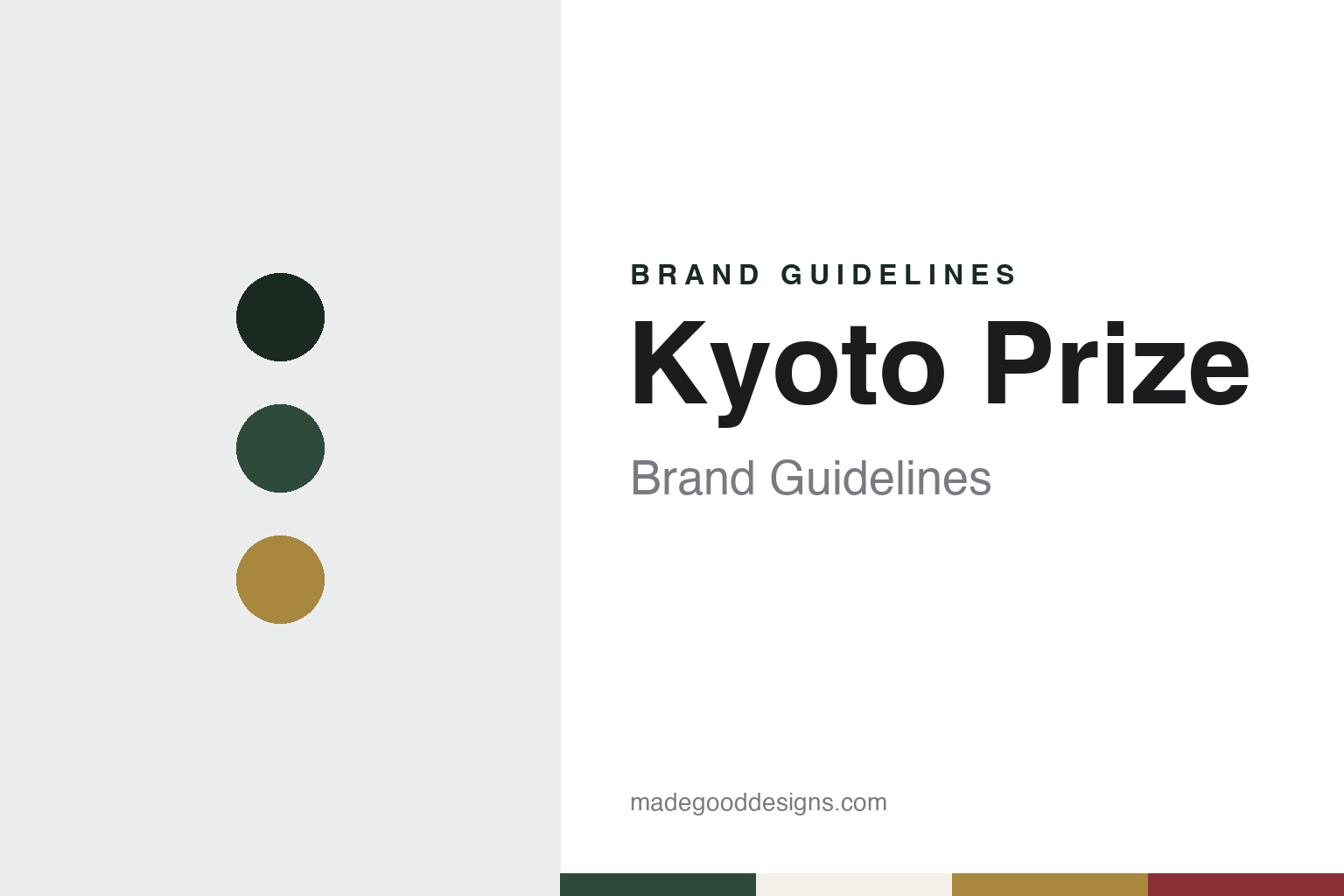
Two constants: a camphor green, leaf gold and lacquer red palette and a Mincho serif register. Abstract homage — not a Kyoto Prize medal, diploma or logo; no mark is reproduced.
Founded in 1984
A foundation, a statement and a first ceremony.
The Kyoto Prize is an international award of Japanese origin, presented each year in Kyoto. It was founded in 1984 by Kazuo Inamori, the founder of the ceramics and electronics company Kyocera, and is organised by the Inamori Foundation. Japanese Wikipedia says the prize was created in 1984 and that its honours began the following year, in 1985; its entry on the foundation lists the foundation’s establishment in 1984 and the first Kyoto Prize ceremony in 1985.
The prize site publishes Inamori’s founding statement, dated 12 April 1984. In it he notes that 1984 marked the twenty-fifth anniversary of Kyocera’s founding, explains that the award would be granted by the Inamori Foundation, which he had endowed partly with Kyocera stock, and sets out two aims: to repay the global community, and to give formal recognition to dedicated researchers whose work had gone unrecognised. The statement also describes a belief in balance between scientific progress and what he called spiritual depth, and that idea shaped the prize’s structure.
Japanese Wikipedia records that the foundation became a public interest incorporated foundation in 2011, the legal form under which it now operates. On 10 November 2026 the foundation’s chairman, Shigetada Nakanishi, presented the medals at that year’s ceremony, the prize site reported.
The prize is run as a single programme across three categories rather than as separate awards. The prize site names the Inamori Foundation as host: it selects the nominators each year, presents the awards and lists the lectures, symposia and exhibitions that go with them, and its Board of Directors approves the final choice. That concentration in one organisation is the frame for everything else in this guide: one name, one foundation, one city and one medal shared across all three categories.
Colour
Three categories, twelve fields, one medal.
The Kyoto Prize is presented in three categories: Advanced Technology, Basic Sciences and Arts and Philosophy. The prize site says each category comprises four fields, making twelve in all. Advanced Technology covers Electronics, Biotechnology and Medical Technology, Materials Science and Engineering, and Information Science; Basic Sciences takes in the biological, mathematical, earth and planetary, and life sciences; and Arts and Philosophy covers Music, the Arts, Theater and Cinema, and Thought and Ethics. The Kyoto Prize at Oxford site, run by the Blavatnik School of Government, adds that the fields awarded in a given year are decided each year, and that a prize goes in principle to one person per category, though it may be shared.
The site explains that the arts category exists because of Inamori’s conviction that the future of humanity depends on a balance between scientific development and the enrichment of the human spirit.
Selection runs through three tiers, the prize site says. Each year the Inamori Foundation chooses nominators among recognised authorities, and laureates come only from those nominations. A Kyoto Prize Selection Committee for each category does the first screening; a Kyoto Prize Committee for each category draws up ranked short lists; and the Kyoto Prize Executive Committee decides the laureates, subject to approval by the foundation’s Board of Directors.
Each laureate receives a medal and a diploma. The medal was designed by Yoshiyuki Chosa, a Japanese metalwork artisan, the prize site says. At its centre is a camphor tree in relief, a tree that the site describes as an object of nature worship since ancient times and a symbol of eternity. It weighs about 250 grams, is made of 20-carat gold and is set with four recrystallised emeralds and four recrystallised rubies; the reverse is engraved with the laureate’s name and the date. The folded diploma measures 34.5 by 63 centimetres. One side carries the category, field, name and date; the other carries a calligraphic inscription by the head of the Myōshin-ji school of Rinzai Zen Buddhism, usually drawn from a Chinese aphorism chosen with that year’s laureates in mind.
Typography
Science prizes and their signs.
Science, mathematics and innovation prizes present themselves through a small set of recurring elements. The first is the name behind the prize. Most are run by an institution — an academy, a foundation, a learned society, a union of national bodies or a royal foundation — and many carry a namesake as well: a scientist, a mathematician or a benefactor whose name stands in the title, sometimes alongside the initials of the society that awards it.
The second is an object. Many of these prizes hand over a medal, a sculpture or a diploma, and some describe that object in detail: its metal, its size, the figure on its face and the words of its inscription. A medal designed once and struck again for each new round can become the most stable part of a prize’s identity.
The third is the structure. Prizes are divided into fields or categories, and candidates usually reach them through nomination by invitation or by named nominators rather than open entry. A selection committee or panel then decides, as each organiser describes it, and some keep the names of their committee members private until the announcement.
Finally there is the calendar. Each prize has its own rhythm — yearly, every two years or every four — with an announcement date and a ceremony in a named city, often in the same hall or at the same congress each time. This guide looks at how each prize sets out those elements: its organiser and namesake, its fields, its process, its object and its cycle.
Aa
A Mincho serif for a prize that joins science and the arts. (Specimen set in Shippori Mincho, a serif STAND-IN; NOT the Kyoto Prize logo.)
Kyoto Prize
A June announcement, a November week in Kyoto.
The Kyoto Prize keeps a fixed calendar. The Kyoto Prize at Oxford site says the laureates are announced each June and that the presentation ceremony and related events are held in Kyoto each November; in 2026 the prize site posted the announcement on 19 June. Japanese Wikipedia says the ceremony is held on 10 November each year at the Kyoto International Conference Center. The prize site reported that the 2026 ceremony took place there on 10 November before 700 guests, and that the commemorative lectures followed on 11 November before 1,200 attendees.
The prize also travels. Japanese Wikipedia says the laureates take part in a Kyoto Prize Symposium in San Diego the following March and in the Kyoto Prize at Oxford in May. The Blavatnik School of Government at the University of Oxford says it brings the laureates to Oxford for a series of events each May, and reported on such a programme on 6–7 May 2025. The prize site also lists permanent exhibits: a Kyoto Prize Room at the Kyoto City KYOCERA Museum of Art and a Kyoto Prize Library in the Inamori Auditorium at Kagoshima University.
For a designer the prize offers a clear set of materials: a three-part structure that gives science, technology and the arts equal billing; a gold medal with a single natural image at its centre; and a diploma that pairs printed details with brush calligraphy. Those elements suggest an identity built on balance and on a small number of crafted objects, presented across a year of announcements, ceremonies, lectures and symposia in several countries.
For a design guide, the Kyoto Prize shows how a prize can hold science and the arts in one system, with a single medal and three equal categories. Compare the Shaw Prize, another Asian prize founded by a business figure and run by a foundation, and Kyocera, the company Inamori founded. For this guide we use a camphor green, a leaf gold and a lacquer red with a serif, an unofficial interpretation; no product or logo is reproduced.
Explore & save
Keep Kyoto Prize’s identity on hand — save it to a board in the Made Good inspiration library.
Kyoto Prize identity set
Pin the Kyoto Prize camphor green, leaf gold and lacquer red palette and the Mincho serif register to your own board.
Source & notes
Frequently Asked Questions
What font can I use to match the Kyoto Prize look?
This guide describes Kyoto Prize’s type as “A Mincho serif for a prize that joins science and the arts”. Its type specimen is set in Shippori Mincho from Google Fonts as a stand-in; Shippori Mincho is not Kyoto Prize’s own lettering.
What colours are in the Kyoto Prize palette?
This guide’s Kyoto Prize palette is Camphor green #2E4A3A, Temple ink #1A2A21, Leaf gold #A8873F, Lacquer red #8A2F35 and Washi #F3F0E9. The tones are the guide’s own unofficial interpretation, not official Kyoto Prize hex codes.
When was Kyoto Prize founded?
Kyoto Prize was founded in 1984 (first presented 1985), in Kyoto, Japan.
Who founded Kyoto Prize?
Kyoto Prize was founded by Kazuo Inamori in 1984 (first presented 1985).