Leeds International Piano Competition Brand Guidelines
A triennial piano contest from a Leeds studio.
Aa
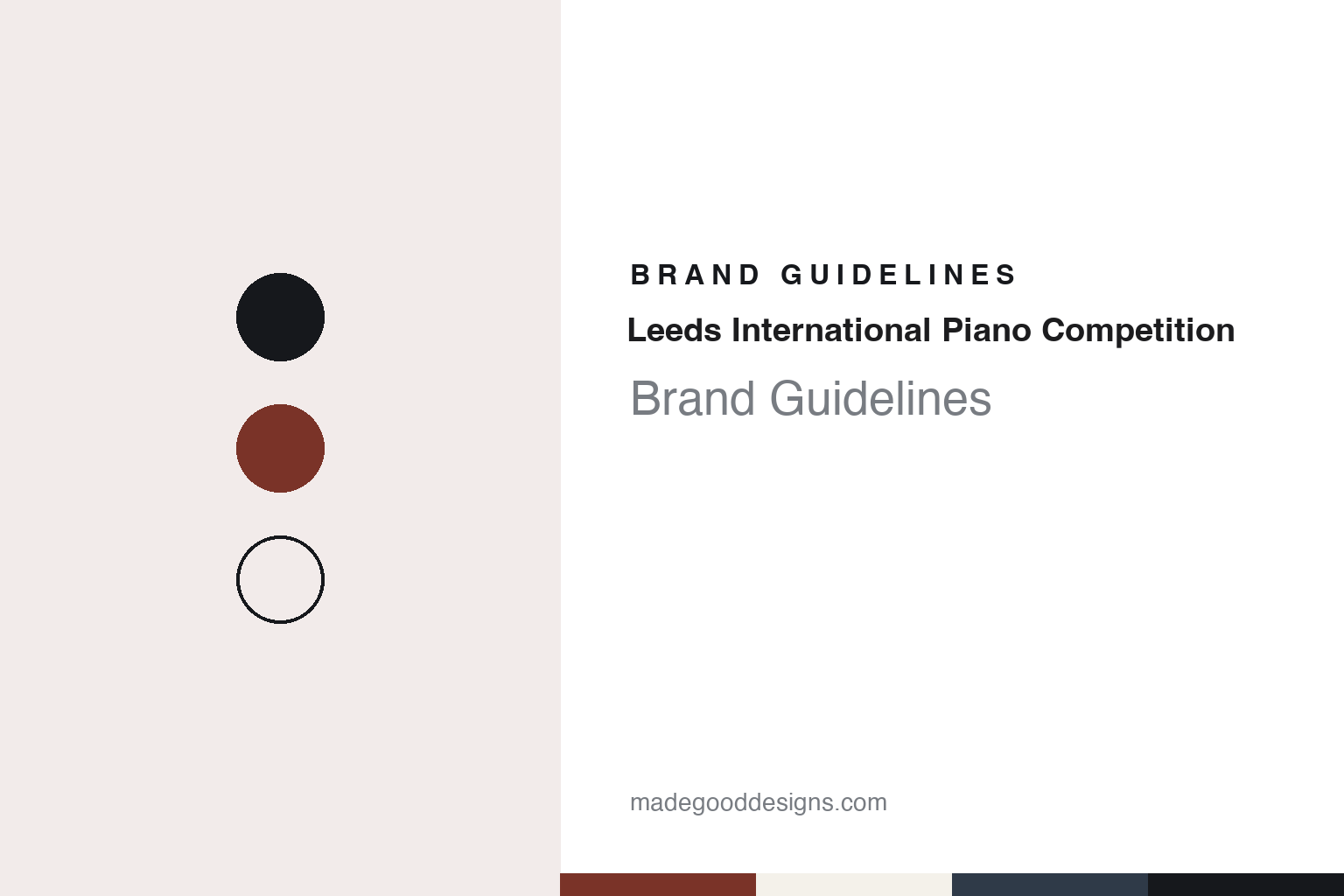
Two constants: a brick, slate and bronze palette and a Civic serif register. Abstract homage — not a Leeds International Piano Competition asset; no logo, medal or emblem is reproduced.
A teacher’s idea
A Leeds piano teacher, a countess and a committee.
The Leeds International Piano Competition, which calls itself The Leeds, grew out of a piano teacher’s studio. The competition’s own timeline says that in 1961 the Leeds teacher Fanny Waterman, believing that competitions raise the profile and standards of young players, had the idea of an international event in her city, and with her friend Marion Thorpe, Countess of Harewood, set about forming a committee and raising funds. The Lyons family, including Roslyn Lyons, were the founding benefactors, matching support from Leeds City Council and the University of Leeds, it says. English Wikipedia also gives 1961 as the founding year and lists four founders, Roslyn Lyons among them; the competition’s about page gives 1963 as the year it was founded.
The first competition was held from 13 to 21 September 1963. The competition says it had 94 entrants aged between 17 and 28 from 23 countries, and that the Royal Liverpool Philharmonic Orchestra played at the finals until 1975. It was known for years as the Leeds International Pianoforte Competition, English Wikipedia notes, and it joined the World Federation of International Music Competitions in 1965.
Fanny Waterman led the competition as chair and artistic director until the 2015 edition, according to English Wikipedia. The contest has kept a three-year cycle, with one longer gap: after the 1996 competition the next took place in 2000, timed for the turn of the millennium. The organiser today is a registered charity and company, The Leeds International Piano Competition, which says it is hosted by the University of Leeds and Leeds City Council.
Colour
International first rounds, a Great Hall and a Town Hall.
The format has changed over six decades, but the two Leeds halls have stayed. The competition says the stage of the Great Hall at the University of Leeds has welcomed competitors since 1963, while Leeds Town Hall is the setting for the concerto finals. In 2018, English Wikipedia says, the preliminary round moved abroad for the first time, to Berlin, New York and Singapore; the semi-final added chamber music; and every round was streamed live online. The 2021 first round was held remotely, with pianists recorded in many locations.
For the 2024 edition the finals left Leeds. Pianist magazine reported in May 2023 that St George’s Hall in Bradford would host the finals on 20 and 21 September 2024 in place of Leeds Town Hall, which was being refurbished, while the earlier rounds stayed at the University of Leeds. The organiser presented the choice as a link between the Leeds 2023 year of culture and Bradford’s year as UK City of Culture in 2025, the magazine said.
The rules changed in 2026. On 2 July 2026 the competition announced that its 2027 edition would have no prescribed repertoire at any stage, and that the upper age limit would rise to 35; Pianist reported the same day that competitors would have complete freedom over what they play. The organiser names the Royal Liverpool Philharmonic as the finals orchestra since 2021.
The prizes carry the founders’ names. The organiser lists the First Prize with the Dame Fanny Waterman Gold Medal, the Second Prize with the Marion Thorpe Silver Medal and the Third Prize with the Lady Roslyn Lyons Bronze Medal, followed by fourth and fifth prizes. Alongside them sit an award from the Royal Liverpool Philharmonic Society for contemporary music, an audience prize voted by online viewers, and two awards announced in 2026 for the next edition: an Encore Prize for a short piece played at the end of the semi-final, and a Leeds Piano Trail Prize for a project that takes the piano outside the concert hall.
Typography
Cities, cycles and halls.
Classical music and dance competitions tend to introduce themselves through a small set of names. Many carry the name of a musician, a composer or a founding patron; the Van Cliburn International Piano Competition is named for an American pianist, and the Warsaw competition for the composer Fryderyk Chopin. Most are also tied to a city, and to the body that runs them, whether a foundation, a national institute, a broadcaster or a school.
Time is measured in years rather than seasons. A competition may run every two, three, four or five years, and each edition is usually known by its number as well as its date. The rules for an edition set out who may enter, most often through an age limit or a range of birth years, and what must be played: a free choice within a time limit, set lists, a newly commissioned piece, or, in Warsaw, the works of a single composer.
The rounds narrow step by step. Recorded applications or screening auditions lead to preliminary rounds, then to one or more further stages, and finally to a small group of finalists. In piano competitions the last stages often bring in an orchestra, with each finalist playing a concerto alongside the solo recitals of earlier rounds. Juries are appointed for each edition, and some organisers publish their scoring rules or the scores themselves.
The hall is often part of the identity. A competition may return to the same stage edition after edition, and its programmes, webcasts and printed material repeat the city, the venue, the namesake and the edition number. This guide looks at how each organiser presents those constants, using what the organisers and independent sources document.
Aa
A civic serif for a contest rooted in two Leeds halls. (Specimen set in Libre Baskerville, a serif STAND-IN; NOT the Leeds International Piano Competition logo.)
The Leeds
A competition, a festival and a city of public pianos.
Broadcasting has been part of the competition for most of its history. English Wikipedia says the BBC has broadcast every edition on television and radio since 1966, and the organiser lists BBC Radio 3 among the recent partners of Competitor+, its programme of mentoring, management, recording and concert opportunities for competitors and prize-winners. Other partners it names include the agency Askonas Holt, the label Warner Classics and the streaming service medici.tv, and it describes an exclusive partnership with Steinway & Sons. Its website offers recorded performances from past editions to stream, searchable by competitor, year and composer.
The competition also reaches beyond its rounds. The organiser describes a city-wide festival held with each three-year cycle, with large piano sculptures and more than 35 public pianos across Leeds and Bradford, and year-round community programmes for amateur pianists, schools and young people in the region. Pianist magazine described the Leeds Piano Trail in July 2026 as more than 35 public pianos around the city. The new trail prize ties that programme to the competition itself.
Its name has also settled into two forms. The full title, the Leeds International Piano Competition, sits beside the short form The Leeds in the organiser’s own pages and press releases, and English Wikipedia notes the older Pianoforte title. Its website gives a timeline of Fanny Waterman’s career and an archive of performances.
For a design guide, the Leeds International Piano Competition shows how a contest can tie its identity to a city, two of its halls and medals named after the people who started it. Compare the Queen Elisabeth Competition, which also names its top award after a founder, and the Van Cliburn Competition, another piano contest held on a multi-year cycle. For this guide we use a brick red, a slate blue and a muted bronze with a serif, an unofficial interpretation; no product or logo is reproduced.
Explore & save
Keep Leeds International Piano Competition’s identity on hand — save it to a board in the Made Good inspiration library.
Leeds International Piano Competition identity set
Pin the brick, slate and bronze palette and the Civic serif register to your own board.
Source & notes
Frequently Asked Questions
What font can I use to match the Leeds International Piano Competition look?
This guide describes Leeds International Piano Competition’s type as “A civic serif for a contest rooted in two Leeds halls”. Its type specimen is set in Libre Baskerville from Google Fonts as a stand-in; Libre Baskerville is not Leeds International Piano Competition’s own lettering.
What colours are in the Leeds International Piano Competition palette?
This guide’s Leeds International Piano Competition palette is Town Hall brick #7A3328, Ink #16181C, Yorkshire slate #2F3A48, Medal bronze #9C7A45 and Paper #F4F1EA. The tones are the guide’s own unofficial interpretation, not official Leeds International Piano Competition hex codes.
When was Leeds International Piano Competition founded?
Leeds International Piano Competition was founded in conceived 1961, first held 1963, in Leeds, England.