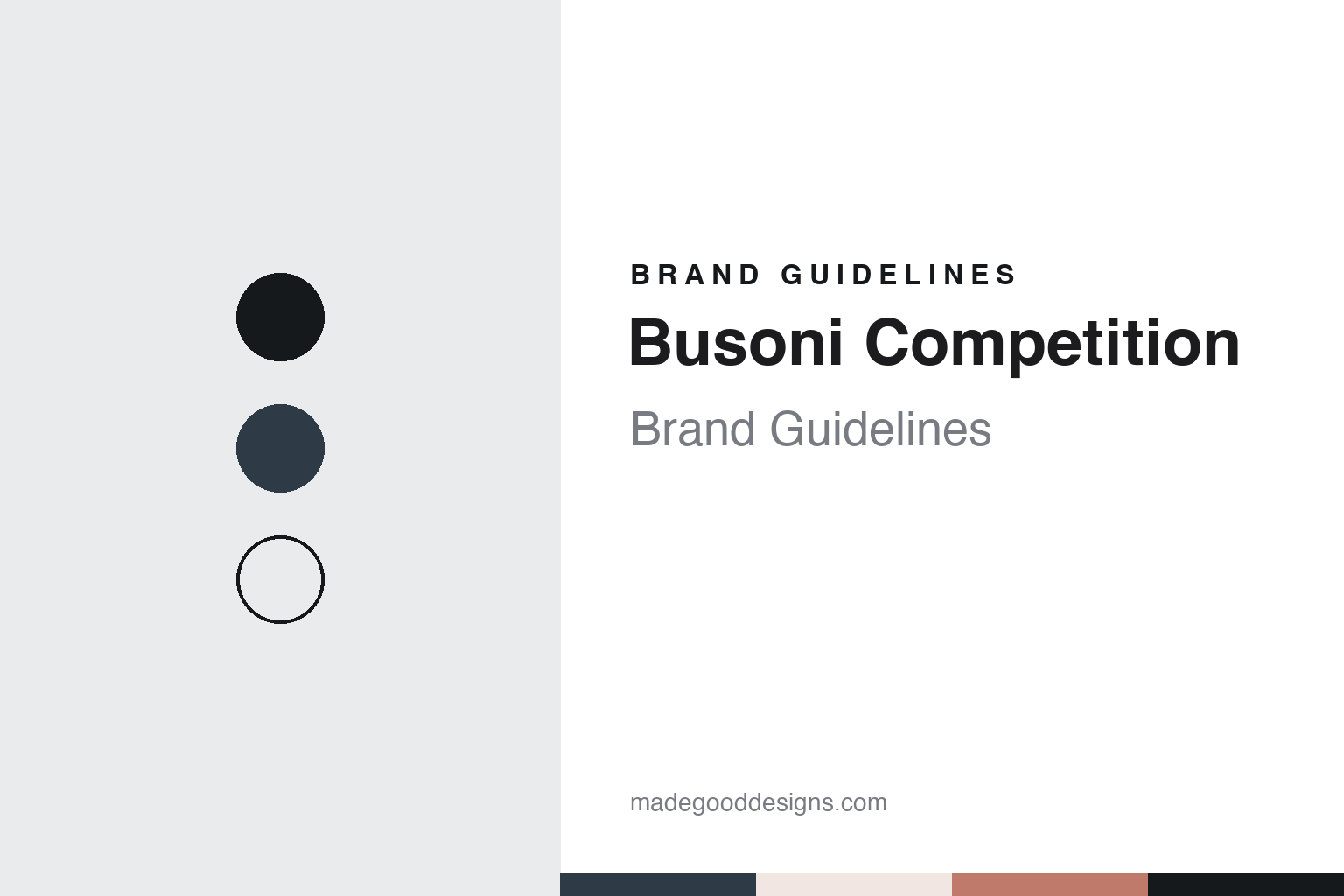
Busoni Competition Brand Guidelines
Bolzano’s piano contest, founded in 1949.
Aa
Two constants: a slate, rose and pale stone palette and a transitional serif register. Abstract homage — not a Busoni Competition asset; no logo, trophy or instrument is reproduced.
Bolzano, 1949
A conservatory director and a bridge between two cultures.
The Ferruccio Busoni International Piano Competition — in German the Internationaler Klavierwettbewerb Ferruccio Busoni, and in everyday use the Busoni Competition — was founded in Bolzano, in northern Italy, in 1949. Its founder was Cesare Nordio, then director of the city’s Conservatorio Claudio Monteverdi, according to both the competition and Italian Wikipedia. The competition says the opening edition began on 12 September 1949.
The namesake is Ferruccio Busoni, born in Empoli in 1866, the Italian pianist, composer and writer who did much of his work in Berlin. The competition says Nordio chose Bolzano, in a region where Italian and German-speaking cultures meet, to create a kind of musical bridge between the two, and to honour Busoni, an Italian artist whose career was centred in Germany, in an anniversary year. Italian Wikipedia quotes Nordio describing the city as an ideal meeting point between “the two major musical civilisations.” According to Italian Wikipedia, the first edition had the backing of the Italian government’s office for border areas and of the Bolzano trade fair, and an honorary committee of well-known concert pianists of the day.
For some editions the competition also ran a piano composition contest alongside the main event, both the competition and Italian Wikipedia say. In its early years the artistic direction belonged, by statute, to the directors of the Bolzano conservatory; Italian Wikipedia says the statute was later revised and the competition became a foundation.
Colour
A two-year cycle that starts on three continents.
Italian Wikipedia says the competition was held every year from 1949 to 2001; as entries grew, it moved to a cycle spread over two years, with preselection in the first year and the final phases in the second. The Italian daily Avvenire, reporting on the 65th edition in September 2025, also described the competition as biennial since the early 2000s. Il Sole 24 Ore wrote in August 2024 that candidates perform twice across the two years and that the competition is a member of the World Federation of International Music Competitions.
The first stage has changed its form in recent editions. Il Sole 24 Ore described a Glocal Piano Project in twelve cities in 2024, streamed on the competition’s platform and judged by an international jury and an online audience. Avvenire reported in 2025 that 648 musicians had applied by video and that 120 of them then played in public in Steinway showrooms around the world, before the final phase in Bolzano from the end of August, where 34 pianists reached the semi-finals of solo and chamber music rounds.
For the 66th edition (2026–2027) the stage is called the Glocal Piano Festival. The competition’s rules say 120 pianists chosen from 12- to 16-minute videos play free programmes of 25 to 30 minutes at ten concert institutions in Asia, Europe and the United States in November 2026; a professional jury follows remotely, while the audience at each venue votes for a pianist, giving two routes to the finals. Il Foglio wrote in November 2026 that the stage ran from Florence to Shanghai, via Boston and Tokyo. Entrants must be born between 1 January 1996 and 31 December 2010, and the rules give up to three places to recent top prizewinners of other federation competitions.
The finals in Bolzano narrow in four steps, according to the published repertoire: a solo round for 39 pianists that must include a work by Busoni; a longer solo round for 12, with a Bach–Busoni transcription and a Classical sonata; a round for six combining a piano quintet with strings and a short solo set; and a final for three, each playing a concerto with orchestra. Avvenire reported that the 2025 final was played with the Orchestra Haydn of Bolzano and Trento at the city’s Teatro Comunale, closed the Bolzano Festival Bozen, and was broadcast live on Rai 5 and online.
Typography
Competitions and their cycles.
Classical music and dance competitions tend to introduce themselves through a small set of names. Many carry the name of a musician, a composer or a founding patron; the Van Cliburn International Piano Competition is named for an American pianist, and the Warsaw competition for the composer Fryderyk Chopin. Most are also tied to a city, and to the body that runs them, whether a foundation, a national institute, a broadcaster or a school.
Time is measured in years rather than seasons. A competition may run every two, three, four or five years, and each edition is usually known by its number as well as its date. The rules for an edition set out who may enter, most often through an age limit or a range of birth years, and what must be played: a free choice within a time limit, set lists, a newly commissioned piece, or, in Warsaw, the works of a single composer.
The rounds narrow step by step. Recorded applications or screening auditions lead to preliminary rounds, then to one or more further stages, and finally to a small group of finalists. In piano competitions the last stages often bring in an orchestra, with each finalist playing a concerto alongside the solo recitals of earlier rounds. Juries are appointed for each edition, and some organisers publish their scoring rules or the scores themselves.
The hall is often part of the identity. A competition may return to the same stage edition after edition, and its programmes, webcasts and printed material repeat the city, the venue, the namesake and the edition number. This guide looks at how each organiser presents those constants, using what the organisers and independent sources document.
Aa
A transitional serif for a composer’s name. (Specimen set in Libre Baskerville, a serif STAND-IN; NOT the Busoni Competition logo.)
Busoni and Mahler
One foundation for a competition, an academy and a festival.
Since 2019 the competition has been run by the Fondazione Ferruccio Busoni – Gustav Mahler, based in Bolzano. The foundation says it was formed that year by merging two earlier bodies, pairing Busoni with Gustav Mahler, his contemporary, and that it now runs three strands: the piano competition, an academy that trains young musicians through chamber music, and a festival. Its artistic director is Peter Paul Kainrath, and Il Sole 24 Ore described him in August 2024 as president of the Busoni Competition and of the World Federation of International Music Competitions.
The main award is the Premio Busoni, the first prize; Italian Wikipedia notes that it has often not been awarded at all. The competition lists ranked prizes down to sixth place and a set of special prizes in its rules for the 66th edition: one offered by the City of Bolzano that is given only when the jury awards the Premio Busoni unanimously, a prize from the Milan new-music association Milano Musica for repertoire from the second half of the twentieth century, a chamber music prize, an audience prize, a prize for the performance of a work by Busoni and a prize from the Orchestra Haydn of a symphonic engagement. The same rules name Steinway & Sons as an exclusive partner of the competition, offering concerts to the Premio Busoni winner, and announce a new partnership with the Cape Town International Piano Competition.
The identity is built on names and places rather than a trophy. The foundation’s website uses “Academy Competition Festival” as its tagline, and the competition’s own pages carry the motto “Prima l’arte – poi il concorso!” (art first, then the competition) for the 2026–2027 edition. The Glocal stage gives each cycle a list of cities, while the finals stay in Bolzano, a bilingual city whose two languages appear side by side on the foundation’s pages.
For a design guide, the Busoni Competition shows how a namesake, a home city and a bilingual voice can hold together a competition whose first stage travels the world. Compare Steinway, named by the competition as a partner, and the Chopin Competition, another international piano competition. For this guide we use a slate, a soft rose and a pale stone with a serif, an unofficial interpretation; no product or logo is reproduced.
Explore & save
Keep Busoni Competition’s identity on hand — save it to a board in the Made Good inspiration library.
Busoni Competition identity set
Pin the Busoni slate, rose and pale stone palette and the transitional serif register to your own board.
Source & notes
Frequently Asked Questions
What font can I use to match the Busoni Competition look?
This guide describes Busoni Competition’s type as “A transitional serif for a composer’s name”. Its type specimen is set in Libre Baskerville from Google Fonts as a stand-in; Libre Baskerville is not Busoni Competition’s own lettering.
What colours are in the Busoni Competition palette?
This guide’s Busoni Competition palette is Slate #2E3B46, Keyboard black #16191C, Dolomite rose #C07A6B, Porphyry pale #F1E6E2 and Paper #FAF8F6. The tones are the guide’s own unofficial interpretation, not official Busoni Competition hex codes.
When was Busoni Competition founded?
Busoni Competition was founded in 1949, in Bolzano, Italy.
Who founded Busoni Competition?
Busoni Competition was founded by Cesare Nordio in 1949.