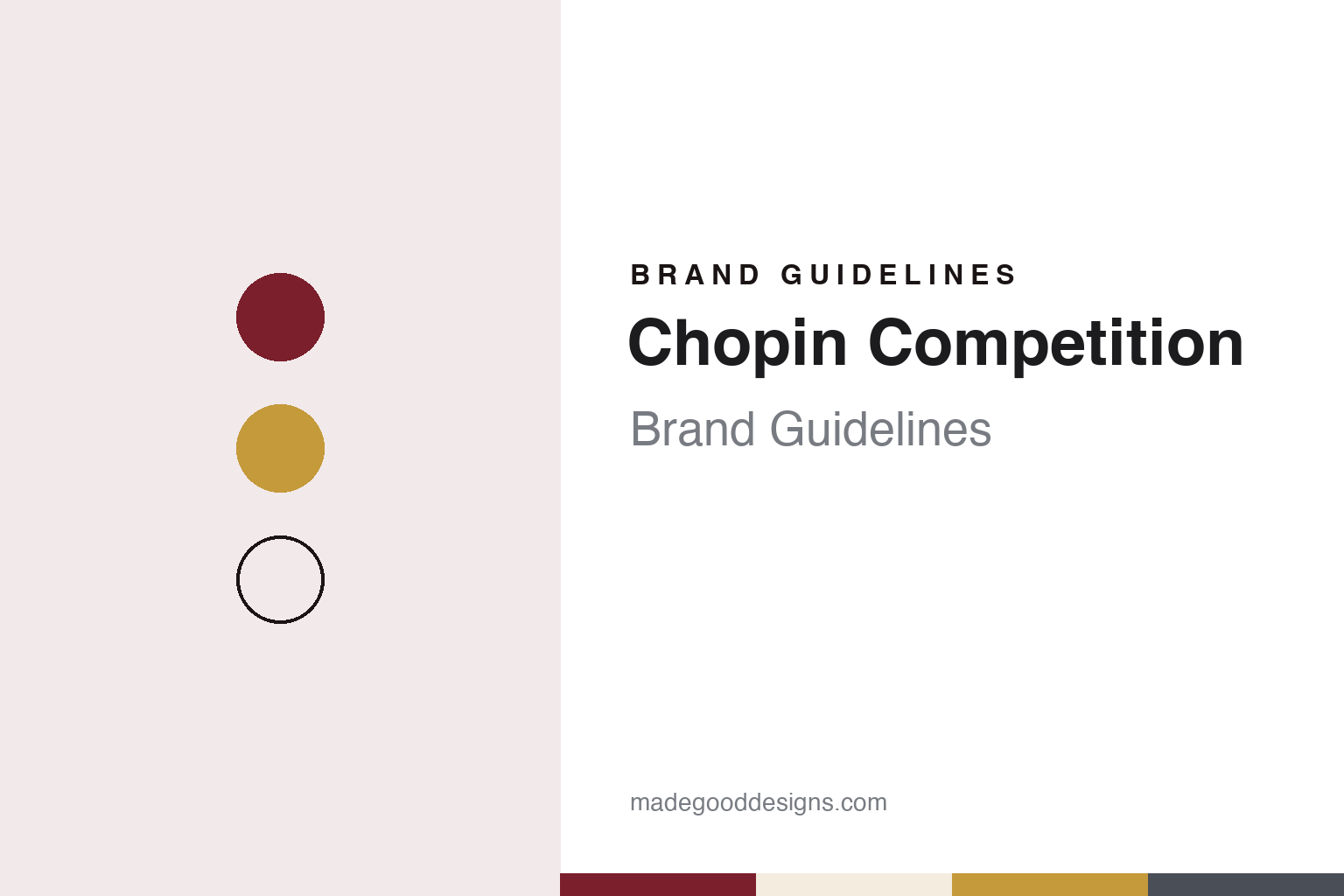
Chopin Competition Brand Guidelines
Warsaw’s all-Chopin piano contest, held every five years since 1955.
Aa
Two constants: a crimson, parchment and gold palette and a Romantic serif register. Abstract homage — not a Chopin Competition mark; no logo, medal or poster is reproduced.
Warsaw, 1927
A pianist’s idea: rivalry in the service of Chopin.
The International Fryderyk Chopin Piano Competition, usually shortened to the Chopin Competition, was first held in Warsaw in 1927. Its organiser today, the Fryderyk Chopin Institute, credits the idea to the Polish pianist and teacher Jerzy Żurawlew, who wanted to open a discussion about how Chopin’s music should be played and to win young listeners for it by bringing an element of sporting rivalry into the concert hall. English Wikipedia, quoting his recollections, says Żurawlew began looking for funds in 1925, and that a board member of the Warsaw Music Society guaranteed to cover any deficit of the first competition.
The competition is named for the composer Fryderyk Chopin, and every work played in it is his. English Wikipedia lists editions in 1927, 1932 and 1937. The institute says that organising the event became impossible for several years during the Second World War and that the tradition was revived in 1949. English Wikipedia gives the fifth edition as 1955 and says the competition has been held every five years since then.
The calendar has moved as well. The prewar editions and those of 1955, 1960 and 1965 took place in winter, near Chopin’s birthday on 22 February, according to English Wikipedia; Polish Wikipedia says the competition has been held in October since 1970. The eighteenth edition took place in 2021 and the nineteenth in October 2025, and the institute says 2025 opened a series of celebrations for the competition’s centenary.
The organising body has changed over the decades. Polish Wikipedia says the competition was prepared with the Ministry of Culture and Art until the 1960s, organised by the Fryderyk Chopin Society in Warsaw from 1960 to 2005, and organised by the national Fryderyk Chopin Institute from the 2010 edition onwards. Both the English and Polish editions of Wikipedia say it was one of the founding members of the World Federation of International Music Competitions, set up in Geneva in 1957.
Colour
Preliminaries in spring, three stages and a final in October.
Polish Wikipedia describes it as one of the few competitions given over to a single composer. Works are played from memory and chosen from lists set out in the rules, with some pieces compulsory for everyone, and the programme has changed from edition to edition. The first competition asked for nocturnes, études, preludes, a polonaise, a ballade and mazurkas, with movements of a concerto in the final; later editions added scherzos, sonatas, the Barcarolle and the Polonaise-Fantasy, Polish Wikipedia says.
The institute’s rules for the nineteenth edition opened it to pianists born between 1995 and 2009. A Preliminary Round ran in Warsaw from 23 April to 4 May 2025. The competition proper ran from 2 to 23 October: round one on 3–7 October, round two on 9–12 October, round three on 14–16 October, a commemorative day on 17 October, the final on 18–20 October and three prizewinners’ concerts on the following evenings. The same rules let top prizewinners of several other contests, among them the Van Cliburn, Leeds, Hamamatsu and Busoni competitions, skip the qualifying stages. The institute reported more than 640 applications, 162 pianists in the preliminaries and 84 performers from 19 countries in the main competition; the World Federation of International Music Competitions gave matching figures in October 2025.
The auditions take place at the National Philharmonic in Warsaw, Polish Wikipedia says. In the 2025 final, eleven pianists each played one of Chopin’s two piano concertos with the Warsaw Philharmonic Orchestra, together with the Polonaise-Fantasy, Op. 61, according to the institute; the award ceremony and the first prizewinners’ concert followed at the Teatr Wielki – Polish National Opera. A 17-member jury judged the 2025 edition. The federation reported that the jury’s scores were published afterwards under the competition rules, with each juror’s marks corrected to within a set margin of the jury average.
The pianos are chosen by procedure. The institute’s 2025 piano selection rules say a committee of experts appointed by the institute’s director assesses one concert instrument from each maker that applies, and that makers supply and service their pianos at their own cost. The rules name Steinway, Fazioli and Kawai as the makes most often chosen by finalists in recent editions, and a partnership between the institute and Yamaha; those four makes were admitted on separate terms, with room on the Philharmonic stage for at most one other.
Typography
How competitions present themselves.
Classical music and dance competitions tend to introduce themselves through a small set of names. Many carry the name of a musician, a composer or a founding patron; the Van Cliburn International Piano Competition is named for an American pianist, and the Warsaw competition for the composer Fryderyk Chopin. Most are also tied to a city, and to the body that runs them, whether a foundation, a national institute, a broadcaster or a school.
Time is measured in years rather than seasons. A competition may run every two, three, four or five years, and each edition is usually known by its number as well as its date. The rules for an edition set out who may enter, most often through an age limit or a range of birth years, and what must be played: a free choice within a time limit, set lists, a newly commissioned piece, or, in Warsaw, the works of a single composer.
The rounds narrow step by step. Recorded applications or screening auditions lead to preliminary rounds, then to one or more further stages, and finally to a small group of finalists. In piano competitions the last stages often bring in an orchestra, with each finalist playing a concerto alongside the solo recitals of earlier rounds. Juries are appointed for each edition, and some organisers publish their scoring rules or the scores themselves.
The hall is often part of the identity. A competition may return to the same stage edition after edition, and its programmes, webcasts and printed material repeat the city, the venue, the namesake and the edition number. This guide looks at how each organiser presents those constants, using what the organisers and independent sources document.
Aa
A Romantic serif for a programme of nocturnes and mazurkas. (Specimen set in Cormorant Garamond, a serif STAND-IN; NOT the Chopin Competition logo.)
Chopin Competition
Six laureates, three medals and prizes for single genres.
The awards follow a fixed pattern. Polish Wikipedia says the jury has been able to award six laureate titles since 1960, with places that may be shared or left unfilled; the first competition gave four main prizes, and some prewar and early postwar editions named more laureates. Since 1975, it says, the top three have also received gold, silver and bronze medals designed by the artist Józef Markiewicz and struck by the Polish State Mint.
Special prizes for single genres run alongside the main prizes. Polish Wikipedia lists a Polish Radio prize for the mazurkas since 1927, a Fryderyk Chopin Society prize for a polonaise since 1960 and a National Philharmonic prize for a concerto since 1980, with prizes for a sonata from 2010 and a ballade from 2025. The institute’s results for 2025 show those five special prizes, and it says the remaining finalists received equivalent distinctions funded by the institute.
The institute runs a sister event. In 2018 it organised the first International Chopin Competition on Period Instruments, English Wikipedia says. For the main competition, the institute says the 2025 auditions were followed most closely on its own YouTube channel, and that recitals and concerts could also be heard live on TikTok. Around the auditions, Polish Wikipedia notes, accompanying events take place at other Warsaw venues, including the Teatr Wielki and the Ostrogski Castle.
The competition’s identity rests on a short list of constants: one composer, one city, a five-year rhythm and an October calendar, and its own pages identify each cycle by its number, as with the nineteenth edition of 2025.
For a design guide, the Chopin Competition shows how a single composer, a single city and a numbered edition can carry an identity across a century. Compare the Van Cliburn Competition, whose prizewinners the 2025 rules admitted directly, and Yamaha, named in the institute’s 2025 piano rules as its partner. For this guide we use a Warsaw crimson, parchment, an October gold and slate with a serif, an unofficial interpretation; no product or logo is reproduced.
Explore & save
Keep Chopin Competition’s identity on hand — save it to a board in the Made Good inspiration library.
Chopin Competition identity set
Pin the crimson, parchment and gold palette and the Romantic serif register to your own board.
Source & notes
Frequently Asked Questions
What font can I use to match the Chopin Competition look?
This guide describes Chopin Competition’s type as “A Romantic serif for a programme of nocturnes and mazurkas”. Its type specimen is set in Cormorant Garamond from Google Fonts as a stand-in; Cormorant Garamond is not Chopin Competition’s own lettering.
What colours are in the Chopin Competition palette?
This guide’s Chopin Competition palette is Warsaw crimson #7A1F2B, Ink #1A1414, Parchment #F3ECDF, October gold #C49A3A and Slate #4A4F57. The tones are the guide’s own unofficial interpretation, not official Chopin Competition hex codes.
When was Chopin Competition founded?
Chopin Competition was founded in 1927, in Warsaw, Poland.