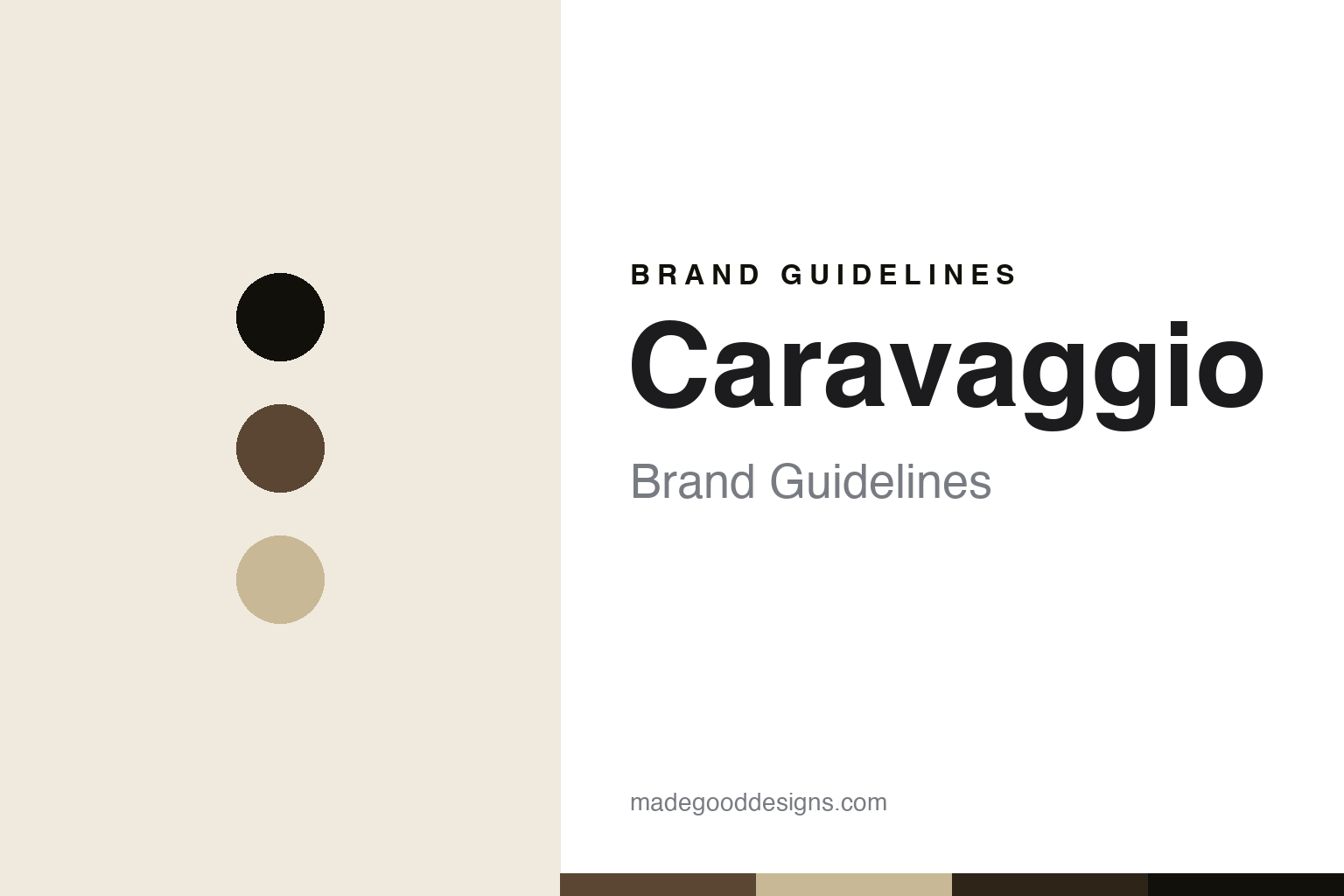
Caravaggio Brand Guidelines
The house-brand linen that names its mill.
Aa
Two constants: an umber palette and a house-brand-sans register. Abstract homage — not a Caravaggio product or mark, and not the painter; no canvas silhouette, no logo, and no painting is reproduced.
The house-brand linen that names its mill
Caravaggio is the Blick house-brand linen canvas that discloses its linen is milled in Varese, Italy.
Caravaggio closes the surface round with its honest house-brand — not a maker at all, but a retailer’s own-brand linen canvas that does the useful thing a house brand rarely does: it names where its linen is milled. Caravaggio is a house-brand painting surface, and its answer to a round about the surface is the disclosed source — a premium linen canvas whose retailer states, plainly, that the linen is milled in Varese, in Italy. A brand, disclosed.
Its identity is the house-brand linen that names its mill. The house-brand status, the disclosed Italian mill and the premium linen are the story here. A brand, disclosed. The house-brand linen that names its mill.
(Honest notes, so the story stays precise, and the name stays clear. Caravaggio, sold through Blick, offers premium linen canvas as its hero — oil- and acrylic-ground linen, with cotton and blends — and we report its performance language as the retailer’s own marketing. It is important to be clear on two things. First, Caravaggio is a house brand, not a maker: it is Blick’s own trademark, carried over from Utrecht, the art-supply company Blick acquired in 2013 — so it is a retailer’s line, not a mill. Second, the name is a brand name only: it borrows the painter’s name and the town’s, and we reproduce neither the painter’s work nor any painting. On where it is made, the star theme of this round, its value is the disclosure: Blick’s own copy states the linen is milled in Varese, Italy, though the mill company itself is not named — a rare, useful transparency from a house brand. On who owns it, a theme of this round, it is a Blick house brand. Its designs are IP we describe but do not reproduce; there is no official brand hex; these tones are an unofficial interpretation.)
Colour
Caravaggio lives in an umber. Click a swatch to copy the hex.
Caravaggio’s identity is disclosed, house-brand and Italian-milled — an umber, an ink, a pale tan, a deep bistre, and a paper. The palette leans umber and pale tan: an old-master register — umber is a painter’s earth — that nods to a premium linen canvas rather than a loud logo colour, and pointedly not to the painter’s dramatic light. It signals an honest house-brand. The honest caveat: with no published brand hex, these values are an original, unofficial interpretation, not first-party colours.
The lesson is an umber signals a disclosed, house-brand identity. Caravaggio’s world is a premium, linen object. For designers, it is a reminder that an umber and a soft pale tan can carry an art-materials brand — the tone of the earth pigment, not a copied painting. Because these tones can fail as small text, keep type dark and let the colour live in the accents, palette and band. The takeaways: disclose the mill; be clear it is a house brand; keep the name a name; and treat any single hex as unofficial.
Typography
The register is a house-brand sans — disclosed, plain, honest.
Caravaggio’s identity carries a disclosed, plain, honest spirit — a transparent house brand, not a graphics label. A house-brand sans captures the mood: clean, direct and confident, the register of a premium linen canvas whose source is named. Set in an umber palette, the house-brand sans feels disclosed and honest — exactly the personality Caravaggio carries. It is a linen object rather than a logo, mirroring linen weave. (Caravaggio’s real canvas is things we describe but do not reproduce, and the exact typeface is not ours to use.) Because it is not ours to use, the honest description is “a house-brand-sans line,” shown here in a stand-in. The type behaves like the brand: disclosed, plain and honest.
Aa
A house-brand-sans line — disclosed and honest. (Specimen set in Manrope, a house-brand-sans STAND-IN; NOT the Caravaggio logo, the painter’s work or any canvas.)
The surface
Caravaggio stands for the house-brand linen that names its mill.
Caravaggio closes the surface round with its honest house-brand. An umber palette, a house-brand sans and a Blick line make one thing — the house-brand linen that names its mill — the whole identity: disclosed, house-brand and Italian-milled. The house-brand status is the pitch, and the disclosed Italian mill is the proof. The point is a premium linen canvas whose retailer states, plainly, that the linen is milled in Varese, in Italy, closing a round about the surface.
Put to work, the identity is the disclosure told straight, as sourcing — with the mill named and the house-brand status made clear. A maker in this spirit would disclose the mill, be clear it is a house brand, and keep the name a name. A reader in this spirit would keep the facts right: Caravaggio offers premium linen canvas as its hero, oil- and acrylic-ground, with cotton and blends; it is a Blick house brand, carried over from Utrecht, which Blick acquired in 2013, so it is a retailer’s line, not a mill; its name borrows the painter’s and the town’s, and neither the painter’s work nor any painting is reproduced; and Blick’s own copy states the linen is milled in Varese, Italy, though the mill company is not named — a rare, useful disclosure from a house brand. Caravaggio closes the round’s where-made thread at the house-brand-discloses-source point, the honest counterpart to the own-production makers. The honest editorial moves are to be clear it is a Blick house brand and not a maker, to quote the Varese disclosure, to note the mill company is unnamed, and to keep the name a name only.
For designers and brand-builders, Caravaggio completes the surface: disclose the mill — and be clear it is a house brand. The lessons: let source disclosure be the virtue of a house brand; distinguish a retailer’s line from a mill; borrow a famous name without borrowing the artwork; note when a disclosure stops short (an unnamed mill); and never reproduce a painting or a canvas. It is also a reminder to stay precise: Caravaggio is the Blick house-brand linen canvas that discloses its linen is milled in Varese, Italy — with the palette here an unofficial interpretation. Read that way, Caravaggio is less a canvas than a disclosure: house-brand, Italian-milled, honest. The lesson for a brand is that source disclosure and honest labelling reinforce each other, and naming the mill keeps the telling honest. Caravaggio made the-house-brand-linen-that-names-its-mill the identity — proof that a house brand can close a round, its disclosed source.
Explore & save
Keep Caravaggio’s identity on hand — save it to a board in the Made Good inspiration library.
Caravaggio identity set
Pin the umber palette and the house-brand-sans register to your own board.