Contest Yachts Brand Guidelines
The Conijn family’s tulip-badged yard in Medemblik.
Aa
Two constants: a tulip red, navy and tile blue palette and a yard serif register. Abstract homage — not a Contest Yachts product or mark; no yacht, tulip emblem or logo is reproduced.
Conyplex
A sailor, a new material and a family name.
Contest Yachts is a yacht builder in Medemblik, in the Netherlands. It was started in 1959 by Ed Conijn, and the company says its name joins “Con,” from the family name, with the word “test.” In its first decade the business went by the name Conyplex, Yachting Monthly reported in March 2009, when the yard marked its fiftieth year in business.
Ed Conijn came to boats through polyester. In a November 2024 interview with the British boating paper All At Sea, his grandson Arjen Conijn said the founder had always sailed and owned boats, but had made his career in another industry that used glass-reinforced plastic, and saw how the new material could be used to build boats. Yachting Monthly wrote in 2009 that his first boat was the Flying Dutchman, a two-person racing dinghy, and that the yard eventually built more than 600 of them.
Cruising yachts followed. With the designer Gerard Luyten (spelled Luiten by Yachting Monthly), Conijn produced the Contest 25, which the company dates to 1959. Through the 1960s and 1970s the range grew with further designs by Luyten and by Dick Zaal, whose first Contest design the company dates to 1971. In the 1970s a design by Robbert Das, drawn without a doghouse, opened what Yachting Monthly called the second generation of Contests, and a later model brought a centre cockpit into the range, the magazine said.
The yard has stayed with the family. The company says Ed’s son Fritz Conijn took over the running of the yard in the mid-1970s and handed it to his own son Arjen in 2003. In September 2013 the German magazine Yacht described Fritz Conijn as steering the yard together with his daughter Annick and his son Arjen. In June 2021 the local news site Medemblik Actueel described Arjen Conijn as director and the third generation at the helm, and in 2024 he called Contest a third-generation, family-owned business. The company said in 2019, its sixtieth year, that it had built more than 3,500 yachts over six decades.
Colour
Centre cockpits, layouts and owners’ choices.
Over the decades Contest moved from series-built boats towards larger, semi-custom yachts. Its sailing range carries the letters CS after the length, and the company says centre cockpits and wheel steering have long been features of the range. In 2013 Yacht reported that the yard had carried the look of its larger centre-cockpit yachts over to an aft-cockpit model, the Contest 42CS, which was shown at the Hiswa in-water show in Amsterdam that September. Fritz Conijn told the magazine that the yard regarded 45 feet as the lower limit for a centre cockpit. The same report said the 42 was offered in 45 possible interior layouts, combining three bow sections, three aft sections and five saloons.
Construction is a recurring theme in the yard’s material. The company says it has used vacuum resin injection since the mid-1990s, and Yacht described the 42 as built by vacuum injection with vinylester resin and E-glass. Contest says its yachts have been built under Lloyd’s Register certification since 1972, and the 2021 Medemblik Actueel report on a new model noted Lloyd’s Register oversight of its design.
The designers have changed over time. The company says that since 2016 its sailing yachts have been drawn with the naval architects judel/vrolijk & co, with interiors by Wetzels Brown Partners; Arjen Conijn named both firms, with Lloyd’s Register, as the yard’s development partners in 2024. Earlier interiors included work by Birgit Schnaase in 1998, the company says. In 2011 the yard built its first motor yacht, styled by Wetzels Brown, and its range now lists motor yachts alongside the sailing yachts.
Owners take part in the specification. Arjen Conijn told All At Sea in 2024 that the yard builds to commission and to each owner’s requirements, and that the original Contest 50CS reached 50 launches before it was retired and replaced by a new 50CS and a sister model. The company says it worked with Bentley Motors in 2021 and again in 2023 on yacht interiors styled to match owners’ cars.
Typography
Builders, yards and owners.
The cruising sailboat builders in this guide mostly present themselves through a place and a name. A yard is often named after a founder, a family or a home port, and that name appears on the hull, on the sail insignia and on the stand at a boat show. Some builders keep an emblem chosen decades ago; others have redrawn their logos as the company changed hands. Where a logo date or a designer is given in this guide, it comes from the builder’s own history or a dated source.
The model range is usually the clearest part of the identity. Builders name their yachts by length, by a number or by a short series name, and their websites group the boats that way, with brochures, layout drawings and configurators for each model. Naval architects and interior designers are named only as the builders or the sailing press credit them, and the same design office may work for several yards.
Boat shows and yard events carry much of the presentation. Builders publish calendars of shows, open days at the yard and owners’ regattas or rallies, and some run brokerage pages for used boats of their own make. Dealers and sales partners in other countries often carry the builder’s name alongside their own, which is why a brand can look the same at a show in Düsseldorf, Southampton or Cannes.
Ownership varies widely. Some yards are still run by the founding family in a second or third generation; others belong to listed groups that hold several boat brands, or to investors who have bought and sold them. Corporate pages describe founders, owners and sister brands; this guide sets those accounts beside dated reporting in the sailing and trade press, and keeps each company’s own claims clearly marked as its own.
Aa
A yard serif for a family yard and its tulip emblem. (Specimen set in Libre Baskerville, a serif STAND-IN; NOT the Contest Yachts logo.)
Contest Yachts
A tulip for a Dutch yard.
The emblem is a tulip. Yachting Monthly wrote in 2009 that the tulip was chosen to represent the Dutch yard with exports to the United States in mind, and that each galley worktop included a typical Makkum tile. The company says the original tulip logo was adopted in 1959 and that a new logo was introduced by Arjen Conijn in 2004; its own timeline still refers to the tulip as the company’s Dutch logo.
The yard presents itself through the boats and the place they are built. Its website sorts the sailing range by length and the CS suffix, shows yachts in build in its Medemblik halls, and gives space to a heritage page, a magazine and a list of boat shows and yard events, including an open house in Medemblik and an owners’ regatta. Under a community heading it lists ARC rallies and a brokerage service for used Contests. In 2024 Contest set up a separate sales operation, Contest Yachts UK, with the Ancasta Group; Arjen Conijn told All At Sea it was launched for the Southampton and Cannes boat shows that year. The yard’s line “building dreams together” appears on its website and in the 2021 Medemblik Actueel report.
For a design guide, Contest Yachts shows how a family yard can carry one national emblem, the tulip, from its early export boats to a semi-custom range. Compare Hallberg-Rassy, a Swedish yacht builder, and Oyster Yachts, a British one. For this guide we use a tulip red, a deep navy and a tile blue with a serif, an unofficial interpretation; no product or logo is reproduced.
Explore & save
Keep Contest Yachts’s identity on hand — save it to a board in the Made Good inspiration library.
Contest Yachts identity set
Pin the Contest Yachts tulip red, navy and tile blue palette and the yard serif register to your own board.
Source & notes
Frequently Asked Questions
What font can I use to match the Contest Yachts look?
This guide describes Contest Yachts’ type as “A yard serif for a family yard and its tulip emblem”. Its type specimen is set in Libre Baskerville from Google Fonts as a stand-in; Libre Baskerville is not Contest Yachts’ own lettering.
What colours are in the Contest Yachts palette?
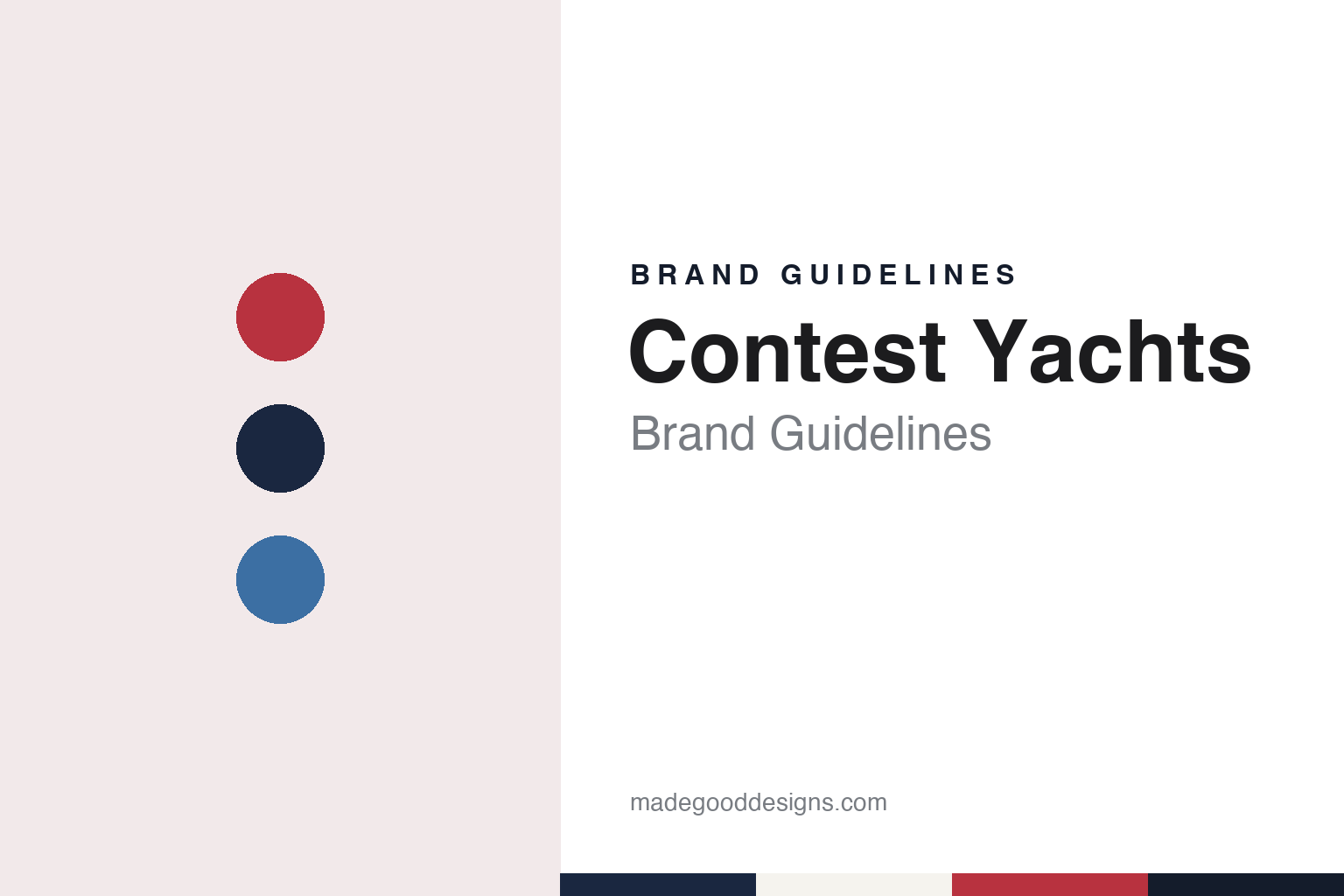
This guide’s Contest Yachts palette is Tulip red #B8323F, North Sea navy #1A2740, Tile blue #3C6FA3, Ink #141C2B and Gelcoat white #F5F3EE. The tones are the guide’s own unofficial interpretation, not official Contest Yachts hex codes.
When was Contest Yachts founded?
Contest Yachts was founded in 1959 (as Conyplex), in Medemblik, Netherlands.
Who founded Contest Yachts?
Contest Yachts was founded by Ed Conijn in 1959 (as Conyplex).
Who owns Contest Yachts?
Contest Yachts today: Family-owned yard, Medemblik. Contest Yachts is known for Centre-cockpit CS yachts, tulip emblem.