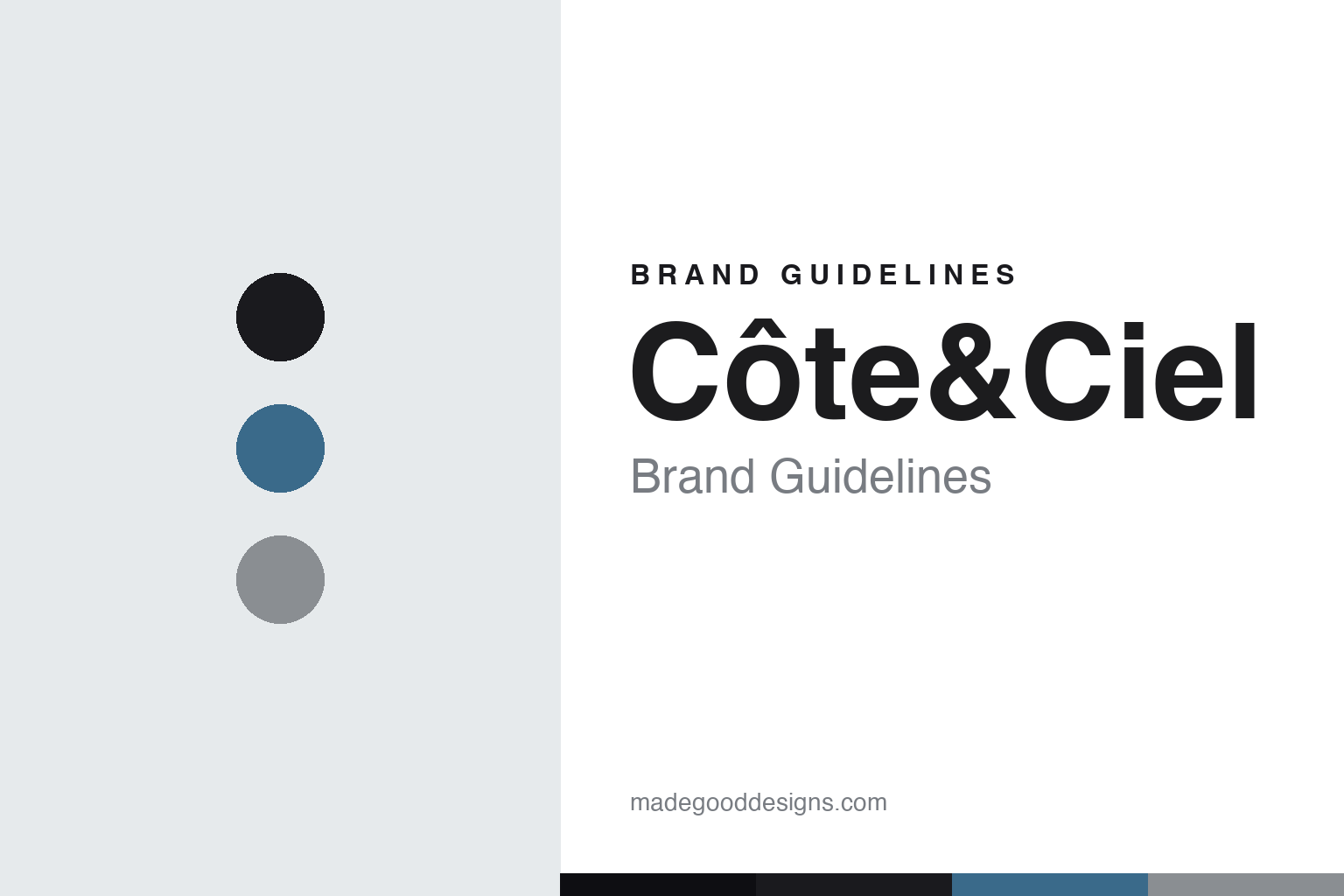
Côte&Ciel Brand Guidelines
Coast & sky — architectural, asymmetric backpacks folded from geometric surfaces, beautifully alien.
Aa
Two constants: a black-and-horizon-blue palette and a geometric, architectural display. Abstract homage — not the Côte&Ciel wordmark.
Coast & sky
Côte&Ciel sculpted the backpack.
Côte&Ciel is a lesson in architecture applied to a backpack. It was founded in 2008 in Paris, France. (An honest note on founders: the brand names none publicly; the name most often attached to it is Alexis Holin, but that’s uncertain, so “founded in Paris in 2008 by a small design studio” is the safe, accurate framing. Two more notes: no official brand hex is published, and the wordmark typeface is undocumented.)
The name is the concept: Côte&Ciel means “Coast & Sky” in French (côte = coast, ciel = sky) — “two worlds stretching toward each other, creating the horizon.” That horizon idea runs through the design philosophy, which is genuinely distinctive: the studio says it works with “no drawing, no cutting,” refusing to freeze an idea on paper — instead shapes emerge by folding, twisting and stitching geometric surfaces. The result is architectural, asymmetric, sculptural backpacks the brand itself calls “beautifully alien.”
The icon is the Isar backpack — an asymmetric, teardrop-like form with a dedicated, architectural laptop compartment (an honest note: the current Isar’s laptop pocket is internal and padded, so describe it as a dedicated/architectural compartment rather than strictly “external”). A signature system ties the range together: every backpack is named after a river (Isar, Sormonne, Moselle, Oril, Tycho, Orco) — echoing the water-and-sky theme. Materials are technical — recycled EcoYarn, Komatsu nylons and more — in a black-dominant, muted palette. (An honest note on ownership: once presented as an independent French brand, Côte&Ciel now operates internationally, with corporate and retail operations centred outside France — a New York corporate address and retail concentrated in Tokyo and Hong Kong — though a specific owner isn’t publicly confirmed.) Coast & sky.
Colour
Côte&Ciel lives in black and horizon blue. Click a swatch to copy the hex.
Côte&Ciel’s identity leans on a black-dominant, architectural palette — deep blacks and charcoals as the base, with a horizon blue (the meeting of coast and sky) and slate greys as accents. The near-total commitment to black is deliberate: it reads as futuristic, sculptural and design-forward, letting the unusual architectural forms of the bags — not colour — be the statement. The muted, technical palette matches an avant-garde brand that treats a backpack as a piece of wearable architecture. The honest caveat: Côte&Ciel publishes no official brand hex, so the black, horizon blue and slate here are an original, unofficial interpretation, not first-party values.
The lesson is a black-dominant palette lets sculptural form lead. Côte&Ciel’s black-and-horizon-blue world foregrounds its architectural shapes. For designers, it’s a reminder that restrained, near-monochrome colour can push unusual form to the forefront. The takeaways: use a black-dominant palette to let form speak; add a single conceptual accent (horizon blue); and treat specific hexes as unofficial when there’s no published spec.
Typography
The wordmark is a geometric architectural display — futuristic and design-led.
Côte&Ciel’s identity carries a futuristic, architectural, design-led spirit — the lowercase “côte&ciel” wordmark whose clean, geometric letterforms read as modern, avant-garde and considered. A geometric display captures the mood: it feels architectural and future-facing, matching a brand that folds geometric surfaces into “beautifully alien” backpacks. Set against a black-and-horizon-blue palette, the type feels futuristic and design-led — exactly the sculptural, coast-and-sky personality Côte&Ciel cultivates. It’s geometric and modern rather than decorative or heritage, mirroring the architectural bags. Because the exact wordmark face isn’t publicly documented, the honest description is “a geometric architectural display spirit,” not a named font. The type behaves like the brand: futuristic, architectural and design-led.
Aa
A geometric architectural display spirit — futuristic and design-led. (Specimen set in Michroma, a geometric architectural display in the spirit of the Côte&Ciel identity; the real face is undocumented.)
Form as the difference
Côte&Ciel made carry sculptural.
Côte&Ciel is a lesson in form itself as the differentiator. Most bags compete on function, price or heritage; Côte&Ciel competes on shape. By treating a backpack as wearable architecture — folding and twisting geometric surfaces into asymmetric, sculptural forms it calls “beautifully alien” — the brand made silhouette its signature, instantly recognisable and impossible to confuse with a conventional pack. That radical commitment to form is the whole identity, reinforced by a coherent conceptual world: the “Coast & Sky” name, the horizon idea, the river-named models, the black-dominant palette that lets the shapes speak. It’s a reminder that in a mature category, a genuinely distinctive design language — form pushed to the point of art — can carve out a unique, design-conscious audience that no amount of feature-matching could win. The lesson is that daring, coherent form can be a brand’s entire differentiator, as long as it’s backed by real design conviction (here, the “no drawing, no cutting” method) rather than novelty for its own sake. Make the shape the statement.
For designers and brand-builders, Côte&Ciel offers a clear takeaway: a genuinely distinctive form can be a brand’s whole differentiator. The lessons: push form to the point of signature (architectural, asymmetric, “beautifully alien”); back it with a real method and concept (“no drawing, no cutting,” Coast & Sky, river names); and keep the palette restrained so form leads. It’s also a reminder to keep the facts precise — Côte&Ciel was founded in Paris in 2008, its name means “Coast & Sky,” the Isar is its architectural icon, and every backpack is named after a river. Côte&Ciel made carry sculptural — proof that form can be the difference.
Explore & save
Keep Côte&Ciel’s identity on hand — save it to a board in the Made Good inspiration library.
Côte&Ciel identity set
Pin the architectural palette and the geometric-display spirit to your own board.