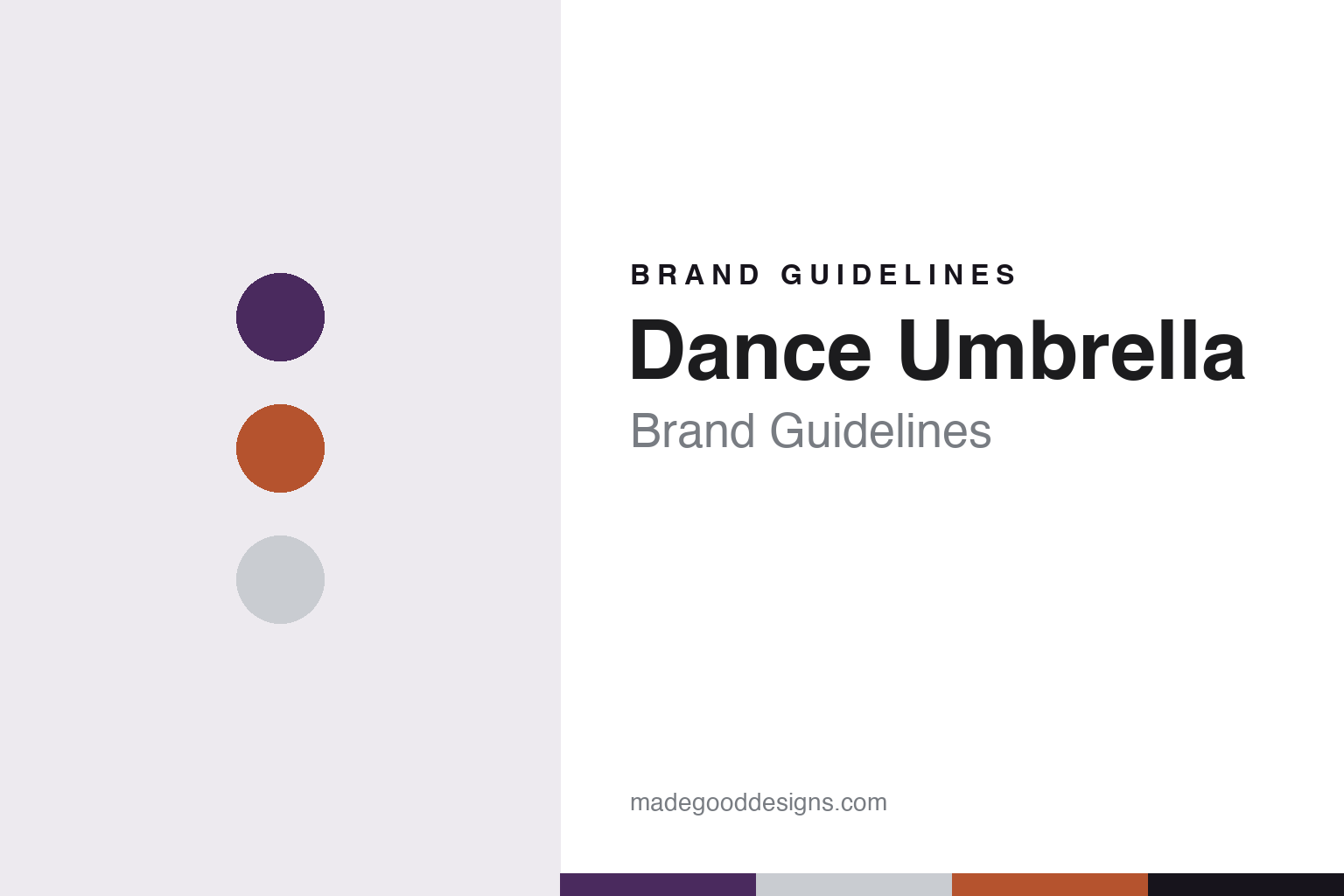
Dance Umbrella Brand Guidelines
London’s October dance festival, spread across the city since 1978.
Aa
Two constants: a plum, rust and river-grey palette and a city-wide sans register. Abstract homage — not a Dance Umbrella poster or mark; no logo or campaign image is reproduced.
A festival borrowed from New York
Five months, twelve companies and a name taken from across the Atlantic.
Dance Umbrella is an annual festival of modern and contemporary dance held in London each October. English Wikipedia names its founders as Val Bourne and Jeremy Alliger and dates the first festival to 1978. The organisation calls itself London’s international dance festival on its website, where it is also listed as a registered charity.
Bourne gave her own account of the beginning in an interview recorded in Tokyo in July 2005 and published that September by the Japan Foundation’s Performing Arts Network Japan. As a junior officer at the Arts Council she had written a proposal for a London festival to show British choreographers working in small companies. By the time the proposal was accepted she had moved to Greater London Arts, and she said the team then had five months to put a festival together. It opened in November 1978, and she said that first edition presented twelve British companies and four soloists.
The name was borrowed, Bourne said. A festival called Dance Umbrella was already being run in New York by the Technical Assistance Group, which worked with an arts-management non-profit that represented composers and choreographers, and the London organisers took the name after hearing about it. The London festival was meant to happen once. A second followed in 1980, after about fifteen months of preparation, and a third in the autumn of 1981, by which time Dance Umbrella had become independent of Greater London Arts.
For its first eight years, until 1988, the organisation also ran a management service, representing four or five dance companies and artists at a time alongside the annual festival, Bourne told the interviewer; from 1995 it usually organised one large-scale tour a year. She led the festival from 1978 to 2006, according to ResCen, the Middlesex University research centre that documented the 40th-anniversary festival with Dance Umbrella in 2018. Two directors followed her, one from 2007 to 2013 and one from 2014, and ResCen noted in March 2021 that all three had been women and former dancers.
Colour
No building, many stages.
Dance Umbrella has never had a theatre of its own. In the 2005 interview Bourne said the festival had never wanted to be tied to one building: a large production could go to Sadler’s Wells, a solo to The Place, and another show to the Barbican Theatre if that suited the work. The drawback, she said, was having no control over the box office. English Wikipedia lists the Queen Elizabeth Hall, The Place, Battersea Arts Centre and the Barbican Theatre among the venues the festival has used.
The festival has also worked outside theatres. Bourne listed the Natural History Museum, the floor of the British Library, the National Sports Centre at Crystal Palace and Tate Modern as places where it had staged work, and said such sites brought in people who did not usually go to the theatre. In 2005 she described a new strand called Brief Encounter: short pieces in the Lilian Baylis Studio at Sadler’s Wells, a 150-seat room in the same building, timed so that people could see one before the main-house show. She put the 2004 festival audience at 39,000.
The spread continued under later directors. When the 2014 programme was announced in May that year, the British Theatre Guide reported a festival running from 14 to 31 October across fourteen venues in sixteen days. It listed ice skating by a Canadian collective at Alexandra Palace, flamenco at the Barbican, a hip hop show at the Young Vic, and performances at Sadler’s Wells, the Shaw Theatre and the Southbank Centre, along with shows for babies and year-round digital projects.
The festival’s own past-festivals page records the recent editions. In 2020, its 42nd year, the festival moved online as Dance Umbrella Digital, with conversations, workshops and films; in 2021 it presented a hybrid edition with events both in person and online. Its notes for 2023 mark ten years of Orbital, a touring network that takes work to young audiences, and describe the 2024 festival as its 46th and its fourth online.
Typography
How dance festivals present themselves.
Dance festivals usually name themselves in one of a few plain ways. Some join a place to the word for dance, as Montpellier Danse and Tanz im August do; some add the word “festival,” as the American Dance Festival and the Holland Dance Festival do; and some use a coined or borrowed name, such as ImPulsTanz, Julidans or Jacob’s Pillow, which takes its name from a rock on a Massachusetts farm.
Their calendars are just as recognisable. Many run for a few weeks in summer, as Jacob’s Pillow does in the Berkshire hills and the American Dance Festival does in Durham, North Carolina; others fill the autumn, and a biennale, as its name says, comes round every second year. Festivals are run by their own organisations rather than by the companies that perform in them: Jacob’s Pillow has its own board, and it was the American Dance Festival’s board that accepted the bid to move the festival to Duke University in 1978.
Their programmes tend to mix invited companies with teaching. The American Dance Festival runs its summer school alongside its performances, as it has done in some form since its Bennington summers of the 1930s, and Jacob’s Pillow keeps a school, an archive and residencies on the same hilltop as its stages. Performances move between theatres, studios, outdoor stages and city sites, from a free outdoor stage facing the hills to a site-specific work staged in a downtown office tower.
Visually, a festival often renews itself each edition, with a new poster, campaign image or photograph of movement, while the name and the place stay fixed. This guide sets out what can be documented about each festival — when it began, who runs it, where it happens and how it describes its programme — and treats the colours and type shown here as an unofficial interpretation, not the festival’s own identity.
Aa
A clean, open sans for a festival spread across many venues. (Specimen set in Archivo, a sans STAND-IN; NOT the Dance Umbrella logo.)
Dance Umbrella
A name, a month and a map of venues.
In February 2021 Dance Umbrella appointed Freddie Opoku-Addaie as artistic director and chief executive, the British Theatre Guide reported on 19 February 2021, describing him as only the fourth person to hold the post in 43 years. The report described him as an East London-born choreographer, dancer, curator and teacher who had been the festival’s guest programmer during a three-year initiative from 2016 to 2019; he started part-time in March 2021 and full-time from May. ResCen had earlier noted his role as guest curator of the festival’s Out of the System programme. The festival’s own notes call 2022 its 44th festival and his first as artistic director.
The website now lists him as Artistic Director and Co-CEO, sharing the leadership with an Executive Director and Co-CEO. It describes the organisation as a commissioner of new work that co-produces with partners in the UK and abroad, and says that alongside the October festival it runs a curated online programme of dance films, talks and artist encounters. The online programme for the 2026 festival was listed from 7 October to 30 November 2026, and the festival’s news page that October introduced a work by a Dutch choreographer at The Place.
The name is the oldest constant. Bourne said in 2005 that the festival had carried it from the start, borrowed from a New York series, and it has stayed with a festival that moves between theatres, museums, parks and screens from year to year. Over the years its venue lists, as Bourne and later reports gave them, have joined large stages such as Sadler’s Wells and the Barbican, smaller rooms such as The Place, and buildings not made for dance, such as the Natural History Museum, the British Library and Alexandra Palace.
For a design guide, Dance Umbrella shows how a festival with no building can hold its identity in a name, a month and a spread of venues across one city. Compare Sadler’s Wells, one of the London stages it has used, and Julidans, a summer dance festival that also spreads across a city. For this guide we use a deep plum, an October rust and a cool river grey with a sans, an unofficial interpretation; no product or logo is reproduced.
Explore & save
Keep Dance Umbrella’s identity on hand — save it to a board in the Made Good inspiration library.
Dance Umbrella identity set
Pin the Dance Umbrella plum, rust and river-grey palette and the city-wide sans register to your own board.
Source & notes
Frequently Asked Questions
What font can I use to match the Dance Umbrella look?
This guide describes Dance Umbrella’s type as “A clean, open sans for a festival spread across many venues”. Its type specimen is set in Archivo from Google Fonts as a stand-in; Archivo is not Dance Umbrella’s own lettering.
What colours are in the Dance Umbrella palette?
This guide’s Dance Umbrella palette is Umbrella plum #4A2A5E, Night ink #17141C, October rust #B5532E, Thames grey #C9CCD1 and Programme paper #F6F4F0. The tones are the guide’s own unofficial interpretation, not official Dance Umbrella hex codes.
When was Dance Umbrella founded?
Dance Umbrella was founded in 1978, in London, UK.
Who founded Dance Umbrella?
Dance Umbrella was founded by Val Bourne and Jeremy Alliger in 1978.