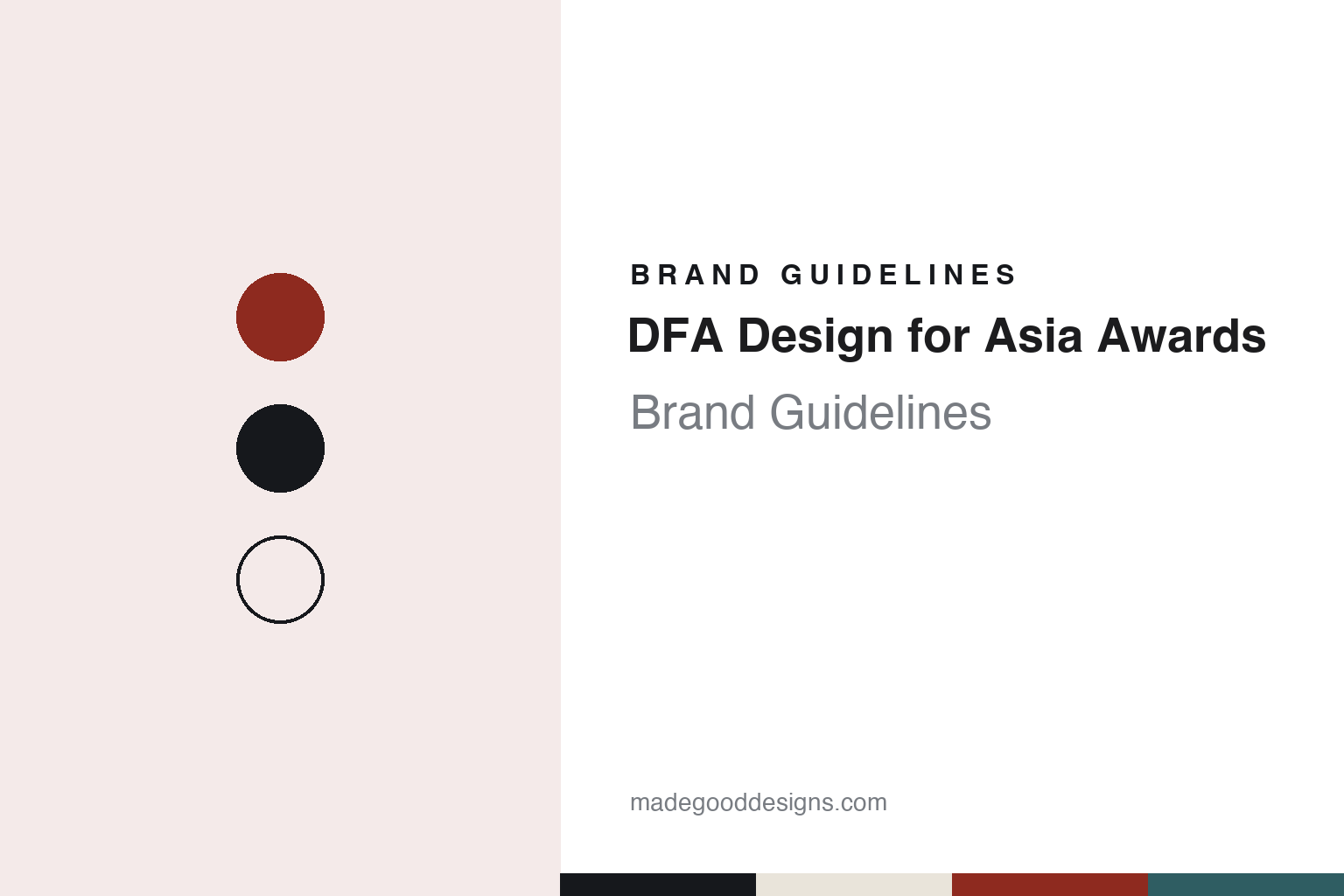
DFA Design for Asia Awards Brand Guidelines
Hong Kong Design Centre’s awards for design with an Asian perspective.
Aa
Two constants: an ink, red and jade palette and a grotesque sans register. Abstract homage — not a DFA Design for Asia Awards mark; no logo, trophy or endorsement mark is reproduced.
Design for Asia
A design centre’s awards, launched in 2003.
The DFA Design for Asia Awards are run by Hong Kong Design Centre (HKDC), which calls the programme its flagship. The organiser dates the awards to 2003, and two independent reports agree: Indesign Live wrote in December 2012 that HKDC had run the programme, then known as the Design for Asia (DFA) Award, since 2003, and Wallpaper* marked its tenth anniversary the same year.
Wallpaper*, writing in December 2012, described HKDC as a publicly funded, non-profit organisation established in 2001 with the support of the design industry. HKDC describes itself today as a strategic partner of the Hong Kong SAR Government in using design to create value. Its own list of flagship programmes places the awards between two other annual events: Business of Design Week, which it dates to 2002, and Knowledge of Design Week, from 2006. The organiser’s 2026 announcement names the Cultural and Creative Industries Development Agency, under the Culture, Sports and Tourism Bureau of the HKSAR Government, as lead sponsor.
The focus of the awards has shifted over time. According to Wallpaper*, the programme began in 2003 by selecting innovative brands available in the region, to identify what it called good design in Asia; it then turned towards homegrown talent, and later towards the particular qualities of Asian design, from mobile phones and websites to low-cost bridges for rural areas. The same report gave the number of entries as about 130 in 2003 and more than 800 in 2012.
For some years the awards sat under an HKDC umbrella name. A news item from the International Council of Design (ICoD), dated December 2008, reported that HKDC had announced the results of the HKDC Design for Asia (DFA) Award on 12 December 2008, alongside its other programmes, at the HKDC Annual Award Gala Dinner, and that 633 entries had been received that year. The current name, DFA Design for Asia Awards, is the one the organiser uses on its website today.
Colour
Six disciplines, five levels, two rounds.
The programme is organised by discipline. HKDC lists six: Communication Design; Digital & Motion Design; Fashion & Accessory Design; Product & Industrial Design; Service & Experience Design; and Spatial Design. Under them sit 30 categories, according to the organiser. Communication Design, for example, covers identity and branding, packaging, publications, posters, typography and marketing campaigns; Digital & Motion Design covers websites, apps, user interfaces, games and video; and Spatial Design runs from homes to hospitality, workspaces, public spaces and exhibitions.
There are five award levels: the Grand Award, Gold Award, Silver Award, Bronze Award and Merit Award. HKDC says entries are judged in two rounds. Silver, Bronze and Merit awards are decided in the opening round on design excellence, and the Grand and Gold awards go to finalists after the final round. The organiser lists its judging criteria as creativity and human-centric innovation, usability, aesthetics, sustainability, impact in Asia, and commercial and societal success. It describes its judges as design professionals with experience of Asian design and of other international design awards.
The 2026 cycle shows how the year runs. HKDC reported on 31 July 2026 that the Category Award judging had ended, with eighteen international judges meeting in Hong Kong across the six disciplines. On 13 August it reported the end of the Grand Award judging, and on 15 October it published the 2026 results: a panel of 26 judges had selected 209 winning projects from entries across 15 economies, the organiser says. HKDC adds that since 2003 the programme has given around 3,300 awards to projects from more than 40 economies.
Earlier editions were tied more closely to a single week. In 2012, Indesign Live reported that HKDC announced the results each year during the Business of Design Week conference, and that the 2012 presentation took place at the Hong Kong Convention and Exhibition Centre, with Grand Awards, three Special Awards for culture, sustainability and technology, and gold, silver, bronze and merit recognitions.
Typography
Design awards and competitions.
Design awards and competitions usually present themselves through a short name and a single sign. Some reduce the name to an acronym or a pair of letters; others rely on a colour or a simple shape. That sign is often carried by a label that winners may print on products, packaging and their own marketing, and sometimes by a named trophy or sculpture handed over at a ceremony.
The organisations behind them vary. Some programmes are run by design councils or design centres, some by foundations or the companies they own, and some grew out of trade fairs, where a special exhibition of well-made goods turned into a yearly selection. Others are run by professional societies of designers or by design publications, and a single organiser may keep several sister programmes for students, concepts or particular disciplines next to its main award.
Most follow a yearly cycle. Entries open for a set period, juries of designers, teachers and specialist writers meet to judge them, often in several rounds and at more than one level of award, and the results are presented at a ceremony or festival. The awarded work then lives on in exhibitions, yearbooks, museums or online archives, which become a record of what each year’s juries selected.
Their disciplines range from product and industrial design to packaging, communication design, interiors, architecture, digital interfaces and unbuilt concepts. This guide describes each programme on its own terms — who founded it, who runs it, how the cycle works and how its name and mark are shown — without ranking the programmes or naming the work they have recognised.
Aa
A grotesque sans — for a programme that signs off with an endorsement mark. (Specimen set in Archivo, a sans STAND-IN; NOT the DFA Design for Asia Awards logo.)
The DFA Awards
One programme in a family of seven.
The DFA Design for Asia Awards are one part of a wider family that HKDC presents as the DFA Awards. Its website lists seven programmes: the DFA Lifetime Achievement Award, the DFA Design Leadership Award, DFA World’s Outstanding Chinese Designer, DFA Designer of the Year, DFA Asian Design Vanguard, the DFA Design for Asia Awards and the DFA Hong Kong Young Design Talent Award. In HKDC’s description, most of these recognise people, from business leaders who use design to young Hong Kong designers given support to work or study overseas, while the Design for Asia Awards are the one open to design projects.
The shared prefix does most of the identity work. Each programme has its own short code on the organiser’s website, such as DFA DFAA for the Design for Asia Awards, and each sits on its own subdomain under the DFA Awards name. HKDC says winning projects may use the DFA DFAA Endorsement Mark, and that they are shown through exhibitions, the DFA Awards Online Showcase and an official Awards Publication, as well as at a Presentation Ceremony. The organiser does not publish the design history of the mark or a colour code, and our colours here are our own.
For a design guide, the DFA Design for Asia Awards show how a design centre can build a recognisable family of awards around one short prefix, with a five-level ladder and a regional focus written into the name. Compare the Golden Pin Design Award, run in Taiwan, and Japan’s Good Design Award. For this guide we use a deep ink, a lacquer red and a jade grey with a sans, an unofficial interpretation; no product or logo is reproduced.
Explore & save
Keep DFA Design for Asia Awards’s identity on hand — save it to a board in the Made Good inspiration library.
DFA Design for Asia Awards identity set
Pin the ink, lacquer red and jade palette and the grotesque sans register to your own board.
Source & notes
Frequently Asked Questions
What font can I use to match the DFA Design for Asia Awards look?
This guide describes DFA Design for Asia Awards’ type as “A grotesque sans — for a programme that signs off with an endorsement mark”. Its type specimen is set in Archivo from Google Fonts as a stand-in; Archivo is not DFA Design for Asia Awards’ own lettering.
What colours are in the DFA Design for Asia Awards palette?
This guide’s DFA Design for Asia Awards palette is Harbour ink #16181C, Lacquer red #8E2A1F, Jade grey #2F5D62, Rice paper #E9E4DA and Paper #F7F5F0. The tones are the guide’s own unofficial interpretation, not official DFA Design for Asia Awards hex codes.
When was DFA Design for Asia Awards launched?
DFA Design for Asia Awards was launched in 2003, in Hong Kong.