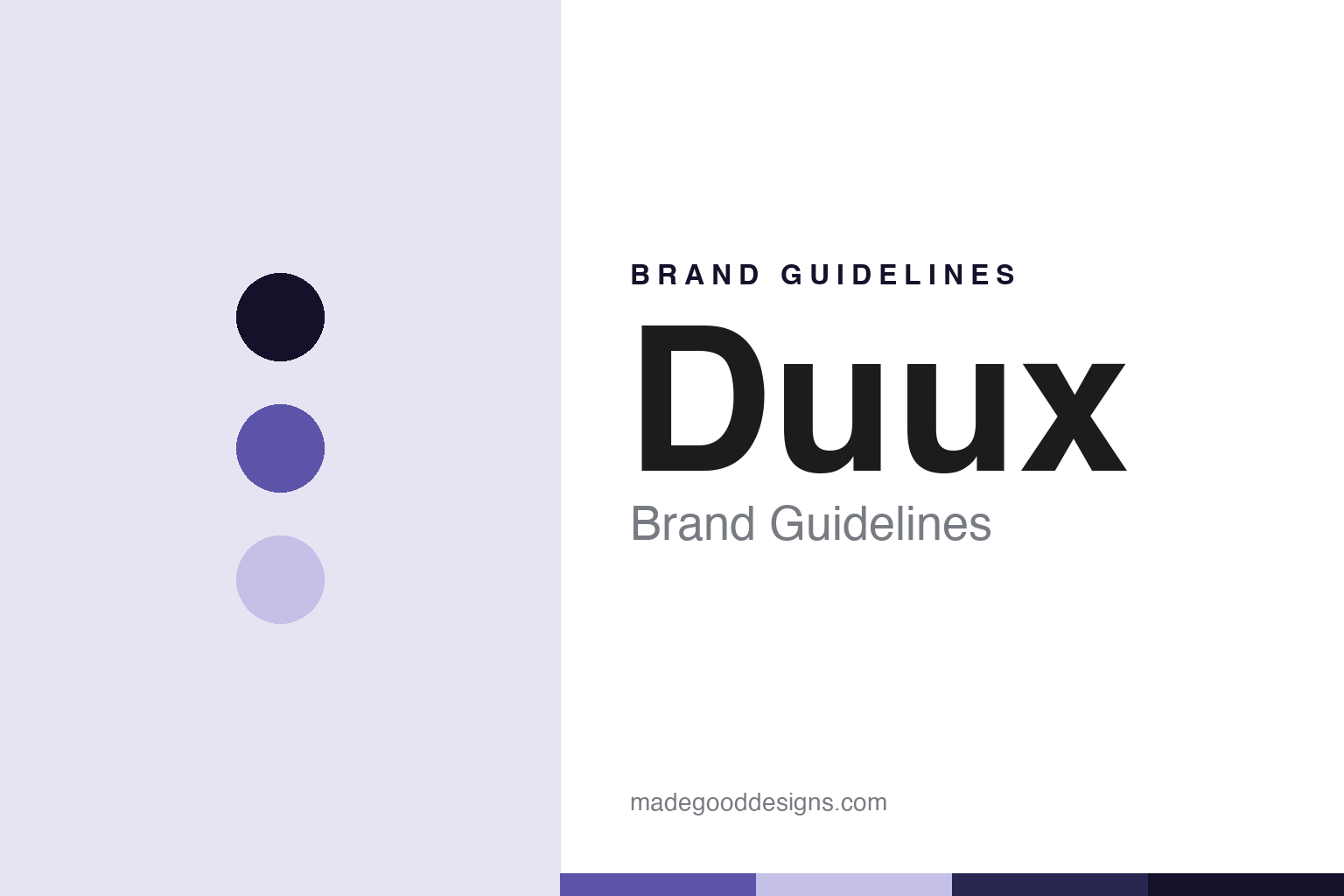
Duux Brand Guidelines
Dutch design, the maker untold.
Aa
Two constants: a modern-indigo palette and a Dutch-sans register. Abstract homage — not a Duux product or mark; no fan, windmill-sail or logo is reproduced.
Dutch design, the maker untold
Duux is the Dutch air-treatment brand with a windmill-sail mark and an iF-Design-winning heater — whose founding and ownership are not on the public record.
Duux follows Meaco as the round’s honesty-test node — a Dutch design brand with a distinctive mark and an award-winning product, whose founding year, founder and owner are simply not on the public record, so its guide reports what can and cannot be verified. Its answer to a round about who owns the fans and where they are made is a candid one: a Dutch company whose design story is clear and whose ownership and making are not.
Its identity is Dutch design, the maker untold. The clear Dutch-design story and the genuinely undocumented ownership are the story here. Verified where it can be. Dutch design, the maker untold.
(Honest notes, so what is known is stated and what is not is hedged rather than guessed. Duux sells air-treatment products as its heroes — the Whisper Flex and Whisper Flex Smart standing fans and the Threesixty smart ceramic fan heater; we report its language as the brand’s own. On origin: this is the hedge — the founding year is inconsistent across business databases, variously given as the 1990s or 2000s, and the company’s own site says only that it has been creating comfort for more than twenty years, so we do not assert a year, and we could not verify a founder name or a founding city, so we name neither. On headquarters: the Netherlands is confirmed, with the city reported as Uden by aggregators rather than by Duux’s own site, so we hedge the city. On ownership, the central honest point: the legal entity is Duux BV, a Dutch private company, but the ultimate owner is not publicly documented; a Danish company, F&H Group, publishes a Duux brand page but describes itself as a multi-brand distributor and does not list Duux among its owned brands, so F&H appears to be a Scandinavian distributor rather than the owner, and we say the ownership is not publicly documented rather than claim it is independent or owned by anyone. On where it is made: Duux markets Dutch design, and design in the Netherlands is credible, but the manufacturing location is not stated and we could not verify it, so we describe making as reported to be in Asia at most, and otherwise leave it open. On recognition: the Threesixty heater is an iF Design Award winner, verified, and several Whisper Flex fans carry the third-party Quiet Mark; we do not attribute a Red Dot to Duux, since a similarly-described Red Dot tower fan belongs to a different, Chinese company. Its designs, the Duux name and the windmill-sail mark are IP we describe but do not reproduce; there is no official brand hex; these tones are an unofficial interpretation.)
Colour
Duux lives in a modern indigo. Click a swatch to copy the hex.
Duux’s identity is design-clear, ownership-untold and Asia-made-as-reported — a modern indigo, an ink, a pale indigo, a deep indigo, and a paper. The palette leans modern indigo and pale indigo: a cool, contemporary register that nods to a clean Dutch-design language rather than a loud logo colour. It signals Dutch design, the maker untold — design-clear, ownership-untold and Asia-made-as-reported. The honest caveat: with no official brand hex, these values are a contemporary, unofficial interpretation, not first-party colours.
The lesson is a modern indigo signals a clean, contemporary identity. Duux’s world is the well-designed comfort appliance. For designers, it is a reminder that a cool indigo and a pale indigo can carry a modern, design-led brand — a contemporary tone held as an accent, not a product shot. Because a mid hue can fail as small text, keep type dark and let the colour live in the accents, palette and band. The takeaways: state the Netherlands and hedge the city as reported; do not assert a founding year, founder or owner that is not documented; keep F&H as a distributor, not the owner; treat the making as reported; credit the verified iF Design Award and Quiet Mark; and do not attribute a Red Dot to Duux.
Typography
The register is a Dutch sans — design-clear, ownership-untold, Asia-made-as-reported.
Duux’s identity carries a design-clear, ownership-untold, Asia-made-as-reported spirit — a clear design story over an unclear public record. A Dutch sans captures the mood: clean, modern and neutral, the register of a contemporary design brand. Set in a modern-indigo palette, the Dutch sans feels calm and current — exactly the personality Duux carries. It behaves like a made, considered thing rather than a loud logo, mirroring a spiral-sweep and an airflow-arc. (Duux’s real products, the name and the windmill-sail mark are things we describe but do not reproduce, and the exact typeface is not ours to use.) Because it is not ours to use, the honest description is “a Dutch-sans brand,” shown here in a stand-in. The type behaves like the brand: design-clear, ownership-untold and Asia-made-as-reported.
Aa
A Dutch-sans brand — calm and current. (Specimen set in Sora, a Dutch-sans STAND-IN; NOT the Duux logo, windmill-sail mark or products.)
The air-circulation node
Duux stands for Dutch design, the maker untold.
Duux sits sixth in the round as its honesty-test node. A modern-indigo palette, a Dutch sans and a clear design story make one thing — Dutch design, the maker untold — the whole identity: design-clear, ownership-untold and Asia-made-as-reported. The Dutch-design story is the pitch, the undocumented ownership is the turn, and the careful hedging is the point. The point is a brand whose design is legible and whose corporate record is not, in a round about who owns the fans and where they are made.
Put to work, the identity is the brand told straight, the gaps hedged and the record respected. A brand in this spirit would state the Netherlands and hedge the city, decline to assert a founding year, founder or owner it cannot document, keep F&H as a distributor rather than the owner, treat the making as reported, and credit only the verified honours. A reader in this spirit would keep the facts right: Duux sells the Whisper Flex fans and the Threesixty ceramic heater; it is a Dutch company, Duux BV, headquartered in the Netherlands, with the city reported as Uden; its founding year, founder and ultimate owner are not publicly documented; its making is not officially stated; and its Threesixty heater has won an iF Design Award while several fans carry the Quiet Mark, with no Red Dot attributable to Duux. Duux sits after Meaco and before Rowenta. The honest editorial moves are to state what is known, to hedge what is not, to keep the distributor distinct, and to credit only verified honours.
For designers and brand-builders, Duux carries the air-circulation node: report the record honestly — say what you cannot verify. The lessons: a brand can have a clear design language and an unclear corporate record, here Duux’s legible Dutch design against undocumented ownership; a founding is left undated because the sources conflict and the company only says more than twenty years; a founder and city are not named because they are not documented, with Uden hedged as reported; an ownership is described as not publicly documented, with F&H kept as a distributor rather than the owner; a making is treated as reported rather than asserted; and only verified honours are credited, the iF Design Award and the Quiet Mark, with a Red Dot explicitly not attributed to Duux because it belongs to a different company. It is also a reminder to stay precise: Duux is the Dutch-designed air-treatment brand whose ownership and making are not on the public record — with the palette here an unofficial interpretation and the windmill-sail mark never reproduced. The hook is that candour: Duux is the round’s honesty test, a design brand whose founding year, founder and owner are simply not public, so the guide reports what it can and flags what it cannot. Read that way, Duux is less a single fan than Dutch design, the maker untold: design-clear, ownership-untold, Asia-made-as-reported. The lesson for a brand is that stating what is known and flagging what is not reinforce each other, and refusing to guess keeps the story honest. Duux made Dutch-design-the-maker-untold the identity — proof that honest hedging can anchor a node.
Explore & save
Keep Duux’s identity on hand — save it to a board in the Made Good inspiration library.
Duux identity set
Pin the modern-indigo palette and the Dutch-sans register to your own board.


