E.C. Emmerich Brand Guidelines
The wooden plane.
Aa
Two constants: a hornbeam palette and a heritage-sans register. Abstract homage — not an E.C. Emmerich plane or mark.
The wooden plane
E.C. Emmerich is the German maker of traditional wooden-bodied hand planes, founded in Remscheid in 1852 and still family-owned, home of the Primus adjustable plane.
E.C. Emmerich — ECE — is the round’s wooden-plane house, still making traditional wooden planes in a metal-plane age. From Remscheid, the German tool town, it makes wooden-bodied hand planes, including its famous Primus adjustable planes, plus saws, gauges, mallets and workbenches. Its answer to how a maker becomes a name is continuity of a craft: keep making the wooden plane, well, in Germany, for five generations. A German wooden plane, made in Remscheid.
Its identity is the wooden plane. ECE’s made-in-Germany craft, its wooden planes and its family continuity are the work it is known for. A plane, made in Remscheid. A wooden tool kept alive by one family.
(Honest notes, so the story stays precise. E.C. Emmerich — E.C. Emmerich Werkzeugfabrik — was founded in 1852 by Friedrich-Wilhelm Emmerich, a master joiner, in Remscheid, Germany; the initials “E.C.” are the historic house mark rather than the founder’s initials, which is why we do not present them as his name. On what it makes, wooden-bodied hand planes are the flagship, including the Primus adjustable plane invented in 1952 by Karl Emmerich, with its zero-play adjustment — a neat symmetry, founded 1852, Primus 1952. On materials, the classic ECE plane has a hornbeam body with a beech or harder lignum-vitae sole, which we attribute as the standard construction rather than a per-model quote. On where it is made — a theme of this round — the planes are made in Germany, in Remscheid, in a largely manual tradition; genuinely German-made. On ownership, it is an independent, family-owned company, led in the fifth generation by Hans-Jörg Emmerich since 1998. Importantly, ECE is a separate company from Two Cherries — Kirschen, Wilh. Schmitt & Comp. — another Remscheid firm it is often confused with; ECE makes wooden planes, and we keep them distinct. Its name and marks are IP, described but never reproduced, and there is no official brand hex; these tones are an unofficial interpretation. This is design commentary and does not promote any product.)
Colour
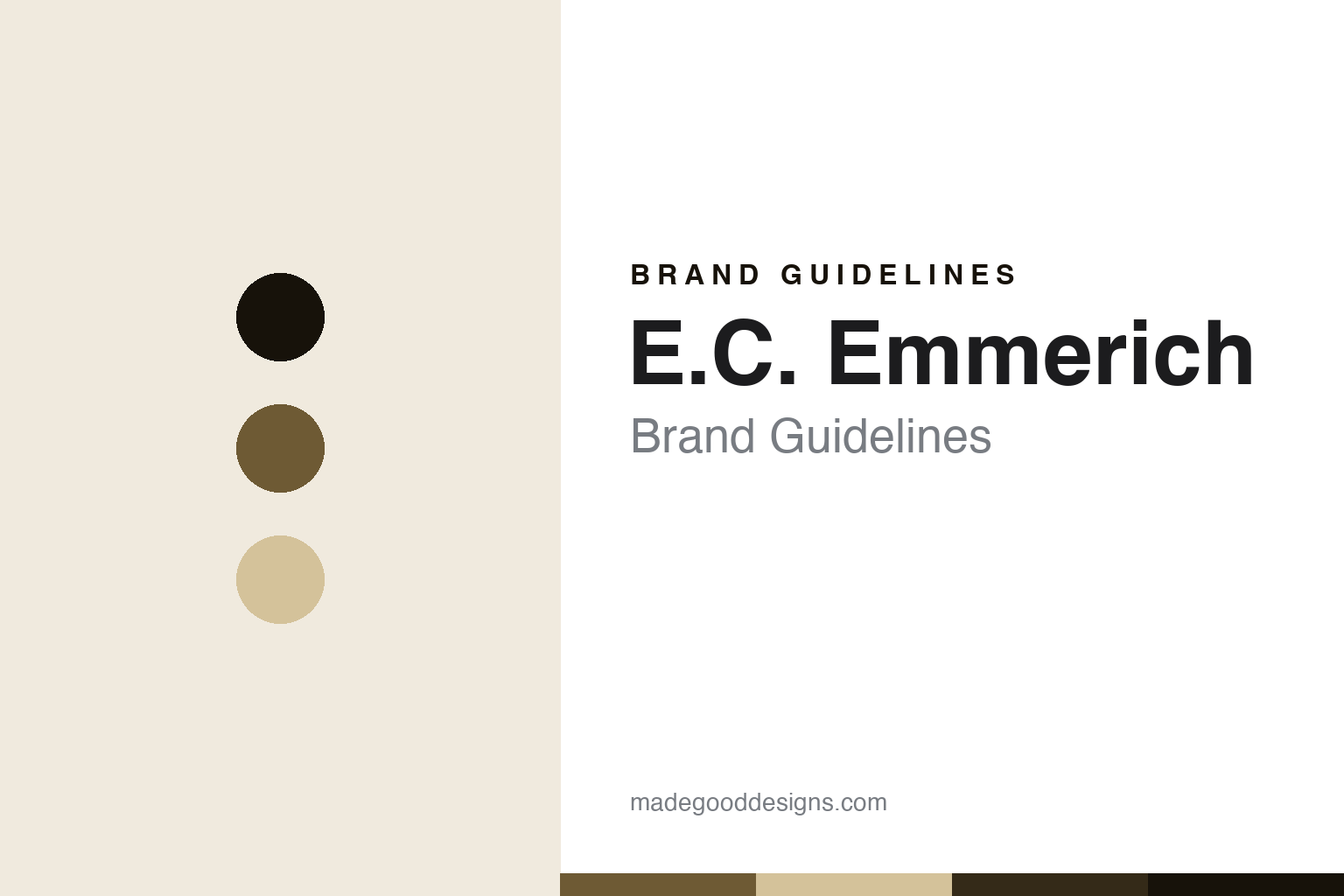
E.C. Emmerich lives in a hornbeam palette. Click a swatch to copy the hex.
ECE’s identity is wooden, German and old — a hornbeam, an ink, a pale wood, a deep timber, and a paper. The palette leans hornbeam and pale wood: the register of a hornbeam plane body and a pale wooden sole. It signals a wooden craft kept alive. The honest caveat: with no published brand hex, these values are an original, unofficial interpretation, not first-party colours.
The lesson is a hornbeam palette signals a wooden, made-in-Germany identity. ECE’s world is a wooden, German object. For designers, it is a reminder that a warm hornbeam and a pale wood can carry a maker built on wooden planes — the tan of hornbeam and the neutral of a beech sole. Because these tones can fail as small text, keep type dark and let the colour live in the accents, palette and band. The takeaways: keep the craft; make it at home; keep the family; and treat any single hex as unofficial.
Typography
The register is a heritage sans — plain, warm, old.
ECE’s identity carries a plain, warm, old spirit — a family wooden-plane house, not a fashion label. A heritage sans captures the mood: even, warm and steady, the register of a Remscheid workshop. Set in a hornbeam palette, the heritage sans feels warm and old — exactly the personality ECE carries. It is family continuity rather than a logo, mirroring a wooden plane. (ECE’s real wordmark and the Primus body shape are things we describe but do not reproduce, and the exact typeface is not ours to use.) Because it is not ours to use, the honest description is “a heritage-sans spirit,” shown here in a stand-in. The type behaves like the house: plain, warm and old.
Aa
A heritage-sans spirit — warm and old. (Specimen set in Libre Franklin, a heritage-sans STAND-IN; NOT the E.C. Emmerich logo or Primus shape.)
The old toolmakers
E.C. Emmerich stands for the wooden plane, kept alive by one family since 1852.
E.C. Emmerich is a lesson in how keeping a craft alive can be an identity. A hornbeam palette, a heritage sans and a wooden plane make one thing — the wooden plane — the whole identity: wooden, German and old. The made-in-Germany craft is the differentiator, and the family continuity is the meaning. The point is a house that has kept making the wooden plane, well, in Remscheid, for five generations, in an age that mostly moved to metal.
Put to work, the identity is continuity, honestly told, as design. A house in this spirit would keep the craft, make it at home, and keep the family — wooden planes, the Primus adjustment, made in Remscheid. A brand learning from it would see that keeping a craft alive is a durable identity — that a wooden plane still made and improved by the founding family carries a continuity a revived brand cannot — and that being precise, founded 1852 by Friedrich-Wilhelm Emmerich, Primus invented 1952 by Karl Emmerich, fifth-generation family-owned, keeps the story honest. ECE holds one of the round’s cleanest survivals — an unbroken family line — and it also settles a catch from earlier in this vein: it is the wooden-plane maker often confused with Two Cherries, and here it stands as its own distinct Remscheid house. The discipline is in the caveats: treating “E.C.” as a house mark not the founder’s initials, attributing the hornbeam-and-lignum construction as standard rather than per-model, and keeping ECE and Two Cherries separate. The lesson ECE teaches is that continuity can hold an identity: the Remscheid making gives it substance, and the family line keeps it credible. The continuity is the personality, and the German-made wooden plane is the proof.
For designers and brand-builders, ECE holds the Germany pole in the old toolmakers: keep the craft, and keep the family. The lessons: keep making the old thing well; make at home; be precise about names and marks; keep confusable firms distinct; and never reproduce a logo. It is also a reminder to stay precise: E.C. Emmerich is the German maker of traditional wooden-bodied hand planes, founded in Remscheid in 1852 and still family-owned, home of the Primus adjustable plane — with the palette here an unofficial interpretation. E.C. Emmerich made continuity the identity — proof that a wooden plane kept alive since 1852, honestly told, can be the difference.
Explore & save
Keep E.C. Emmerich’s identity on hand — save it to a board in the Made Good inspiration library.
E.C. Emmerich identity set
Pin the hornbeam palette and the heritage-sans register to your own board.