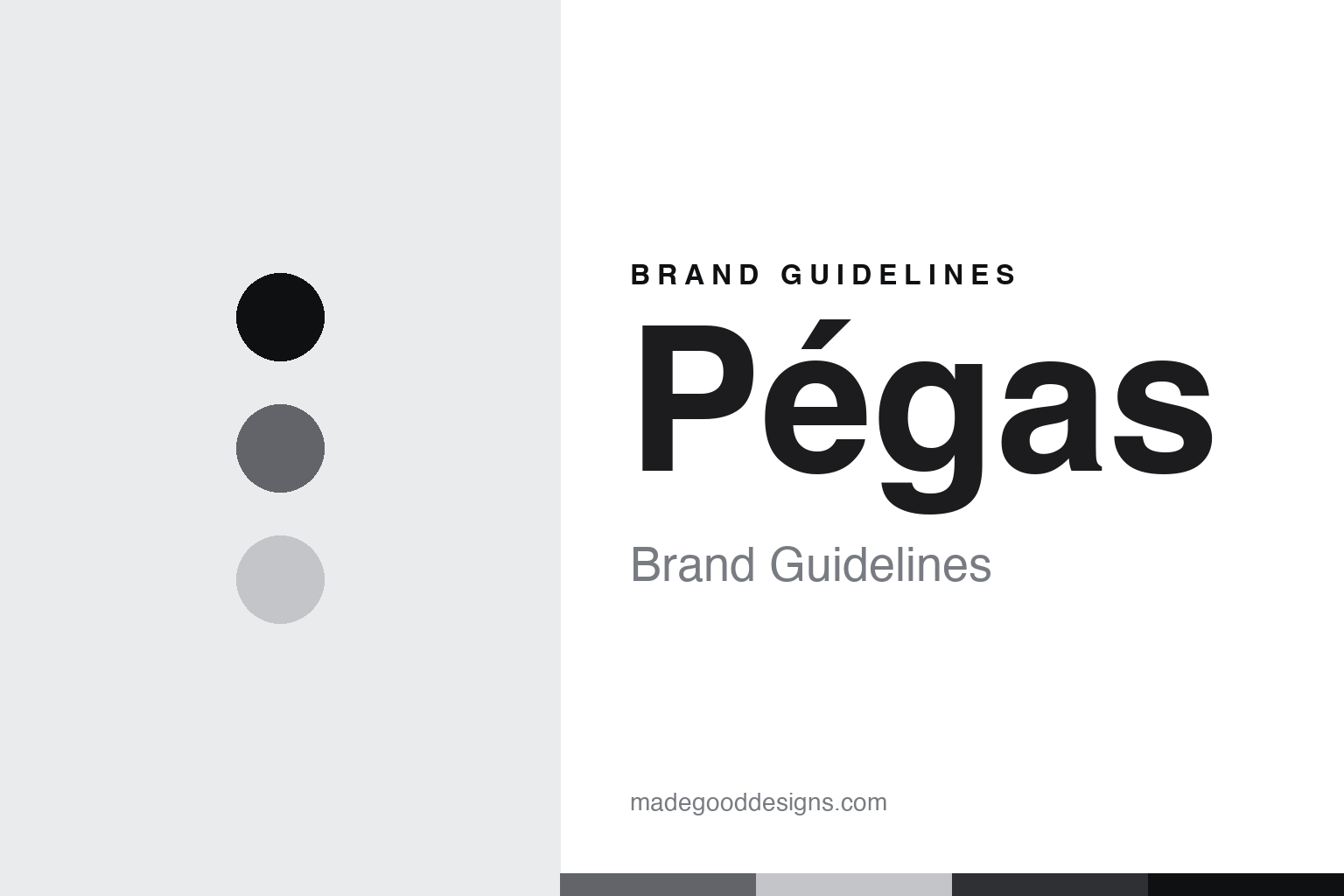
Pégas Brand Guidelines
The Swiss saw blade.
Aa
Two constants: a pewter palette and a precision-sans register. Abstract homage — not a Pégas blade or mark.
The Swiss saw blade
Pégas is the Swiss scroll and jeweller’s saw-blade brand of Scies Miniatures, produced in Vallorbe, Switzerland.
Pégas is the round’s blade maker, the fine saw blade that goes into other people’s frames and machines. From Vallorbe, in the Swiss Jura, Scies Miniatures makes Pégas scroll-saw blades and jeweller’s piercing blades — the thin, precise blades scroll-sawyers, jewellers and marquetry workers cut with. Its answer to how a maker becomes a name is precision steel: cut and set a blade so fine and consistent it becomes the reference. A Swiss blade, made in the Jura.
Its identity is the Swiss saw blade. Pégas’s made-in-Vallorbe precision, its scroll and jeweller’s blades and its Swiss blade-making are the work it is known for. A blade, made in Vallorbe. The consumable other tools cut with.
(Honest notes, so the story stays precise. Pégas is the flagship brand; the manufacturer is Scies Miniatures — a Sàrl, a limited company, not an SA — based in Vallorbe, in the canton of Vaud, with its site at scies.ch. On what it makes, scroll-saw blades in plain-end and pinned ranges, jeweller’s and piercing (fret) blades, saw frames and scroll saws; we describe scroll and jeweller’s blades and do not assert a distinct coping-saw-blade line we could not confirm. On founding, the company states its Swiss sawing expertise dates to 1966, which we present as its own claim rather than an independently verified year. On where it is made — a theme of this round — the blades are produced in Switzerland at the Vallorbe factory, which the company states plainly; genuinely Swiss-made, and central. On a nice thread, Vallorbe is the same Jura file-and-blade town that produced the Swiss files earlier in this vein — a precision-steel town making blades for the world. On ownership, it is an independent Swiss Sàrl, managed by Marc Monferrini; we could not verify the full shareholder structure, so we say independent without more. On the widely-cited reverse-tooth blades, we note them as reported by resellers rather than confirmed on the current site. Its Pégas mark is IP we describe but do not reproduce, and there is no official brand hex; these tones are an unofficial interpretation. This is design commentary and does not promote any product.)
Colour
Pégas lives in a pewter palette. Click a swatch to copy the hex.
Pégas’s identity is precise, Swiss and made — a pewter, an ink, a silver, a deep pewter, and a paper. The palette leans pewter and silver: the register of a fine, cut-and-set saw blade. It signals precision steel. The honest caveat: with no published brand hex, these values are an original, unofficial interpretation, not first-party colours.
The lesson is a pewter palette signals a precise, made-in-Switzerland identity. Pégas’s world is a precise, steel object. For designers, it is a reminder that a cool pewter and a soft silver can carry a blade maker — the grey of fine blade steel and the neutral of a set tooth line. Because these tones can fail as small text, keep type dark and let the colour live in the accents, palette and band. The takeaways: cut the blade precisely; make it in the blade town; keep the consistency; and treat any single hex as unofficial.
Typography
The register is a precision sans — fine, exact, made.
Pégas’s identity carries a fine, exact, made spirit — a precision blade maker, not a lifestyle brand. A precision sans captures the mood: even, exact and quiet, the register of a Vallorbe blade works. Set in a pewter palette, the precision sans feels fine and exact — exactly the personality Pégas carries. It is a precise consumable rather than a logo, mirroring a scroll-saw blade. (Pégas’s real wordmark is a thing we describe but do not reproduce, and the exact typeface is not ours to use.) Because it is not ours to use, the honest description is “a precision-sans spirit,” shown here in a stand-in. The type behaves like the blade: fine, exact and made.
Aa
A precision-sans spirit — fine and made. (Specimen set in Mulish, a precision-sans STAND-IN; NOT the Pégas wordmark.)
The component makers
Pégas stands for the fine Swiss blade other tools cut with.
Pégas is a lesson in how a fine consumable can be an identity. A pewter palette, a precision sans and a scroll-saw blade make one thing — the Swiss saw blade — the whole identity: precise, Swiss and made. The made-in-Vallorbe precision is the differentiator, and the fine, consistent blade is the meaning. The point is a maker of the thin, precise blade that scroll-sawyers, jewellers and marquetry workers fit into their frames and machines — the reference blade for the job.
Put to work, the identity is a precise consumable, honestly told, as design. A maker in this spirit would cut the blade precisely, make it in the town that knows blades, and keep the consistency — scroll and jeweller’s blades, made in Vallorbe. A brand learning from it would see that a fine consumable is a durable identity — that a blade good enough to be the reference carries a trust a generic blade cannot — and that being precise, the Pégas brand of Scies Miniatures, a Swiss Sàrl in Vallorbe, keeps the story honest. Pégas draws one of the round’s nicest threads: Vallorbe again, the same Jura precision-steel town that made the Swiss files earlier in this vein, now making the world’s scroll-saw blades — a place whose identity is fine steel. The honest editorial moves are to correct the company form to a Sàrl, to present 1966 as the company’s claim, to say scroll and jeweller’s blades without inventing a coping-blade line, and to treat the reverse-tooth blades as reseller-reported. The lesson Pégas teaches is that a consumable can hold an identity: the Vallorbe making gives it substance, and the honesty about form and claims keeps it credible. The blade is the personality, and the Swiss-made blade is the proof.
For designers and brand-builders, Pégas holds the Switzerland pole in the component makers: make the fine consumable, in the town that knows it. The lessons: cut it precisely; make in the craft town; present claims as claims; don’t invent a product line; and never reproduce a logo. It is also a reminder to stay precise: Pégas is the Swiss scroll and jeweller’s saw-blade brand of Scies Miniatures, produced in Vallorbe, Switzerland — with the palette here an unofficial interpretation. Pégas made the fine blade the identity — proof that a Swiss saw blade, honestly told, can be the difference.
Explore & save
Keep Pégas’s identity on hand — save it to a board in the Made Good inspiration library.
Pégas identity set
Pin the pewter palette and the precision-sans register to your own board.