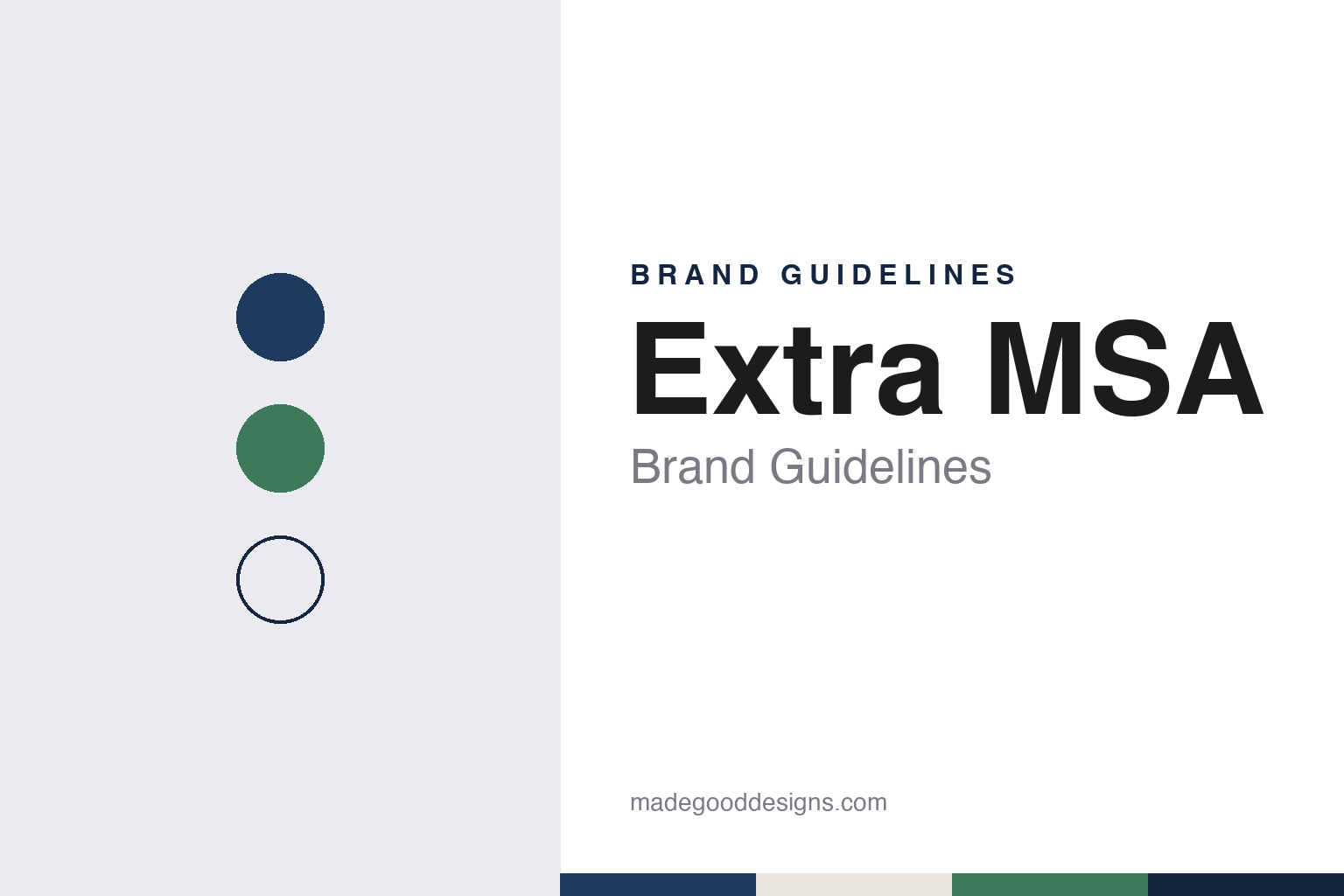
Extra MSA Brand Guidelines
A landlord of the motorway: food courts, forecourts and hotels let to other brands.
Aa
Two constants: an ink blue, lake green and concrete palette and a roadside grotesque register. Abstract homage — not an Extra MSA sign or mark; no logo, fascia or building is reproduced.
Swayfields
A Lincoln developer and a deregulated roadside.
Extra, trading as Extra MSA (the initials stand for motorway service area), is one of the smaller names on England’s motorways, and one of the more unusual. It does not run the restaurants, shops or coffee counters in its buildings. It develops and owns the sites and lets the space to other brands. The Independent described the model in April 2008: unlike Welcome Break and Moto, Extra did not operate as a caterer on any of its sites but let space to long-term tenants, with its filling stations rented by Shell and fast-food chains taking units in the food courts.
The business grew out of a property developer. The Independent reported that Extra was owned by Swayfields, a Lincoln-based developer founded in 1992 by Stephen Spouge and his family. English Wikipedia says the company came into operation after the government deregulated motorway services to encourage competition, and that its first service area opened in December 2000 at Cambridge, on the A14 at the northern end of the M11 route. The operating company that holds Extra’s property was incorporated in January 1999 under an earlier name, Gold Star MSA Forecourts, according to the UK’s Companies House register, which lists its registered office at the company’s Peterborough services site in Cambridgeshire. English Wikipedia says the head office is now at Beaconsfield services, having previously been in the centre of Lincoln.
In April 2008 Swayfields put Extra up for sale through an auction, The Independent reported, with Australian and infrastructure investors among the bidders. Two years later Swayfields itself went into administration while the Cobham scheme on the M25 was being tendered; the administrator, PricewaterhouseCoopers, kept the project going as a valuable asset, New Civil Engineer reported in May 2012. The Extra name and the sites carried on, and the company is now generally described as Extra MSA Group in planning and trade reports.
Colour
Large sites between junctions, and fuel stations beside other operators.
Extra’s reputation rests on a small number of large sites rather than a long list of small ones. English Wikipedia counts eight service areas as of April 2026: Baldock on the A1(M), Beaconsfield on the M40, Blackburn with Darwen on the M65, Cambridge on the A14, Cullompton on the M5, Peterborough on the A1(M), Cobham on the M25 and Leeds Skelton Lake on the M1. It ranks Extra fourth among UK operators by number of locations, behind Moto, Welcome Break and Roadchef. The company’s own website lists ten locations, adding two pairs of fuel stations: Shell stations on each side of the M1 at Tibshelf, next to Roadchef’s services there, and BP stations on the M3 north of Winchester, next to Moto’s.
Beaconsfield opened on 17 March 2009, according to English Wikipedia, which says it was the largest motorway service area in the United Kingdom when it opened. Cobham followed after a long planning history. The BBC reported its opening in September 2012, near junction 10 at Wisley in Surrey, filling a 65-mile gap between service stops on the M25; planning permission had been granted in 2005. Construction Enquirer wrote in May 2016 that Extra MSA Group had developed “two of the largest and busiest new MSAs” on England’s main road network at Cobham and Beaconsfield.
The newest site is Leeds Skelton Lake, at junction 45 of the M1. Leeds City Council granted outline planning permission in January 2017, Construction News reported, for a scheme with a food court, a 100-bed hotel and a visitor centre and viewing space over Skelton Lake. English Wikipedia says the services opened in late March 2020. The company says the building has exposed long-span timber beams under a “living green roof”.
Inside, the brands are other people’s. The company lists tenants including McDonald’s, M&S Simply Food, Starbucks and Greggs, with hotels from Ramada, Days Inn, Travelodge and Ibis Budget, and electric-vehicle charging from Ionity and Gridserve. English Wikipedia notes that several of the outlets at Extra sites, among them M&S Simply Food, Costa and Greggs, are run by Moto, its larger competitor.
Typography
Design and documentation.
A motorway service area or a fuel-and-convenience chain has to be recognised at speed, from a slip road or a forecourt, and then again at the counter. The identities in this group are therefore spread across many surfaces: the roof sign and the forecourt canopy, the store fascia, the cup and the receipt, and a website where the company sets out who it is. The guides that follow look at what each company publishes about itself and what dated independent sources add.
In Britain the operator’s own name often sits above a row of partner brands. Moto’s website lists coffee, bakery, burger and food-hall partners alongside its own name and its own charging brand, Moto CHARGE, launched in 2026; English Wikipedia describes how Welcome Break’s 2006 wordmark set a green word and a white word on black, and how each site was given a mural of a local landmark. The operator’s mark becomes the frame, and the partners fill it.
Food sub-brands, mascots and member programmes carry much of the personality. Some chains put their own name on a food counter, as Welcome Break does with The Good Breakfast, and some gather offers into a named section of a website or an app, as Moto does with My Moto for families, business travellers, coach drivers and HGV drivers. Where a chain uses a mascot or a member programme, the guides describe it as the company presents it.
Ownership is part of the story too. Several of these businesses have passed between caterers, investment funds, pension schemes and fuel retailers, and some carry a different name in a neighbouring market, as Welcome Break’s Northern Ireland sites carry Applegreen’s. Each guide gives owners and site counts only as a dated source states them, and marks clearly what rests on the company’s own word.
Aa
A plain roadside grotesque for signs and fascias. (Specimen set in Archivo, a sans STAND-IN; NOT the Extra MSA logo.)
Extra MSA
More sites in planning, and a sustainability rating.
Extra’s growth has come slowly, through long planning processes. The Birmingham Mail reported in March 2019 that Extra MSA Group had first lodged proposals in 2014 for a service area on the M42 near Birmingham Airport in Solihull; English Wikipedia says the Solihull scheme gained planning permission in 2025. In the north-west, TheBusinessDesk reported in February 2026 that work had officially begun on the group’s Warrington service area at junction 11 of the M62, after the contractors Glencar and Bethell were appointed in November 2025. English Wikipedia also records that Extra withdrew a plan for a site on the M1 at junction 25 in 2020.
English Wikipedia says Extra’s service stations are designed by Nash and Partners, a practice in West Sussex. The company has spent the 2020s refitting older sites: its website says the Cambridge food court and washrooms were fully refurbished in 2022, with an outdoor play area added. In October 2026 the trade title Transport + Energy reported that Extra MSA had received a four-star rating in the 2026 Global Real Estate Sustainability Benchmark infrastructure assessment, and listed its charging partnerships with Gridserve and Ionity and solar panels installed with Spirit Energy at Cobham and Beaconsfield. The company’s own sustainability pages set out three themes, which it calls Energising Journeys, Empowering People and Neutralising Climate Change.
As a brand, Extra is mostly a frame around other brands. Its own name appears on the buildings, the road signs and the website, while the fascias inside belong to the tenants, which makes it a useful case of a landlord identity that has to sit quietly beside louder ones.
For a design guide, Extra MSA shows how an operator can build a recognisable roadside presence while the shopfronts belong to someone else. Compare Moto, the larger operator that runs several of the outlets at Extra sites, and Welcome Break. For this guide we use ink blue, lake green and a pale concrete with a sans, an unofficial interpretation; no product or logo is reproduced.
Explore & save
Keep Extra MSA’s identity on hand — save it to a board in the Made Good inspiration library.
Extra MSA identity set
Save the Extra MSA ink blue, lake green and concrete palette and the roadside grotesque register to your own board.