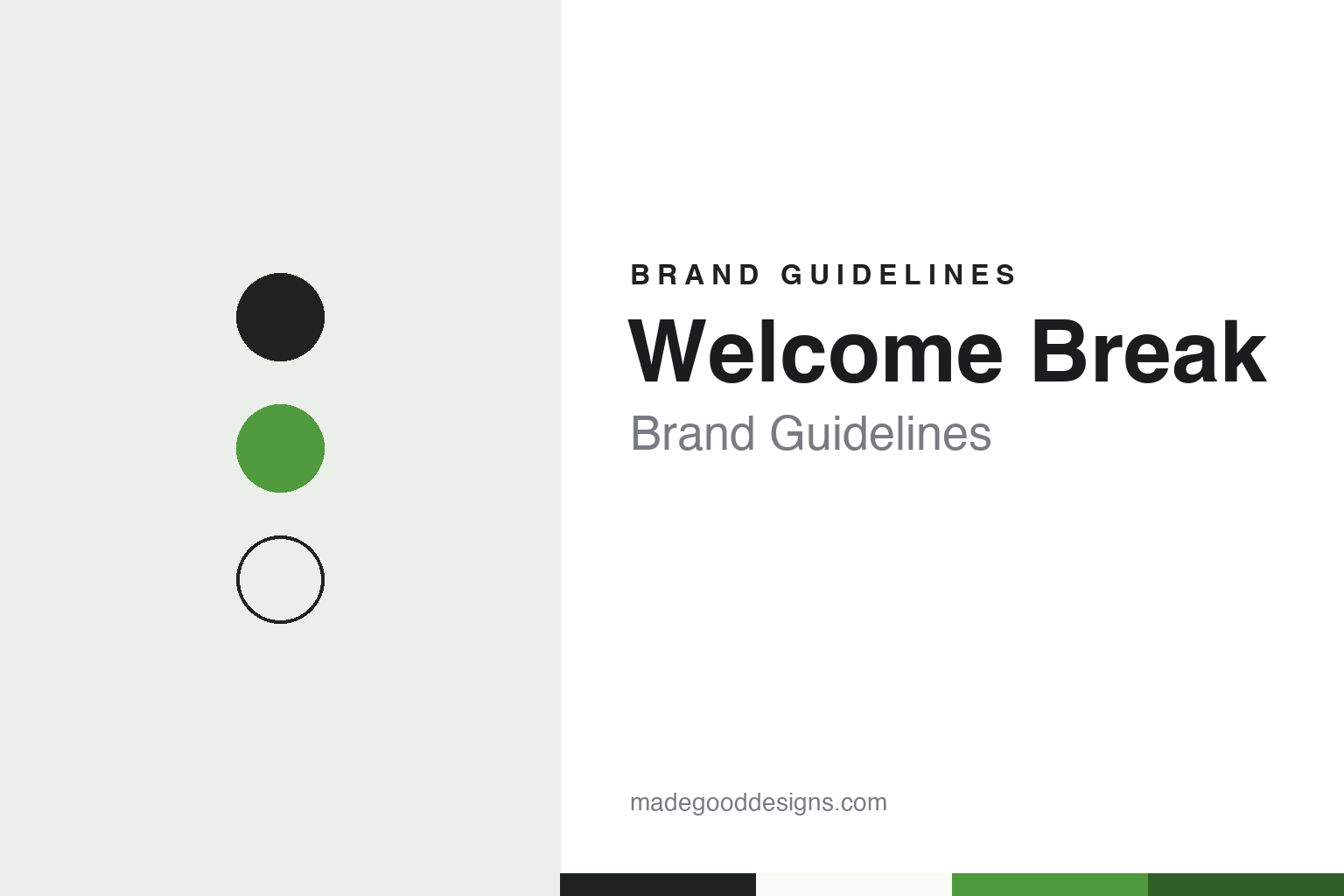
Welcome Break Brand Guidelines
A 1960 café on the new M1 that became a Forte name and an Applegreen arm.
Aa
Two constants: a Welcome Break charcoal, green and white palette and a geometric sans register. Abstract homage — not a Welcome Break product or mark; no logo, sign or mural is reproduced.
Newport Pagnell, 1960
A café beside the new M1.
Welcome Break traces its story to Newport Pagnell on the M1 in Buckinghamshire. BBC News reported in August 2025 that the company was marking 65 years since it opened its first outlet there, in the summer of 1960. In 1959, the BBC said, Motorway Services Ltd, a union of Fortes and Blue Star, won the bid to build and run the services. The northbound café opened on 15 August 1960, and a restaurant called The Grill & Griddle followed two days later, offering table service with a view of the new motorway; a footbridge and the southbound side opened on 30 September.
The name came later. English Wikipedia says “Welcome Break” began as a chain of roadside restaurants set up as a rival to Little Chef, and was revived when the Hanson Trust renamed the service stations of Ross Foods. That small estate, built up under the Imperial Group and then Hanson, was bought by Trusthouse Forte in 1986, and the Welcome Break name was then put on the whole estate, including Trusthouse Forte’s 16 existing service areas, the same source says.
The company register follows the same path. Companies House lists Welcome Break Limited as incorporated on 30 June 1983; it was called Trusthouse Forte Service Areas from 1983 and Forte Welcome Break from 1991, before taking its present name in 1997. Its registered office is in Newport Pagnell, the site where the story began.
Colour
From Forte to Applegreen.
Welcome Break has changed hands several times. English Wikipedia says that after the media group Granada took over Forte in 1996, the Monopolies and Mergers Commission required Granada, which already ran its own motorway services, to sell the Welcome Break sites. The investment firm Investcorp bought the business in 1997 and sold it to Appia Investments in March 2008, the same source says.
In August 2018 the Irish fuel and convenience retailer Applegreen agreed to buy a majority of Welcome Break, according to English Wikipedia. Applegreen, founded in Ireland in 1992, was itself taken private in March 2021; English Wikipedia says it is now majority-owned by the US investment firm Blackstone, with its two co-founders keeping a minority stake.
Applegreen agreed in January 2025 to sell its separate UK filling-station business to EG On The Move, and Fleet World reported the sale completed in February 2025; Welcome Break was not part of it. English Wikipedia says Welcome Break stays with Applegreen as its UK arm.
English Wikipedia puts the network at 35 motorway service stations in England, Scotland and Wales, and describes Welcome Break as the second-largest operator behind Moto. Its Northern Ireland sites, at Ballymena, Hillsborough, Lisburn and Templepatrick, carry the Applegreen name instead, the same source says.
Charging arrived early on the network. English Wikipedia says the energy company Ecotricity announced in July 2011 that it would put electric vehicle chargers at Welcome Break sites between London, Exeter and Edinburgh as part of its Electric Highway; GRIDSERVE bought that network in July 2021 and kept the link with Welcome Break, and by 2024 the sites also hosted chargers from a range of other providers.
Typography
How roadside brands present themselves.
A motorway service area or a fuel-and-convenience chain has to be recognised at speed, from a slip road or a forecourt, and then again at the counter. The identities in this group are therefore spread across many surfaces: the roof sign and the forecourt canopy, the store fascia, the cup and the receipt, and a website where the company sets out who it is. The guides that follow look at what each company publishes about itself and what dated independent sources add.
In Britain the operator’s own name often sits above a row of partner brands. Moto’s website lists coffee, bakery, burger and food-hall partners alongside its own name and its own charging brand, Moto CHARGE, launched in 2026; English Wikipedia describes how Welcome Break’s 2006 wordmark set a green word and a white word on black, and how each site was given a mural of a local landmark. The operator’s mark becomes the frame, and the partners fill it.
Food sub-brands, mascots and member programmes carry much of the personality. Some chains put their own name on a food counter, as Welcome Break does with The Good Breakfast, and some gather offers into a named section of a website or an app, as Moto does with My Moto for families, business travellers, coach drivers and HGV drivers. Where a chain uses a mascot or a member programme, the guides describe it as the company presents it.
Ownership is part of the story too. Several of these businesses have passed between caterers, investment funds, pension schemes and fuel retailers, and some carry a different name in a neighbouring market, as Welcome Break’s Northern Ireland sites carry Applegreen’s. Each guide gives owners and site counts only as a dated source states them, and marks clearly what rests on the company’s own word.
Aa
A clean geometric sans for a two-word name. (Specimen set in Outfit, a sans STAND-IN; NOT the Welcome Break logo.)
Welcome Break
A swan retired, a green word kept.
The visual identity is documented in outline. English Wikipedia says Welcome Break introduced a new logo in September 2006: the swan that had been central to the old logo was removed, and the new mark set the words “welcome” in green and “break” in white on a black background. Each site was given a large mural of a local landmark, many of them commissioned from the artist David Fisher, the same source says. In 2020 the logo was updated to look closer to Applegreen’s.
Inside, the brand works through partners. English Wikipedia says most sites have a WHSmith, first trialled at Newport Pagnell in February 2007, a Starbucks and a food court with names such as Burger King and KFC; Welcome Break is a long-standing KFC licensee, and in 2005 it registered a “Welcome Break KFC” subsidiary to get around rules that then limited the brand names allowed on motorway signs. Waitrose runs franchise stores at most sites, and an own-brand outlet, The Good Breakfast, serves cooked breakfasts. Hotels are mainly Days Inn or Ramada franchises, many of them once branded Welcome Lodge; the last two Welcome Lodges, at Newport Pagnell and Charnock Richard, became Days Inns in May 2009. In September 2012 Welcome Break opened a Days Inn at the new Cobham services on the M25, the same source says.
Fast-food partners have shifted over time. English Wikipedia says a 1995 plan to add a McDonald’s to every site stopped after two outlets when Granada took over Forte, and the last two, at Fleet and Woodall, closed in March 2020; Burger King now operates at almost every site. In 2025 Welcome Break announced a partnership with Chick-fil-A for the Applegreen-branded sites at Lisburn and Templepatrick in Northern Ireland, the same source says.
The first site keeps changing. BBC News reported in 2025 that Newport Pagnell now has a 24-hour service station, showers, 28 fuel pumps and 52 electric vehicle charging points, where in 1960 it had fuel pumps, toilets and one café.
For a design guide, Welcome Break shows how a name can outlast several owners when the wordmark and the welcome stay simple. Compare Moto, the former Granada estate, now the larger network, and Roadchef, another British motorway operator. For this guide we use a deep charcoal, a verge green and a clean white with a geometric sans, an unofficial interpretation; no product or logo is reproduced.
Explore & save
Keep Welcome Break’s identity on hand — save it to a board in the Made Good inspiration library.
Welcome Break identity set
Pin the Welcome Break charcoal, green and white palette and the geometric sans register to your own board.