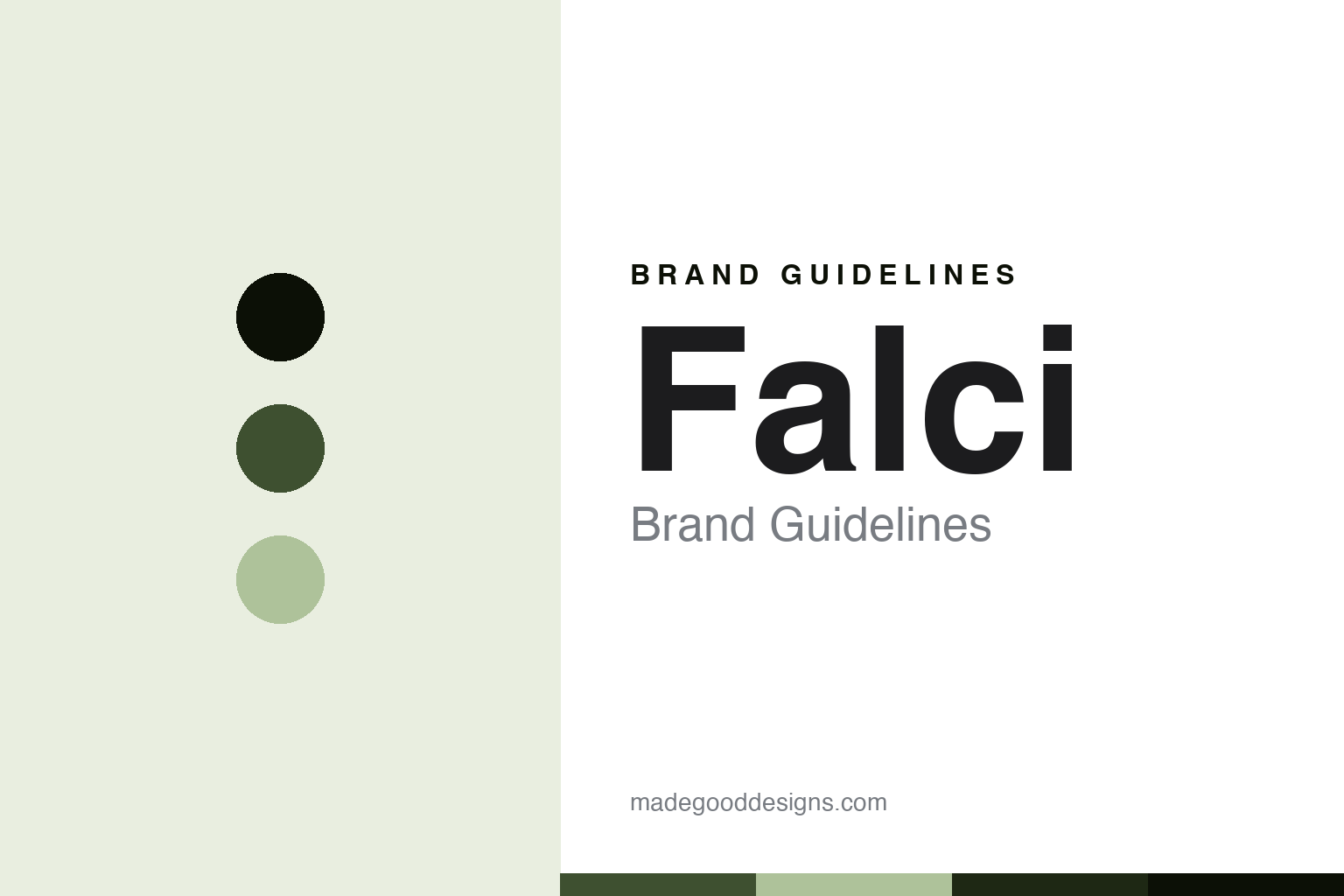
Falci Brand Guidelines
The Italian forge.
Aa
Two constants: a forest palette and a forged-sans register. Abstract homage — not a Falci product or mark.
The Italian forge
Falci is the Italian forge of Dronero since 1921, forging scythes and agricultural tools in Piedmont.
Falci is the round’s Italian forge — a Piedmont maker built on the scythe. Falci makes forged cutting and agricultural tools — scythes, billhooks, hoes, mattocks, shears and saws. Its answer to how a maker becomes a name is a union of forges: bring together a region’s blacksmiths into one house, and forge agricultural tools in the Piedmont hills. A tool, forged in Italy.
Its identity is the Italian forge. Falci’s scythes, its forged agricultural tools and its Piedmont making are the work it is known for. A tool, made in Italy. The Italian forge.
(Honest notes, so the story stays precise. Falci — at falcitools.com, its canonical site — makes forged cutting and agricultural tools: scythes are the historic signature, alongside billhooks, hoes, mattocks, shears and saws, sold under a Falci Specialist tier for professionals and a Falci tier for others. It was founded in 1921 in Dronero, in the Cuneo province of Piedmont, as “Fabbriche Riunite Falci,” formed by uniting local forging blacksmiths with a centuries-old metalworking tradition. On where it is made — the theme of this round — Falci forges in Dronero, so it is one of the round’s made-at-home makers, made in Italy. On ownership, its structure is not disclosed on its site, so we describe it as an independent Italian manufacturer that grew via mergers into a national leader, and do not claim it is family-owned. Its name and marks, and its tools’ shapes, are IP, described but never reproduced, and there is no official brand hex; these tones are an unofficial interpretation. This is design commentary and does not promote any product.)
Colour
Falci lives in a forest palette. Click a swatch to copy the hex.
Falci’s identity is forged, made and rural — a forest, an ink, a sage, a deep green, and a paper. The palette leans forest and sage: the register of the Piedmont fields and hedgerows a scythe and billhook work. It signals an Italian agricultural forge. The honest caveat: with no published brand hex, these values are an original, unofficial interpretation, not first-party colours.
The lesson is a forest palette signals a forged, made-in-Italy identity. Falci’s world is a forged, rural object. For designers, it is a reminder that a deep forest and a soft sage can carry a tool maker — the green of the fields the tools are made for. Because these tones can fail as small text, keep type dark and let the colour live in the accents, palette and band. The takeaways: unite a craft; forge at home; serve the land; and treat any single hex as unofficial.
Typography
The register is a forged sans — sturdy, rural, made.
Falci’s identity carries a sturdy, rural, made spirit — an agricultural forge, not a boutique. A forged sans captures the mood: solid, plain and working, the register of a scythe forged in Piedmont. Set in a forest palette, the forged sans feels sturdy and rural — exactly the personality Falci carries. It is a forge rather than a logo, mirroring a scythe blade. (Falci’s real wordmark, and the scythe’s shape, are things we describe but do not reproduce, and the exact typeface is not ours to use.) Because it is not ours to use, the honest description is “a forged-sans spirit,” shown here in a stand-in. The type behaves like the tool: sturdy, rural and made.
Aa
A forged-sans spirit — sturdy and made. (Specimen set in Libre Franklin, a forged-sans STAND-IN; NOT the Falci logo.)
The garden tool makers
Falci stands for the Italian forge, made in Italy.
Falci is a lesson in how a union of forges can be an identity. A forest palette, a forged sans and a scythe make one thing — the Italian forge — the whole identity: forged, made and rural. The Piedmont-forged agricultural tools are the differentiator, and the union of local blacksmiths is the meaning. The point is an Italian house built by bringing a region’s forges together in 1921, still forging in Dronero.
Put to work, the identity is a union of forges, told straight, as design. A maker in this spirit would gather a craft and forge at home — scythes and billhooks, in Piedmont. A reader in this spirit would keep the honest gaps: Falci’s ownership structure is not disclosed, so it is not claimed as family-owned, and its canonical site is falcitools.com. Falci holds the round’s who-owns-the-forge thread at the made-at-home end with ARS, DeWit and Fisher, and adds Italy to the round’s country spread. It carries the forge thread with the scythe, the round’s most agricultural tool. The honest editorial moves are to present the founding as a union of local forges, to state the Italian making plainly, and to leave the ownership undisclosed rather than guess. The lesson Falci teaches is that a union of forges can hold an identity: the Piedmont forging gives it substance, and the scythe heritage keeps it credible. The Italian forge is the personality, and the scythe is the proof.
For designers and brand-builders, Falci holds an Italy pole in the garden tool makers: unite a craft — and forge at home. The lessons: bring a region’s makers together into one house; forge in-country; serve the land you sit in; leave an undisclosed ownership undisclosed rather than inventing a family story; cite a domain that actually resolves; and never reproduce a logo. It is also a reminder to stay precise: Falci is the Italian forge of Dronero since 1921, forging scythes and agricultural tools in Piedmont — with the palette here an unofficial interpretation. The Piedmont forging carries the substance, and the scythe heritage carries the reputation; together they show that a house built by uniting a region’s blacksmiths can forge for the land it sits in for a century, and that leaving an undisclosed ownership undisclosed — rather than guessing at a family story — is part of telling it straight. Falci made the-Italian-forge the identity — proof that a tool, honestly made, can be the difference.
Explore & save
Keep Falci’s identity on hand — save it to a board in the Made Good inspiration library.
Falci identity set
Pin the forest palette and the forged-sans register to your own board.


