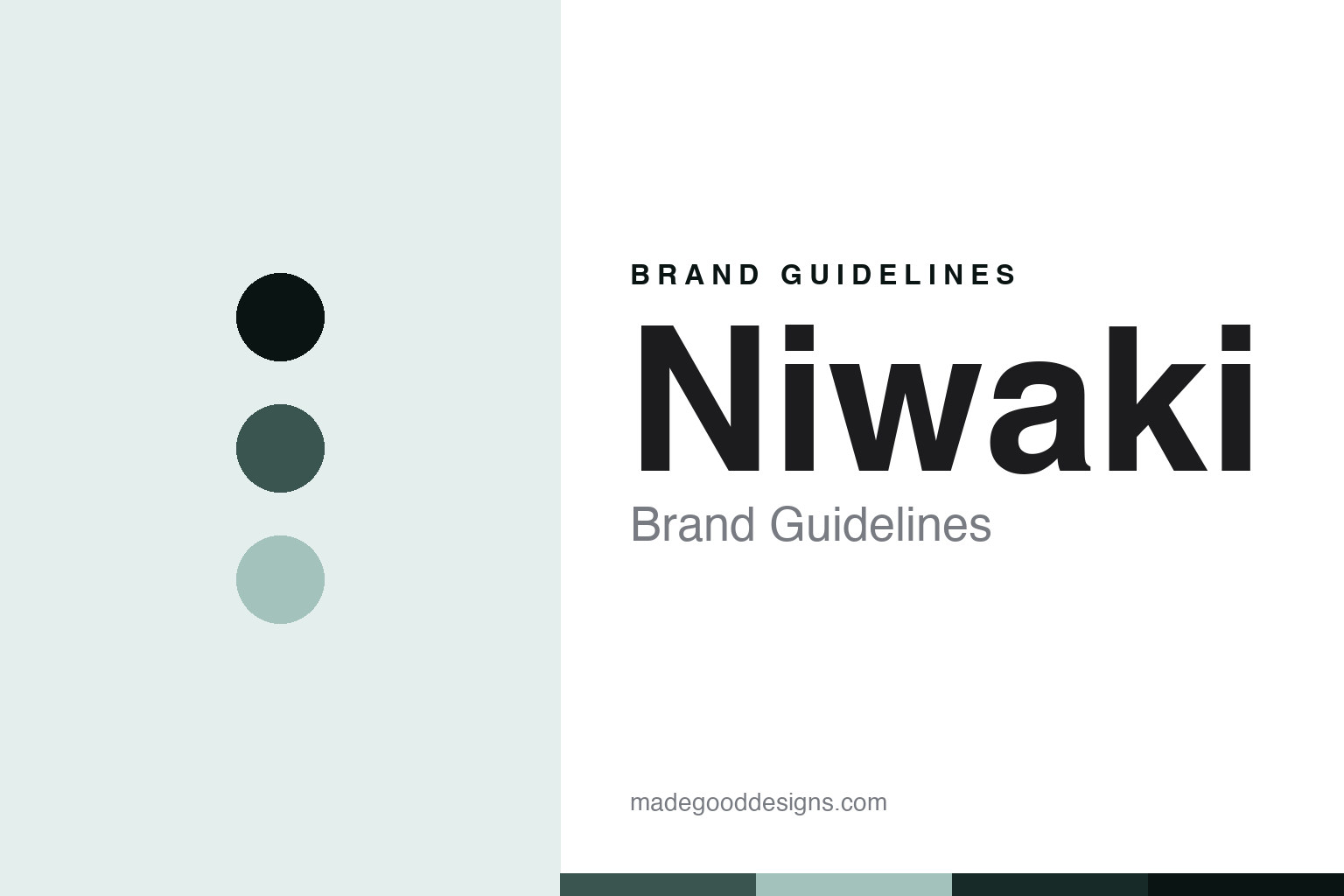
Niwaki Brand Guidelines
The Japanese-tool curator.
Aa
Two constants: a slate-teal palette and a curator-sans register. Abstract homage — not a Niwaki product or mark.
The Japanese-tool curator
Niwaki is the British brand that curates and own-brands Japanese garden tools, made in Japan and sold from Dorset.
Niwaki is the round’s curator — a British brand that brings Japanese garden tools to Western gardeners. Niwaki sells Japanese garden and pruning tools — secateurs, Hori Hori knives, shears, pruning saws, whetstones and its signature tripod ladders — plus workwear. Its answer to how a maker becomes a name is curation, not manufacture: choose and own-brand the best Japanese tools, explain how to use them, and let the expertise carry the brand. A tool, chosen from Japan.
Its identity is the Japanese-tool curator. Niwaki’s curated Japanese tools, its tripod ladders and its British-brand-Japanese-made model are the work it is known for. A tool, made in Japan. The Japanese-tool curator.
(Honest notes, so the story stays precise, because Niwaki does not forge its own tools. Niwaki — at niwaki.com — is a curator and importer, not a manufacturer: it sells Niwaki-branded tools made to its specification by Japanese makers, and it distributes established Japanese brands, notably Okatsune (the secateur maker from the first round), Silky (saws) and Hasegawa (the aluminium tripod ladders). It was founded, as reported, around 1997 by Jake Hobson, a topiary and Japanese-pruning specialist who trained in fine art and worked at a Japanese nursery, and it is based in Dorset, England; the name “niwaki” is the Japanese term for garden trees and the art of shaping them, not a coinage. On where it is made — the crux of this round — Niwaki is a British brand, but its tools are made in Japan, so it is a name-isn’t-origin case told transparently; we credit the Japanese makers and do not imply Niwaki forges anything. On ownership, it is independent and founder-led. Its name and marks are IP, described but never reproduced, and there is no official brand hex; these tones are an unofficial interpretation. This is design commentary and does not promote any product.)
Colour
Niwaki lives in a slate-teal palette. Click a swatch to copy the hex.
Niwaki’s identity is curated, natural and considered — a slate teal, an ink, a mist, a deep teal, and a paper. The palette leans slate teal and mist: a muted, natural register in keeping with the brand’s understated, garden-and-workwear world. It signals a Japanese-tool curator. The honest caveat: with no published brand hex, these values are an original, unofficial interpretation, not first-party colours.
The lesson is a slate-teal palette signals a curated, considered identity. Niwaki’s world is a curated, natural object. For designers, it is a reminder that a muted slate teal and a soft mist can carry a curator brand — the calm of a considered, understated garden world. Because these tones can fail as small text, keep type dark and let the colour live in the accents, palette and band. The takeaways: curate rather than make; credit the makers; explain the use; and treat any single hex as unofficial.
Typography
The register is a curator sans — understated, considered, clear.
Niwaki’s identity carries an understated, considered, clear spirit — a curator, not a factory. A curator sans captures the mood: quiet, editorial and knowledgeable, the register of a brand that chooses and explains tools. Set in a slate-teal palette, the curator sans feels understated and considered — exactly the personality Niwaki carries. It is curation rather than a logo, mirroring a well-chosen tool. (Niwaki’s real wordmark, and the tools’ shapes, are things we describe but do not reproduce, and the exact typeface is not ours to use.) Because it is not ours to use, the honest description is “a curator-sans spirit,” shown here in a stand-in. The type behaves like the brand: understated, considered and clear.
Aa
A curator-sans spirit — understated and clear. (Specimen set in Work Sans, a curator-sans STAND-IN; NOT the Niwaki logo.)
The garden tool makers
Niwaki stands for the Japanese-tool curator, made in Japan.
Niwaki is a lesson in how curation can be an identity. A slate-teal palette, a curator sans and a well-chosen tool make one thing — the Japanese-tool curator — the whole identity: curated, natural and considered. The British-brand, Japanese-made model is the differentiator, and the expertise-led curation is the meaning. The point is a British brand that chooses and own-brands Japanese tools, made in Japan, and explains how to use them.
Put to work, the identity is curation, told straight, as design. A maker in this spirit would choose the best tools and credit their makers — Japanese secateurs, saws and ladders. A reader in this spirit would keep the model clear: Niwaki does not forge; it is a British brand whose tools are made in Japan, and it distributes real Japanese makers, including Okatsune from the first round, so it credits rather than claims the making. Niwaki holds the round’s name-isn’t-origin and curation thread on its own — a modern answer to the vein’s question of who actually makes a tool — against the forge-at-home and consolidated makers. The honest editorial moves are to say Niwaki curates rather than manufactures, to credit the Japanese makers, and to frame the name as a real horticultural term. The lesson Niwaki teaches is that curation can hold an identity: the choosing gives it substance, and the credited Japanese making keeps it credible. The Japanese-tool curator is the personality, and the curated tool is the proof.
For designers and brand-builders, Niwaki holds the curator pole in the garden tool makers: curate rather than make — and credit the makers. The lessons: choose and explain, don’t pretend to forge; credit the real makers; own-brand transparently; borrow a real term correctly; and never reproduce a logo. It is also a reminder to stay precise: Niwaki is the British brand that curates and own-brands Japanese garden tools, made in Japan and sold from Dorset — with the palette here an unofficial interpretation. The choosing carries the substance, and the credited Japanese making carries the trust; together they show that a brand can add real value by selecting, own-branding and explaining tools it does not forge — as long as it credits the makers rather than implying it made them — and that curation, done honestly, is its own kind of craft. Niwaki made the-Japanese-tool-curator the identity — proof that a tool, honestly told, can be the difference.
Explore & save
Keep Niwaki’s identity on hand — save it to a board in the Made Good inspiration library.
Niwaki identity set
Pin the slate-teal palette and the curator-sans register to your own board.