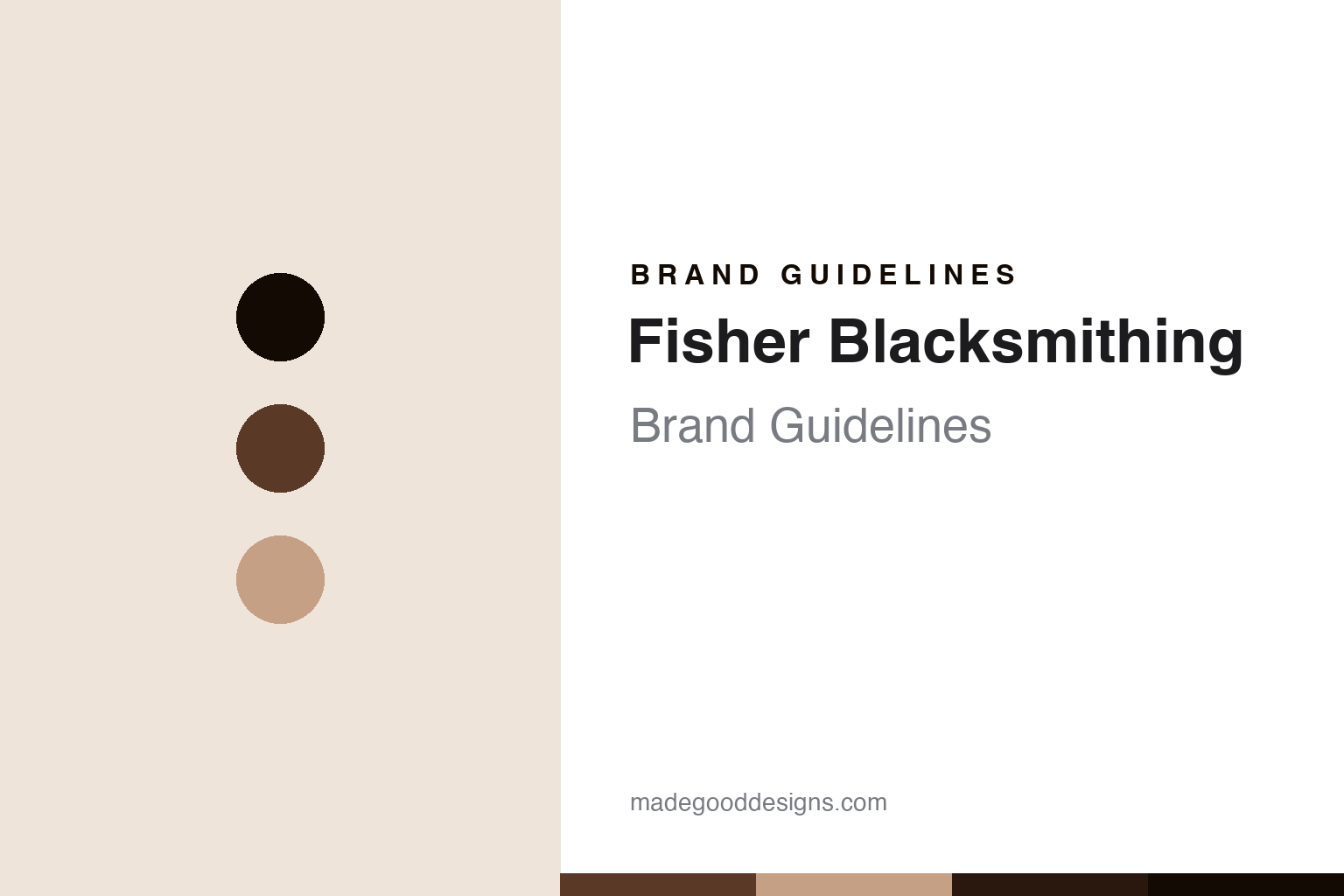
Fisher Blacksmithing Brand Guidelines
Hand-forged in Montana.
Aa
Two constants: a walnut palette and a blacksmith-sans register. Abstract homage — not a Fisher Blacksmithing product or mark.
Hand-forged in Montana
Fisher Blacksmithing is the one-person American forge in Bozeman, Montana, hand-forging garden tools since 2003.
Fisher Blacksmithing closes the round on the purest forge of all — one blacksmith, one anvil, in Montana. Fisher Blacksmithing makes hand-forged garden tools — trowels, hoes, cultivators, weeders and harvesters. Its answer to how a maker becomes a name is the individual hand: forge each tool yourself, over an anvil, and make it to be handed down. A tool, forged by one person.
Its identity is hand-forged in Montana. Fisher Blacksmithing’s hand-forged tools, its one-person forge and its heirloom durability are the work it is known for. A tool, made in the USA. Hand-forged in Montana.
(Honest notes, so the story stays precise. Fisher Blacksmithing — at fisherblacksmithing.com — makes hand-forged garden tools, including trowels, hoes, cultivators, weeders and a Crescent Moon Harvester, each heated in a forge, shaped over an anvil with hammer and tongs, and joined with solid steel rivets; the handles are American black walnut, not hickory, with some leather details. It was founded in 2003 by Tuli Fisher, who has studied traditional toolmaking since 1999, in Bozeman, Montana. On where it is made — the theme of this round — Fisher hand-forges in the USA, in Bozeman, by Tuli himself, so it is the round’s clearest one-person, made-in-America forge. On ownership, it is an independent, one-person operation, founder-run; a black-walnut-handle collaboration is a retail partnership, not a change of ownership. Its name and marks, and its tools’ shapes, are IP, described but never reproduced, and there is no official brand hex; these tones are an unofficial interpretation. This is design commentary and does not promote any product.)
Colour
Fisher Blacksmithing lives in a walnut palette. Click a swatch to copy the hex.
Fisher Blacksmithing’s identity is hand-forged, made and warm — a walnut, an ink, a tan, a deep walnut, and a paper. The palette leans walnut and tan: the warm register of a black-walnut handle and forged steel. It signals a one-person American forge. The honest caveat: with no published brand hex, these values are an original, unofficial interpretation, not first-party colours.
The lesson is a walnut palette signals a hand-forged, made-in-USA identity. Fisher’s world is a hand-forged, warm object. For designers, it is a reminder that a rich walnut and a soft tan can carry a maker — the grain of a black-walnut handle and the warmth of the forge. Because these tones can fail as small text, keep type dark and let the colour live in the accents, palette and band. The takeaways: forge by your own hand; make it at home; build for the next generation; and treat any single hex as unofficial.
Typography
The register is a blacksmith sans — plain, sturdy, made.
Fisher Blacksmithing’s identity carries a plain, sturdy, made spirit — a one-person forge, not a factory. A blacksmith sans captures the mood: honest, solid and handmade, the register of a tool forged over an anvil. Set in a walnut palette, the blacksmith sans feels plain and sturdy — exactly the personality Fisher carries. It is the individual hand rather than a logo, mirroring a forged head. (Fisher Blacksmithing’s real wordmark, and the tools’ shapes, are things we describe but do not reproduce, and the exact typeface is not ours to use.) Because it is not ours to use, the honest description is “a blacksmith-sans spirit,” shown here in a stand-in. The type behaves like the tool: plain, sturdy and made.
Aa
A blacksmith-sans spirit — sturdy and handmade. (Specimen set in Mulish, a blacksmith-sans STAND-IN; NOT the Fisher Blacksmithing logo.)
The garden tool makers
Hand-forged in Montana — Fisher Blacksmithing closes the round.
Fisher Blacksmithing closes the round on the purest forge — one person, one anvil. A walnut palette, a blacksmith sans and a forged head make one thing — hand-forged in Montana — the whole identity: hand-forged, made and warm. The one-person American forge is the differentiator, and the heirloom durability is the meaning. The point is a single blacksmith who forges each garden tool by hand in Bozeman, Montana, to be handed down.
Put to work, the identity is the individual hand, told straight, as design. A maker in this spirit would forge each tool personally and make it to last — trowels and hoes, in Montana. A reader in this spirit would place it at the far artisan end of the round’s who-owns-the-forge thread — one person, against Bahco’s Snap-on scale and Burgon & Ball’s Venanpri group — and at the new end of the heritage spectrum, a maker of 2003 beside houses from 1730 and 1876. Across two rounds, fourteen garden-tool makers — from a Swiss secateur and an English watering can to a solo Montana blacksmith — answer the vein’s question: in a garden tool, who makes it, and where? The honest editorial moves are to correct the handle wood to black walnut, to date the founding to 2003, and to state the one-person Montana forge plainly. The lesson Fisher teaches is that the individual hand can hold an identity: the Montana forging gives it substance, and the heirloom build keeps it credible. Hand-forged in Montana is the personality, and the forged tool is the proof.
For designers and brand-builders, Fisher closes the garden tool makers, from the USA: forge by your own hand — and make it to last. The lessons: let one maker’s hand be the brand; forge in-country; build against the disposable; correct a wrong material and date; and never reproduce a logo. It is also a reminder to stay precise: Fisher Blacksmithing is the one-person American forge in Bozeman, Montana, hand-forging garden tools since 2003 — with the palette here an unofficial interpretation. The Montana forging carries the substance, and the heirloom build carries the meaning; together they show that one maker’s own hand can be the entire brand, and that the smallest forge in the round — one person, one anvil — can stand beside century-old houses and global groups on nothing but the quality of the work. Fisher made hand-forged-in-Montana the identity — proof that a tool, honestly made, can be the difference.
Explore & save
Keep Fisher Blacksmithing’s identity on hand — save it to a board in the Made Good inspiration library.
Fisher Blacksmithing identity set
Pin the walnut palette and the blacksmith-sans register to your own board.