Gessi Brand Guidelines
The total-look bathroom.
Aa
Two constants: a gunmetal palette and a design-sans register. Abstract homage — not a Gessi product or mark.
The total-look bathroom
Gessi is the family-owned Italian design house making taps and total-look bathrooms at one site in Serravalle Sesia.
Gessi is the round’s Italian design house — a Piedmont maker that treats the whole bathroom as one designed “total look.” Gessi makes design taps and mixers, showers, kitchen fittings and wellness systems. Its answer to how a maker becomes a name is a coherent look plus a single site: design a complete, matching bathroom language, and make it at one large integrated plant in Italy. A tap, as part of a total look.
Its identity is the total-look bathroom. Gessi’s design taps, its total-look philosophy and its single-site Italian making are the work it is known for. A fixture, made in Italy. The total-look bathroom.
(Honest notes, so the story stays precise. Gessi — at gessi.com — makes design taps and mixers, showers, kitchen fittings and “Private Wellness” systems, with signature lines such as Goccia and Rettangolo, marketed as a coherent “total look.” It was founded, by the Gessi family, in the early 1990s — the specific year 1992 is reported, and the company held ISO 9001 from 1996, so we date it to the early 1990s and hedge — in Serravalle Sesia, in the province of Vercelli, Piedmont. On where it is made — a theme of this vein — Gessi is genuinely made in Italy, at a single large integrated production complex, the “Parco Gessi,” in Serravalle Sesia. On ownership, it is family-owned and family-controlled, led by Gian Luca Gessi; reports of a private-equity stake could not be verified and appear inconsistent, so we present it as family-controlled. Its name and marks, and its line names, are IP, described but never reproduced, and there is no official brand hex; these tones are an unofficial interpretation. This is design commentary and does not promote any product.)
Colour
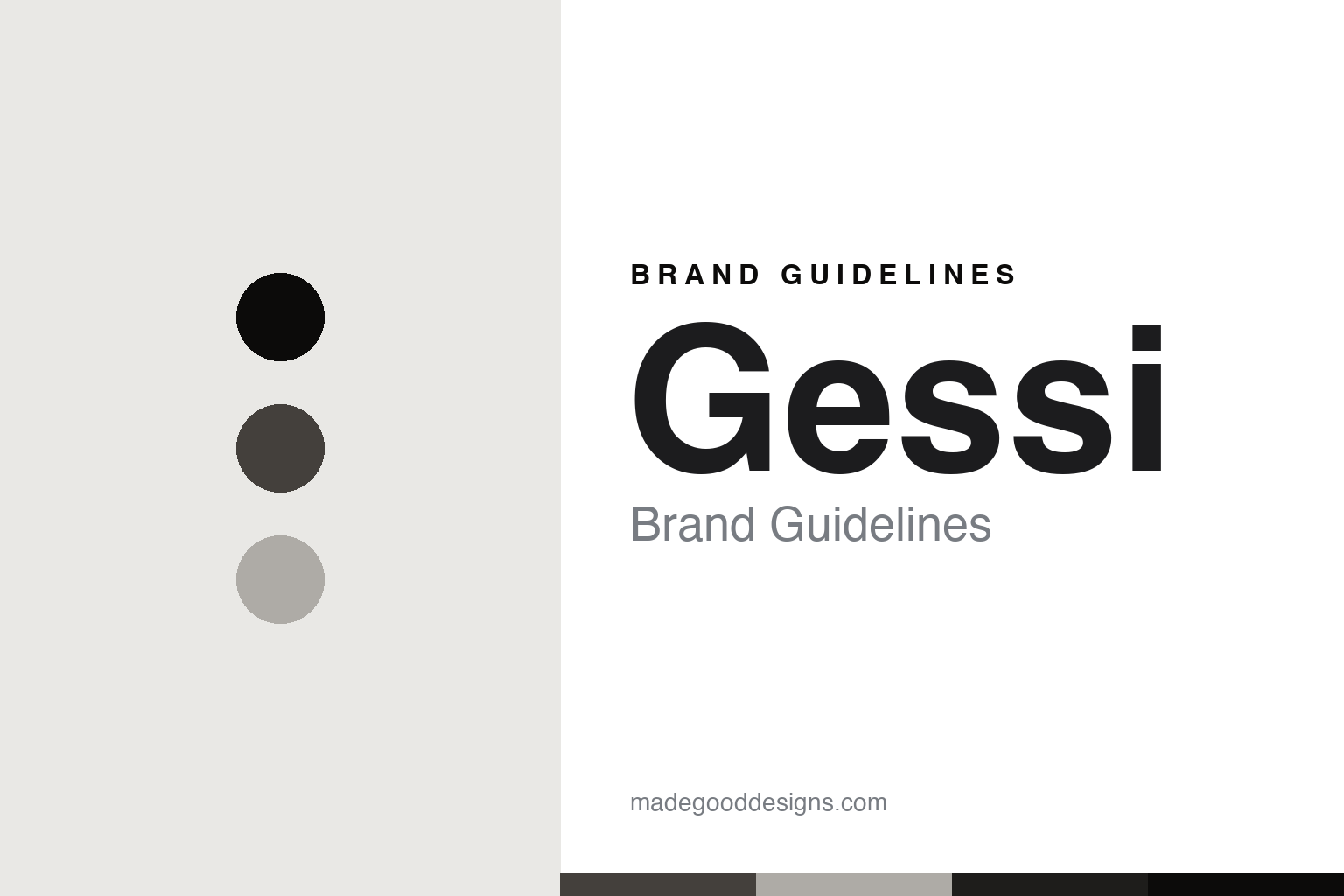
Gessi lives in a gunmetal palette. Click a swatch to copy the hex.
Gessi’s identity is designed, made and coherent — a gunmetal, an ink, a warm grey, a deep gunmetal, and a paper. The palette leans gunmetal and warm grey: a contemporary register that nods to Gessi’s dark PVD finishes. It signals a design-led Italian house. The honest caveat: with no published brand hex, these values are an original, unofficial interpretation, not first-party colours.
The lesson is a gunmetal palette signals a designed, made-in-Italy identity. Gessi’s world is a designed, coherent object. For designers, it is a reminder that a warm gunmetal and a soft grey can carry a design house — the tone of a dark PVD-finished tap. Because these tones can fail as small text, keep type dark and let the colour live in the accents, palette and band. The takeaways: design a coherent look; make it at one site; keep it in the family; and treat any single hex as unofficial.
Typography
The register is a design sans — coherent, modern, made.
Gessi’s identity carries a coherent, modern, made spirit — a design house, not a parts supplier. A design sans captures the mood: contemporary, considered and Italian, the register of a matching, total-look bathroom. Set in a gunmetal palette, the design sans feels coherent and modern — exactly the personality Gessi carries. It is a total look rather than a logo, mirroring a matched suite of fittings. (Gessi’s real wordmark, and its line names, are things we describe but do not reproduce, and the exact typeface is not ours to use.) Because it is not ours to use, the honest description is “a design-sans spirit,” shown here in a stand-in. The type behaves like the suite: coherent, modern and made.
Aa
A design-sans spirit — coherent and made. (Specimen set in Work Sans, a design-sans STAND-IN; NOT the Gessi logo.)
The tap makers
Gessi stands for the total-look bathroom, made in Italy.
Gessi is a lesson in how a coherent look can be an identity. A gunmetal palette, a design sans and a matched suite make one thing — the total-look bathroom — the whole identity: designed, made and coherent. The total-look design is the differentiator, and the single-site Italian making is the meaning. The point is a Piedmont family house that designs a whole matching bathroom language and makes it at one integrated plant.
Put to work, the identity is a coherent look, told straight, as design. A maker in this spirit would design the whole suite and make it in one place — the total look, in Serravalle Sesia. A reader in this spirit would keep the honest limits: the founding is best dated to the early 1990s and hedged, since the exact year is uncertain; and it is family-controlled, not private-equity-owned, on the current evidence. Gessi holds the round’s around-the-world thread from Italy, its who-owns-it thread at the family-dynasty end with Roca, Jaquar and Astra Walker, and its where-made thread at the single-site made-at-home end. The honest editorial moves are to hedge the founding year, to place the making at the Parco Gessi, and to keep the family ownership current. The lesson Gessi teaches is that a coherent look can hold an identity: the single-site Italian making gives it substance, and the total look keeps it credible.
For designers and brand-builders, Gessi holds an Italy pole in the tap makers: design the whole look — and make it in one place. The lessons: make the suite match; integrate the making on one site; hold family control; hedge a date you cannot confirm; and never reproduce a logo. It is also a reminder to stay precise: Gessi is the family-owned Italian design house making taps and total-look bathrooms at one site in Serravalle Sesia — with the palette here an unofficial interpretation. Read that way, Gessi is less a tap maker than a bathroom author: it writes one design language and makes every word of it in a single Piedmont park. The lesson for a brand is that coherence is a product in itself: when every fitting in a room speaks the same language, the room reads as designed, and a single integrated site is what keeps that language consistent. Gessi made the-total-look-bathroom the identity — proof that a fixture, honestly made, can be the difference.
Explore & save
Keep Gessi’s identity on hand — save it to a board in the Made Good inspiration library.
Gessi identity set
Pin the gunmetal palette and the design-sans register to your own board.