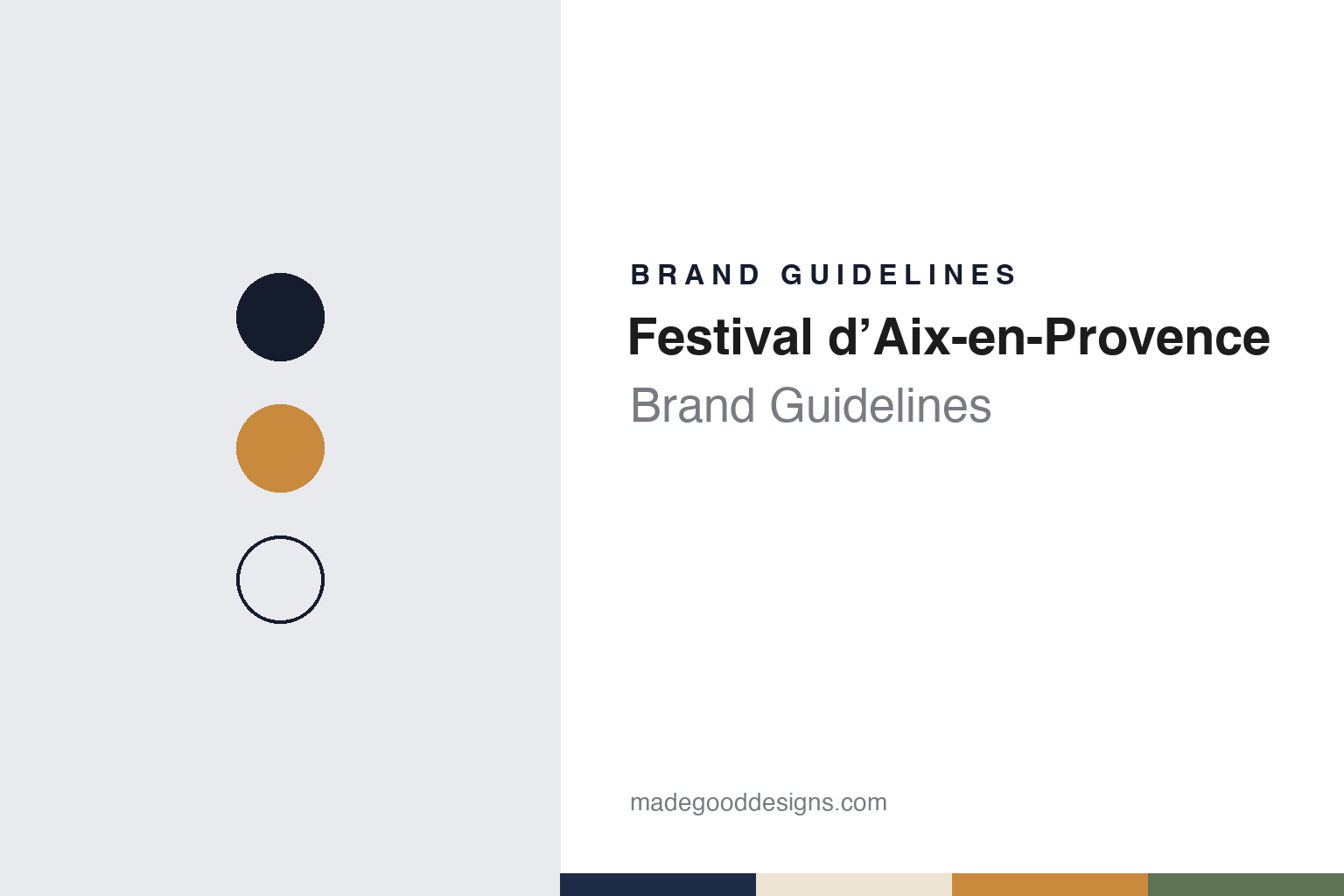
Festival d’Aix-en-Provence Brand Guidelines
Mozart in an archbishop’s courtyard, every July since 1948.
Aa
Two constants: a night-blue, stone and ochre palette and a constructivist sans register. Abstract homage — not a Festival d’Aix-en-Provence poster or mark; no logo or season image is reproduced.
Così in the courtyard
A first edition in July 1948.
The Festival d’Aix-en-Provence was first held in July 1948 in Aix-en-Provence, the old capital of Provence in the south of France. French Wikipedia, which gives its full name as the Festival international d’art lyrique d’Aix-en-Provence, credits its creation to Gabriel Dussurget, who wanted to encourage musical life in the Marseille region, with the backing of a private patron, a countess who, English Wikipedia says, covered the whole cost of the first edition. The initial push came from the company that ran the town’s municipal casino, French Wikipedia adds.
The first festival was built around Mozart. Così fan tutte, a work English Wikipedia describes as practically unknown to French audiences at the time, was staged in the open air in the courtyard of the former archbishop’s palace, the Archevêché, and around ten concerts and recitals were given there, in the Cathedral of Saint-Sauveur and elsewhere in the town. In 1949 the festival staged Don Giovanni, and English Wikipedia dates the festival’s breakthrough to that production. From then on the programme was fixed at three operas a year, two of them by Mozart and the third drawn from the baroque or contemporary repertoire, according to French Wikipedia. The third edition gave the French premiere of Olivier Messiaen’s Turangalîla-Symphonie.
Dussurget led the artistic side until the early 1970s; English Wikipedia gives 1974 as the end of his tenure and French Wikipedia 1972. In 1974 the casino company’s part in running the festival ended and the festival became an association, a status it kept until 1991, French Wikipedia says.
Each later director left a mark on the repertoire. From 1974 the festival opened up to bel canto, with operas by Verdi and Donizetti; from 1982 baroque operas by Purcell, Lully, Campra and Rameau and works by Gluck joined Mozart; from 1998 new operas were commissioned, among them Le Balcon by Péter Eötvös, and the courtyard was completely renovated and renamed the Théâtre de l’Archevêché. Between 2006 and 2009 the festival shared a production of Wagner’s Ring with the Salzburg Easter Festival, showing each opera in Aix in July and in Salzburg the following spring. Later commissions included the opera Written on Skin, English Wikipedia notes.
Colour
A courtyard, a new theatre and an academy.
The festival still takes place principally in July, and it mixes opera with orchestral, chamber, vocal and solo concerts, English Wikipedia says. Its heart remains the Théâtre de l’Archevêché. French Wikipedia describes the early open-air performances, given after nightfall on a small stage about seven metres deep and a dozen wide, and says the courtyard was later fitted with tiered seating and a stage frame.
Since 2007 part of the programme has moved indoors to the Grand Théâtre de Provence, a theatre built for the purpose, which French Wikipedia says the festival inaugurated in July 2007 with Wagner’s Die Walküre. Other stages listed by English Wikipedia are the Théâtre du Jeu de Paume, a restored eighteenth-century theatre; the courtyard of the Hôtel Maynier d’Oppède; and the Théâtre du Grand Saint-Jean, in the grounds of a château outside Aix. Concerts have also been given in public spaces such as the Place des Quatre-Dauphins and at the foot of the Montagne Sainte-Victoire, according to French Wikipedia.
Training runs alongside the stage programme. The festival says its Académie was created in 1998 and offers residencies for singers, composers, conductors, stage directors, dramaturgs, chamber musicians and digital artists, with more than three thousand artists taking part since it began. It describes the Académie as a founding member of enoa, the European Network of Opera Academies, and French Wikipedia lists the festival as a member of Opera Europa and of RESO, a European network for opera and dance education.
The Académie has also fed the festival’s own leadership. Ted Huffman, a New York-born stage director and writer, first came to Aix in 2012 through the Académie sessions, OperaWire reported in October 2025. The French Ministry of Culture lists his productions for the festival as L’incoronazione di Poppea in 2022 and the chamber opera The Story of Billy Budd, Sailor in 2025, among others.
The festival also reaches audiences beyond Aix. French Wikipedia says the television channels Arte, Mezzo, France 3 and NHK have broadcast its operas live or with a short delay.
Typography
Opera festivals and their settings.
Opera festivals usually present themselves through a place or a person. Many take the name of their town with the word “festival” or “opera” attached, as Aix-en-Provence does; others carry the name of a composer, as the Rossini Opera Festival in Pesaro does, or the name of a house or estate. The name, the town and the stage often become the identity before any logo does.
Most run for a few weeks in summer. The Festival d’Aix-en-Provence takes place principally in July and the Rossini Opera Festival in August, each over a few weeks. Behind them stand non-profit bodies of different kinds: charities, associations and foundations, often with a city council or regional authority among their founders or members. The festival in Pesaro, for example, was set up by its city council in 1980 and became a foundation in 1994.
The settings vary as much as the names. Some festivals perform in castle or palace courtyards under the open sky, as Aix has done in the courtyard of its former archbishop’s palace since 1948; others use country-house theatres, historic Italian-style opera houses, purpose-built modern theatres or converted halls. Many festivals use more than one stage, and the list of venues is often part of how a festival describes itself.
Programmes commonly mix new productions with revivals, concerts and training. Academies and young-artist schemes, such as the Académie in Aix and the Accademia Rossiniana in Pesaro, put early-career singers, directors and musicians on the festival’s own stages. A poster, programme cover or season image is usually made anew for each edition, and Aix, for one, has worked with the same graphic designer since 2019. This guide describes those identities plainly, using our own unofficial colours and type.
Aa
A constructivist sans, in the spirit of a Dutch-designed identity. (Specimen set in Archivo, a sans STAND-IN; NOT the Festival d’Aix-en-Provence logo or lettering.)
Festival d’Aix
An identity by Irma Boom.
The festival’s current look has a named author. In a video page dated September 2023, the festival says the Dutch graphic designer Irma Boom has created its visual identity since 2019, and describes her as following in the footsteps of the Dutch Constructivist school. It adds that her work was shown at the Rijksmuseum in Amsterdam and at the Vatican Library in 2023 and is held in collections including the Museum of Modern Art in New York.
Leadership changed at the start of 2026. On 27 October 2025 the festival’s board unanimously appointed Ted Huffman general director for a five-year term from 1 January 2026, on the recommendation of its chairman and with the approval of the Ministry of Culture, the city of Aix-en-Provence, the Aix-Marseille-Provence metropolitan authority, the Bouches-du-Rhône department and the Provence-Alpes-Côte d’Azur region, OperaWire reported. He succeeded the stage director who had run the festival since 2018. French Wikipedia lists him as the festival’s director from 2026.
For a design guide, the Festival d’Aix-en-Provence shows how a summer festival can tie its name to a town and a courtyard while handing its graphic identity to a single designer. Compare Opéra de Lyon and Opéra national de Paris, two other French opera institutions. For this guide we use a night blue, warm stone and an ochre with a sans, an unofficial interpretation; no product or logo is reproduced.
Explore & save
Keep Festival d’Aix-en-Provence’s identity on hand — save it to a board in the Made Good inspiration library.
Festival d’Aix-en-Provence identity set
Pin the night blue, stone and ochre palette and the constructivist sans register to your own board.
Source & notes
Frequently Asked Questions
What font can I use to match the Festival d’Aix-en-Provence look?
This guide describes Festival d’Aix-en-Provence’s type as “A constructivist sans, in the spirit of a Dutch-designed identity”. Its type specimen is set in Archivo from Google Fonts as a stand-in; Archivo is not Festival d’Aix-en-Provence’s own lettering.
What colours are in the Festival d’Aix-en-Provence palette?
This guide’s Festival d’Aix-en-Provence palette is Night courtyard #1E2B47, Deep ink #141C2E, Archevêché stone #EDE4D3, Provence ochre #C98A3D and Plane-tree green #5E7356. The tones are the guide’s own unofficial interpretation, not official Festival d’Aix-en-Provence hex codes.
When was Festival d’Aix-en-Provence founded?
Festival d’Aix-en-Provence was founded in July 1948, in Aix-en-Provence, France.
Who founded Festival d’Aix-en-Provence?
Festival d’Aix-en-Provence was founded by Gabriel Dussurget in July 1948.