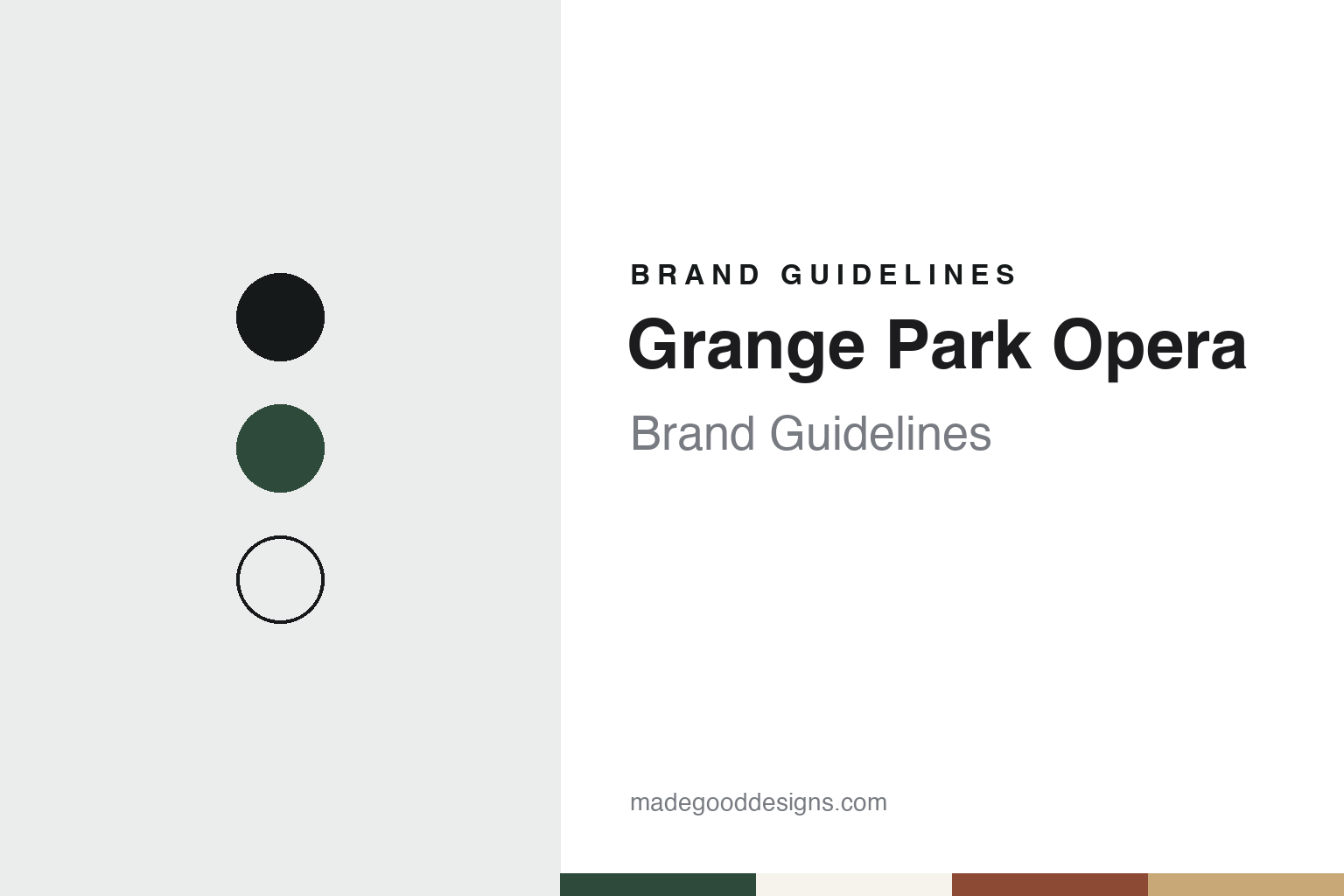
Grange Park Opera Brand Guidelines
From a Hampshire orangery to a theatre in the woods.
Aa
Two constants: a woodland green, brick and larch palette and an old-style serif register. Abstract homage — not a Grange Park Opera poster, programme or mark; no logo or image is reproduced.
The Grange, 1998
An orangery fitted out as an opera house.
Grange Park Opera is a professional opera company and charity founded in 1998 by Wasfi Kani and Michael Moody, English Wikipedia says; the company’s own history names Kani as its founder. From 1998 to 2016 it staged an annual summer festival at The Grange, at Northington in Hampshire, a house in the care of English Heritage, under a lease agreed with English Heritage and the owners of the estate.
The theatre at The Grange was improvised. For its opening four seasons, English Wikipedia says, performances took place in the house’s Orangery, fitted with raked seating whose seats came from Covent Garden, a stage and an orchestra pit. For the 2002 season the auditorium was enlarged, with seating raised to 550 on two levels. The festival grew to a five-week season of three operas in 2000 and to four operas in 2013, according to the same article.
The company also worked away from Hampshire. In 2003 its season was extended to Nevill Holt Hall, near Market Harborough in Leicestershire, where a 300-seat theatre was built in the stable courtyard; in 2012 the company handed that season to the newly formed Nevill Holt Opera, English Wikipedia says. Its repertoire widened to include musicals: Fiddler on the Roof in 2015, later staged at the Royal Albert Hall as part of that year’s BBC Proms, and Oliver! in 2016. The company says it has staged more than eighty operas in all.
The company held its last Hampshire season in 2016, by its own account, and in 2017 moved to West Horsley Place in Surrey.
Colour
A five-storey house in a Surrey wood.
West Horsley Place, near Guildford, is a 350-acre estate with a fourteenth-century house, formal gardens and a long crinkle-crankle wall, the company writes. The estate belongs to the West Horsley Place Trust, which granted the company a 99-year lease, English Wikipedia says. Planning permission for a five-storey opera house, modelled on La Scala in Milan and designed by Tim Ronalds Architects, was granted in May 2016, and building began at once, according to the same article.
The company says it built the house in eleven months. It describes the building, glimpsed between trees, as a cross-gartered brick drum, and the interior as an intimate five-tiered horseshoe auditorium seating 700. It calls it the Theatre in the Woods.
The house opened in June 2017. WhatsOnStage, reviewing the opening Tosca on 9 June 2017, reported that the building had opened for business that week still in bare plywood and MDF, with second-hand seats from the Royal Opera House amphitheatre, and that its acoustic was vivid, if a little dry before the decoration was finished. The production starred the tenor Joseph Calleja as Cavaradossi, with the BBC Concert Orchestra in the pit, and ran in repertory until 2 July. The reviewer singled out the three-dimensional sets and the lighting as the evening’s strongest visual elements. English Wikipedia dates that Tosca premiere to 8 June 2017.
The move changed the scale of the company’s theatre. The Orangery at The Grange had held 550 after its 2002 enlargement, on two levels; the new house seats 700, the company says, on five tiers arranged in the horseshoe shape of an Italian opera house, while English Wikipedia records the same La Scala model for its plan.
Building continued after the opening season. A second phase added the exterior brickwork and a free-standing round lavatory building, and a third added a colonnade whose columns are larch trunks, English Wikipedia says; the company adds that the larch came from a Sussex estate and that roses are planted at the foot of each column, making a covered walk it calls the “passeggiata”. A smaller stage, the Piccolo theatre, opened in 2019, according to the company.
Typography
Opera festivals.
Opera festivals usually present themselves through a place or a person. Many take the name of their town with the word “festival” or “opera” attached, as Aix-en-Provence does; others carry the name of a composer, as the Rossini Opera Festival in Pesaro does, or the name of a house or estate. The name, the town and the stage often become the identity before any logo does.
Most run for a few weeks in summer. The Festival d’Aix-en-Provence takes place principally in July and the Rossini Opera Festival in August, each over a few weeks. Behind them stand non-profit bodies of different kinds: charities, associations and foundations, often with a city council or regional authority among their founders or members. The festival in Pesaro, for example, was set up by its city council in 1980 and became a foundation in 1994.
The settings vary as much as the names. Some festivals perform in castle or palace courtyards under the open sky, as Aix has done in the courtyard of its former archbishop’s palace since 1948; others use country-house theatres, historic Italian-style opera houses, purpose-built modern theatres or converted halls. Many festivals use more than one stage, and the list of venues is often part of how a festival describes itself.
Programmes commonly mix new productions with revivals, concerts and training. Academies and young-artist schemes, such as the Académie in Aix and the Accademia Rossiniana in Pesaro, put early-career singers, directors and musicians on the festival’s own stages. A poster, programme cover or season image is usually made anew for each edition, and Aix, for one, has worked with the same graphic designer since 2019. This guide describes those identities plainly, using our own unofficial colours and type.
Aa
An old-style serif for a brick drum among trees. (Specimen set in Libre Caslon Text, a serif STAND-IN; NOT the Grange Park Opera logo.)
Grange Park Opera
Black tie, a walled garden and a long interval.
The evening at West Horsley Place follows the country-house pattern. The company describes audiences arriving from four in the afternoon, often in black tie, walking through the walled gardens, dining in the fourteenth-century house during a long interval or picnicking in pavilions in the crinkle-crankle garden and on the croquet lawn, and leaving into open landscape when the opera ends. Its pages present the house, the gardens and the theatre together as one evening rather than the opera alone. WhatsOnStage in 2017 described the estate as closer in spirit to a festival field than to a formal opera house, a short distance from the M25.
The season remains a summer one. In 2026 the company staged Wagner’s Das Rheingold, played by the orchestra of English National Opera, according to the company.
The company’s look draws on its buildings more than on a single emblem: a brick drum among trees, a five-tier horseshoe interior and a larch colonnade. Those materials suggest the palette used in this guide: a deep green for the woodland around the theatre, a warm red-brown for the brick drum, a pale gold for the larch columns and a soft paper tone for programmes and tickets, with an old-style serif in place of any house typeface. A classical serif also echoes the formal, black-tie side of the evening that the company describes, while the green keeps the setting outdoors.
For a design guide, Grange Park Opera shows how an opera company can carry its identity from one site to another through the shape of its theatre and the ritual of the evening. Compare La Scala, the Milan house its auditorium is modelled on, and English National Opera, whose orchestra played its Das Rheingold in 2026. For this guide we use a woodland green, brick and larch with an old-style serif, an unofficial interpretation; no product or logo is reproduced.
Explore & save
Keep Grange Park Opera’s identity on hand — save it to a board in the Made Good inspiration library.
Grange Park Opera identity set
Pin the woodland green, brick and larch palette and the old-style serif register to your own board.
Source & notes
Frequently Asked Questions
What font can I use to match the Grange Park Opera look?
This guide describes Grange Park Opera’s type as “An old-style serif for a brick drum among trees”. Its type specimen is set in Libre Caslon Text from Google Fonts as a stand-in; Libre Caslon Text is not Grange Park Opera’s own lettering.
What colours are in the Grange Park Opera palette?
This guide’s Grange Park Opera palette is Woodland green #2E4A3A, Ink #16191A, Brick drum #8C4A35, Larch #C9A877 and Paper #F6F3EC. The tones are the guide’s own unofficial interpretation, not official Grange Park Opera hex codes.
When was Grange Park Opera founded?
Grange Park Opera was founded in 1998, in The Grange, Northington, Hampshire.
Who founded Grange Park Opera?
Grange Park Opera was founded by Wasfi Kani and Michael Moody in 1998.