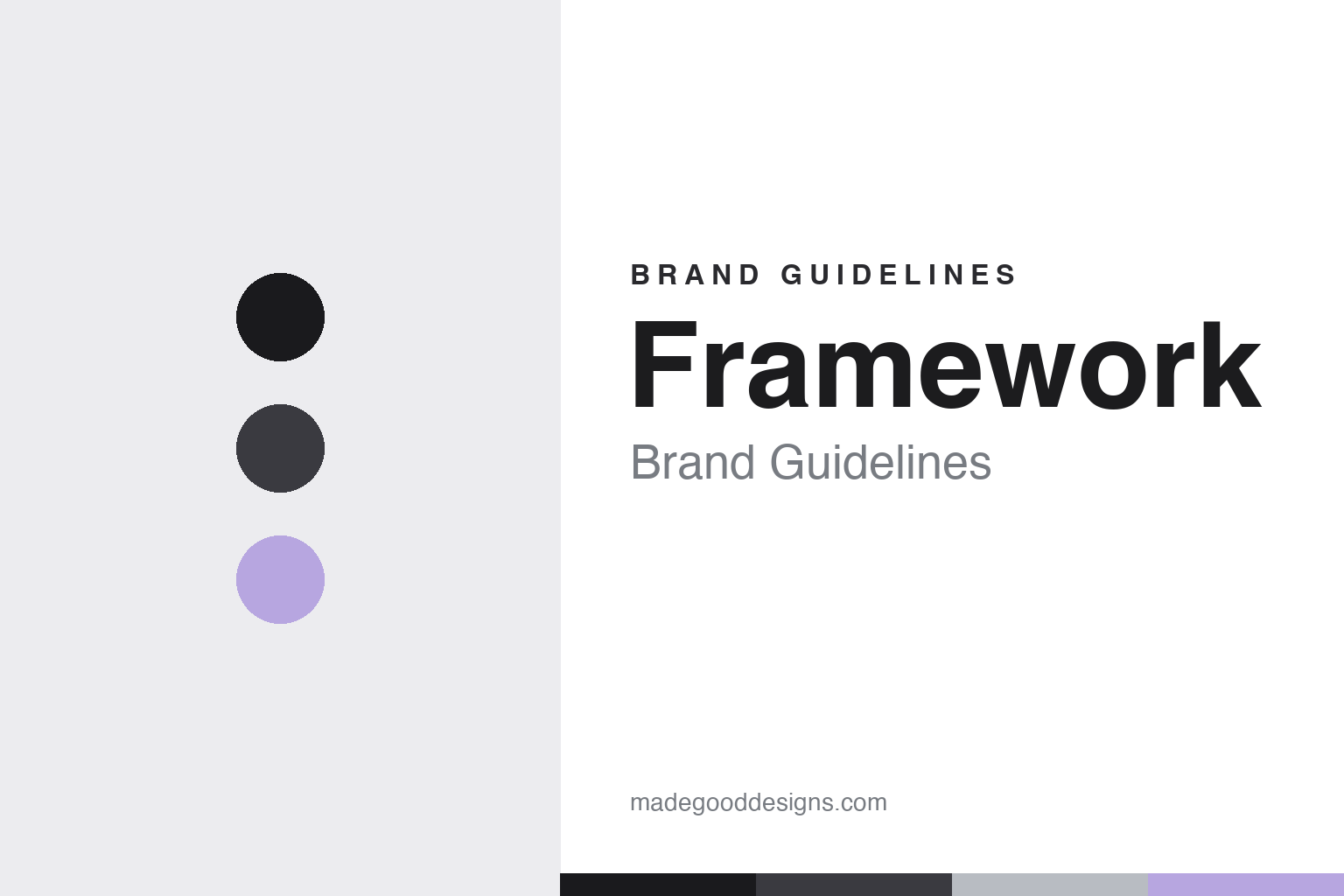
Framework Brand Guidelines
A laptop you can open, upgrade and repair — a clean, technical brand built to fight throwaway electronics.
Aa
Two constants: a clean black-on-white palette and a technical sans. Abstract homage — not the Framework wordmark or mark.
The repairable laptop
Framework fights disposable electronics.
Framework is a lesson in building a brand around a mission. Framework Computer was founded in 2020 by Nirav Patel — a former Apple and Oculus engineer — and is headquartered in San Francisco. Its first product, the Framework Laptop (now “Laptop 13”), began shipping in 2021 and was named to Time’s Best Inventions. But the products are really vehicles for a cause. (Honest caveats: no official brand hex is published, so the tones below are approximate; the wordmark typeface is undocumented; and Framework publishes no official meaning for its logo, so it’s described here by shape only.)
The mission is the brand: repairability, modularity, and fighting e-waste. Framework laptops are designed to be easily opened, upgraded and repaired by the user — every major part (mainboard, screen, keyboard, battery) is replaceable — with a signature Expansion Card system: swappable USB-C-based modules that slot into the chassis so you choose your own ports (USB-C, USB-A, HDMI, DisplayPort, Ethernet, storage). Framework open-sourced the Expansion Card designs, publishes full repair guides, sells every spare part directly, and earned a perfect 10/10 iFixit repairability score. It’s a leading champion of the right-to-repair movement.
The line has grown to the Laptop 16 (with a modular, upgradeable GPU and a reconfigurable input deck) and the Framework Desktop — all built on the same modular, user-serviceable philosophy. The identity matches: a clean, technical, black-on-white aesthetic with a distinctive geometric mark (interlocking right-angle forms making a square), silver-aluminium hardware and occasional translucent accents. Everything about the brand signals “open, honest, built to last.” A company selling repairability as a product.
Colour
Framework lives in clean black-on-white. Click a swatch to copy the hex.
Framework’s palette is deliberately restrained: a clean black-on-white base, with silver-aluminium hardware tones and occasional translucent/lavender accents on some models. (A correction worth noting: despite some assumptions, orange is not a verified Framework brand colour — the dominant identity is black and white.) The monochrome base reads as technical, honest and no-nonsense, matching a brand about transparency, open specs and repairability, while the aluminium and subtle accents keep it feeling modern and premium. It’s a minimal, engineering-forward scheme that puts the product and the mission first, not flashy branding. The honest caveat: Framework publishes no official brand hex — the tones here are observed approximations.
The lesson is let a restrained palette signal honesty and substance. Framework’s clean black-on-white feels transparent and technical, matching its open, repair-friendly ethos. For designers, it’s a reminder that a minimal palette can communicate “substance over hype.” The takeaways: match the palette to the brand’s values (minimal and honest for an open, technical brand); don’t assume a colour is “the brand” without checking (orange isn’t Framework’s); and treat specific hexes as approximate when no official spec is published.
Typography
The type is a clean technical sans — open and precise.
Framework’s clean technical sans wordmark — a lowercase, modern sans — is open and precise. The even, engineered letterforms read as honest, technical and approachable, matching a brand about open specs, repair guides and user-serviceable hardware, and the lowercase keeps it friendly rather than corporate. Paired with the geometric mark (interlocking right-angle forms making a square, evoking modularity and construction), the type feels clean and trustworthy — exactly the “open and built to last” personality Framework wants. (Because the exact face is undocumented and Framework publishes no official logo meaning, the honest descriptions are “a clean technical sans” and “interlocking right-angle forms,” not a named font or an official symbol story.) The type behaves like the brand: open, precise and technical.
Aa
A clean technical sans — open and precise. (Specimen set in Space Grotesk, a technical sans in the spirit of the Framework wordmark; the real face is undocumented.)
A mission as a brand
Framework sells values, not just laptops.
Framework is a lesson in making a mission the core of the brand. In a market where electronics are designed to be sealed, disposable and replaced every few years, Framework’s entire proposition is the opposite: open it, upgrade it, repair it, keep it. That mission — repairability, modularity, fighting e-waste, championing right-to-repair — isn’t a marketing footnote; it is the product and the brand. The open-sourced designs, published repair guides, directly-sold spare parts and clean, technical identity all reinforce one honest message. It’s proof that a clear, genuinely-held mission can differentiate a brand in a crowded, commoditised category as powerfully as any feature.
For designers and brand-builders, Framework offers a clear takeaway: a genuine mission, expressed consistently through product and identity, can be the whole brand. The lessons: build the product to embody the mission (repairability, Expansion Cards); let the identity reflect the values (clean, open, technical black-on-white); and stay honest — publish specs, guides and parts. It’s also a reminder to keep the facts precise — Framework was founded in 2020 by Nirav Patel (ex-Apple/Oculus), shipped the repairable Framework Laptop in 2021, is built on repairability and the modular Expansion Card system with a 10/10 iFixit score, and uses a clean black-on-white identity with a geometric mark (not a confirmed “gear,” and orange is not a brand colour). Framework made its mission the brand — proof that clear values can differentiate as powerfully as features.
Explore & save
Keep Framework’s identity on hand — save it to a board in the Made Good inspiration library.
Framework identity set
Pin the black-on-white palette and the technical-sans spirit to your own board.