Francisco Pacheco is often met as a footnote to Velázquez, but his own career is a design lesson. He wrote rules for how religious images should look, ran a Seville studio where young painters learned drawing and the painting of sculpture, and compiled a book of portrait drawings with handwritten biographies. For designers who build brand systems, editorial templates or illustration guidelines, Francisco Pacheco shows what happens when one person codifies a visual language and teaches it to others.
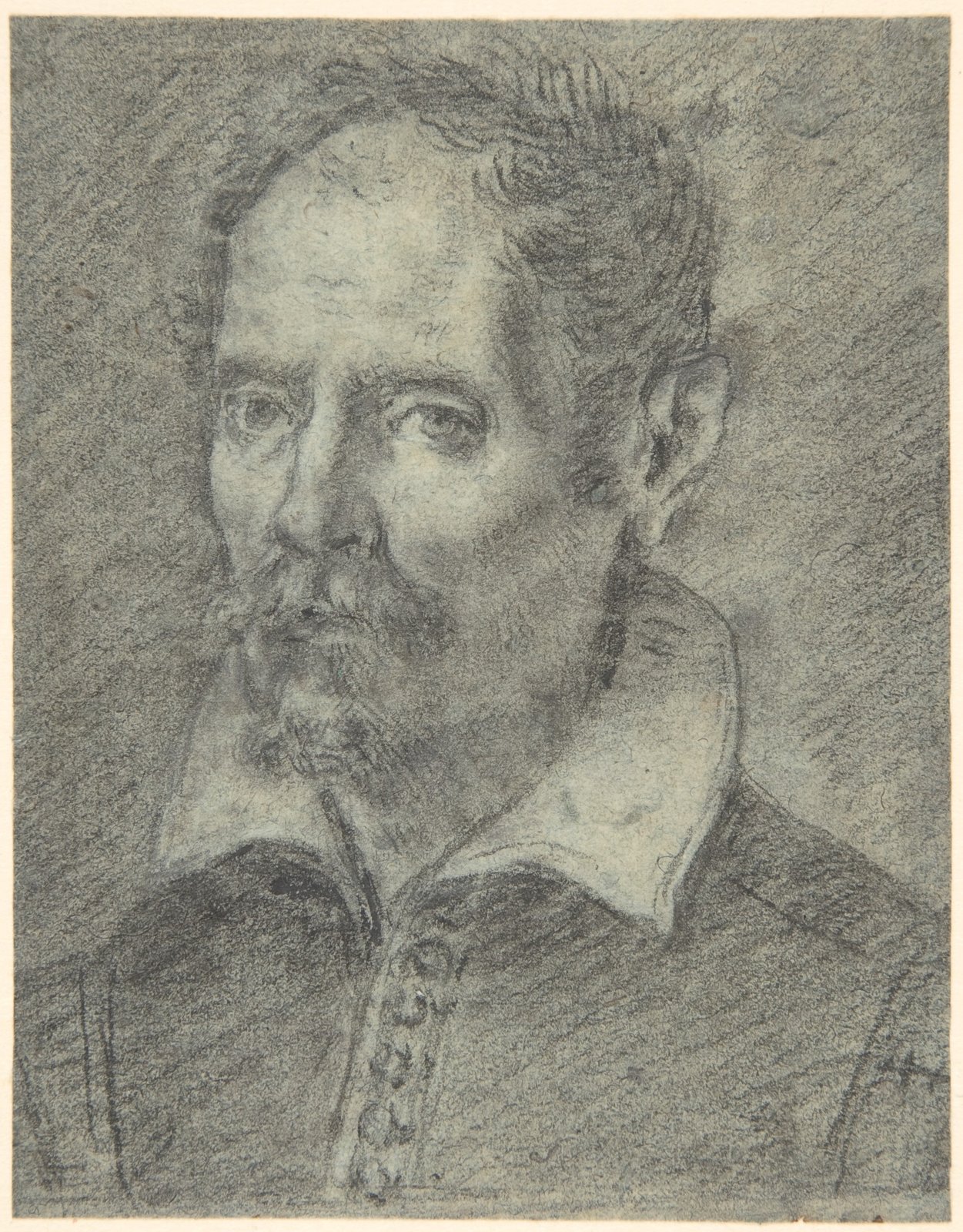
His surviving paintings are in churches and museums in Spain and France, and none of them appears among the public-domain records of the Metropolitan Museum of Art, the Art Institute of Chicago or the Cleveland Museum of Art. One small drawing attributed to him at the Met is public domain, and it is shown below. For more public-domain works to study, browse the MGD museum inspiration collection.
Who was Francisco Pacheco?
Pacheco was born in Sanlúcar de Barrameda, near Cádiz, in 1564 and died in Seville in 1644, according to the Met’s collection record and the Dictionary of Art Historians; the National Gallery in London gives the same dates. The Dictionary of Art Historians says he was brought up by his uncle and namesake, a canon of Seville Cathedral, whose surname he took, and that he trained with the painter Luis Fernández from about 1580, becoming a master painter by 1585.
In 1611 he travelled to Madrid and the Escorial and met El Greco, a visit recorded both by the Dictionary of Art Historians and by France’s national museum database, Joconde. The Dictionary of Art Historians adds that Seville’s city government made him an inspector of the painters’ trade in 1616, and that in 1618 the Inquisition named him an inspector of sacred painting. The National Gallery likewise describes him as a censor of religious art on behalf of the Inquisition.
Teacher of Velázquez
Pacheco’s studio was a training ground. The National Gallery says that both Velázquez and Alonso Cano studied there. The Royal Collections Gallery in Madrid dates Velázquez’s apprenticeship contract with Pacheco to September 1611, and the National Gallery says Velázquez was eleven when he was apprenticed and that he finished in 1617, when he was licensed to set up his own studio. A year later, both sources record, he married Pacheco’s daughter Juana; the Royal Collections Gallery gives the date as 23 April 1618.
The National Gallery credits Pacheco with teaching Velázquez the technical skills of drawing and painting, and its exhibition guide for The Sacred Made Real suggests the young painter probably also learned the painting of sculpture in the studio. The Royal Collections Gallery notes that Velázquez’s 1623 summons to paint the king came through a friend of Pacheco’s.
Key works by Francisco Pacheco
Saint Ignatius Loyola, 1610
The National Gallery’s exhibition guide records this life-size sculpture, carved by Juan Martínez Montañés and painted by Pacheco to mark Ignatius’s beatification in 1609. It is an imagen de vestir, a dressed figure in which only the head and hands were carved and painted. The guide calls it a fine example of Pacheco’s matt technique, which he believed made flesh more natural than a glossy varnish.
The Last Judgment, 1611–14
Joconde records this oil on canvas, 3.38 by 2.35 metres, at the Musée Goya in Castres, bought by the town in 1996. A contract of 28 July 1610 commissioned it for a retable by Martínez Montañés in the convent of Santa Isabel in Seville. The dating is split: Pacheco’s own treatise says he finished it in 1611, while the Latin inscription gives 1614. Joconde relates the composition to El Greco’s Martyrdom of Saint Maurice at the Escorial and notes that Pacheco painted himself among the saved.
Christ on the Cross, 1614
The National Gallery lists this painting, oil on cedar, in the Instituto Gómez-Moreno of the Fundación Rodríguez-Acosta in Granada. It notes the strongly sculptural quality of the figure, which it connects with his work painting carved Crucifixions, and that as a censor he held that Christ should always be shown with four nails, not three.
Saint Francis Borgia, about 1624
Made with Montañés for the Jesuits of Seville to mark Borgia’s beatification in 1624, this sculpture is in the Church of the Anunciación of Seville University. The National Gallery calls it one of the pair’s masterpieces and describes Pacheco working “like a make-up artist”: a darker brown to sharpen the cheekbones, a black line along the eyelids, and egg-white varnish on the eyes so that they sparkle.
What to look at: line, light and the drawing on blue paper
The Met’s drawing is small, 10.8 by 8.4 centimetres, and catalogued as black chalk with traces of white chalk on blue paper. The museum attributes it to Pacheco rather than giving it to him outright, and dates it only to his lifetime. Look at how the paper does the work of a mid-tone. Black chalk builds the hair, beard and dark doublet in hatched strokes, while the white chalk is saved for the collar, the forehead and the lit side of the face.
That three-value system, dark chalk, toned paper and a sparing highlight, is the same economy the National Gallery describes in his sculpture painting, where a single dark line or a touch of varnish brings a face to life.
Measured from the museum’s scan of this impression, the main colours are a shadow grey #6f6d65, a mid-tone #848277, a lighter paper tone #929083 and a highlight #b2b19e. The paper, catalogued as blue, now reads in the scan as a muted grey-green. You can sample your own values with the image colour picker.
Lettering, portraits and the book as a system
Pacheco signed The Last Judgment in Latin, “FRANCISCUS PACIECUS ROMULENSIS DEPINGEBAT”, as Joconde records, alongside an inscription composed by the poet Francisco de Medina.
His portrait book makes the same point at a smaller scale. The Museo Lázaro Galdiano in Madrid, which holds the manuscript, dates it 1599–1644 and describes 56 portraits drawn in red and black chalk on shaded backgrounds, each with a short biography, and praises both the drawings and the calligraphy. It also notes that Pacheco asked in his will for the portraits to be kept together. For designers, it is an early example of a consistent portrait series: one format, one medium, one text block per page.
The treatise: Arte de la pintura
The Dictionary of Art Historians says Pacheco began his treatise in the 1620s and that it was published in Seville in 1649, nearly five years after his death, in three books and an appendix; the National Gallery also dates it to 1649 and calls it influential. The Dictionary of Art Historians describes it as a synthetic work drawing on Italian, German and Flemish theorists.
The National Gallery quotes its advice that a wooden sculpture “requires the painter’s hand to come to life”, and summarises his rules for the Immaculate Conception: the Virgin as a beautiful young girl of twelve or thirteen, with flowing golden hair, serious eyes and a perfect nose and mouth. It adds that Montañés and Pacheco produced several versions of the subject together.
How designers can borrow from Francisco Pacheco
- Write the rules down. His specifications for the Immaculate Conception and the four nails fixed an image so that many hands could produce it consistently. Document proportions, colours and do-and-don’t examples for any recurring character or mark.
- Work on a toned ground. The blue-paper drawing gets three values from two chalks. For quick portraits or icons, start on a mid-tone and add only darks and a few highlights.
- Finish matters. His preference for matt flesh and selective gloss on the eyes is a lesson in surface. In print, a matt stock with a spot gloss on one detail draws the eye exactly where you want it.
- Design the series, not the single. The portrait book’s fixed format, image above a short text, is a ready template for team pages, speaker cards or a biographical feature.
- Treat the signature as typography. A Latin signature and a composed inscription on a large altarpiece show lettering used to authorise an image, an idea that survives in colophons and maker’s marks.
For his pupil’s work, see our guides to Diego Velázquez and Alonso Cano; for the painter he met in 1611, our guide to El Greco; and for the wider period, our guide to Baroque art.
Frequently asked questions
Who was Francisco Pacheco?
He was a painter, teacher and writer in Seville, born in Sanlúcar de Barrameda in 1564 and died in Seville in 1644, remembered today as the teacher and father-in-law of Velázquez and the author of Arte de la pintura.
Was Francisco Pacheco Velázquez’s teacher?
Yes. Velázquez signed an apprenticeship contract with him in 1611, qualified in 1617 and married his daughter Juana on 23 April 1618, according to the Royal Collections Gallery and the National Gallery in London.
What is Arte de la pintura?
It is Pacheco’s treatise on painting, published in Seville in 1649 after his death. It draws on Italian, German and Flemish theorists and sets out rules for religious subjects, such as how to show the Immaculate Conception.
Did Pacheco paint sculpture?
Yes. The National Gallery describes him as celebrated for painting sculpture and as a frequent collaborator of Juan Martínez Montañés, including on Saint Ignatius Loyola (1610) and Saint Francis Borgia (about 1624).