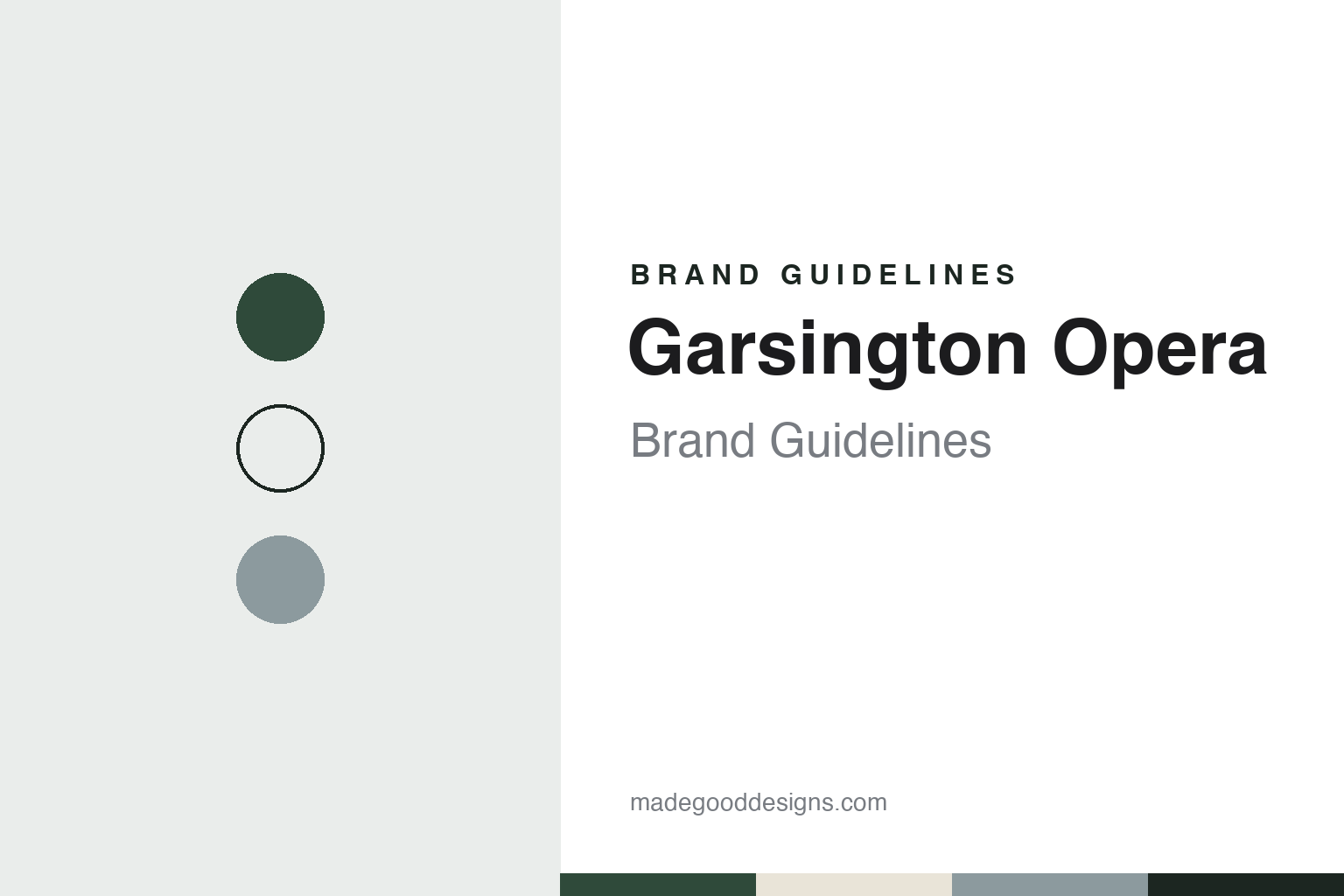
Garsington Opera Brand Guidelines
A country-house festival that moved from a manor loggia to a pavilion in the Chilterns.
Aa
Two constants: a parkland green, canvas and lake grey palette and a garden serif register. Abstract homage — not a Garsington Opera poster or mark; no logo, programme or production image is reproduced.
Garsington Manor
Opera on a stone loggia near Oxford.
Garsington Opera began in the garden of a house. English Wikipedia says the financier Leonard Ingrams and his wife bought Garsington Manor, near Oxford, in 1982, and soon saw its possibilities for outdoor performance. The first opera there came in 1989, when the touring company Opera 80 gave Le nozze di Figaro in aid of the Oxford Playhouse; the company says Garsington Opera was founded that year by Ingrams and his wife.
The new company’s own first season, in 1990, paired Mozart’s Così fan tutte with the British premiere of Haydn’s Orlando paladino, English Wikipedia says. Ingrams asked the Guildhall Strings to play, and within a few years the company had its own orchestra built around that ensemble. From 1993 it staged three productions a summer.
The setting shaped the format. The operas were sung on the manor’s stone loggia, which looks over a flower garden laid out by a former owner of the house. As demand grew, the architect Robin Snell designed a raked seating structure for about 500 people, and in 1995 a PVC fabric canopy, made by the tensile-structure firm Architen Landrell, was added over part of the stage, which stayed open to the gardens behind. English Wikipedia says the whole structure was taken down at the end of every season and the fabric returned to Architen Landrell for storage. The manor’s barn served as the interval restaurant and as a hall for chamber concerts, fitted with panelling from the old auditorium at Glyndebourne, which had been removed when Glyndebourne built its new theatre.
The repertoire mixed familiar works with rarities. English Wikipedia lists British premieres of Richard Strauss’s Die ägyptische Helena, Rossini’s La gazzetta and L’equivoco stravagante and Vivaldi’s L’incoronazione di Dario, and the first British professional staging of Haydn’s La vera costanza and Janáček’s Šárka.
Colour
A pavilion that appears to float.
In April 2008 the Ingrams family gave notice that the manor could not host performances after the 2010 season, as the company needed more space, English Wikipedia says. In April 2010 Garsington Opera announced an agreement with the Getty family to move to Wormsley, their estate in the Chiltern Hills near Stokenchurch in Buckinghamshire. WhatsOnStage reported in April 2011 that the company had negotiated a 15-year lease and described Wormsley as a 2,500-acre estate at the northern end of the Hambleden Valley, with a lake and a deer park.
The new theatre came from the same architect. WhatsOnStage credited Snell Associates with a demountable pavilion of timber, steel and sail fabric, designed to be put up within weeks and taken down again every year. Its design drew on traditional Japanese architecture, the magazine said, with sliding screens, extended platforms, verandas and bridges linking it to the landscape, and it was raised so that it seemed to “float” over a ha-ha that forms the orchestra pit. The auditorium has 600 seats, and transparent PVC side walls let the audience see the park and the sky beyond the stage. “The inspiration at Wormsley was the landscape,” Robin Snell told the magazine.
The first Wormsley season ran from 2 June to 5 July 2011. Seen and Heard International described the pavilion in its season preview as sheltered but only partly enclosed, looking out over a lake with deer in the distance, and said the company would keep its policy of presenting rare works. The three operas were Mozart’s The Magic Flute, sung in English, Rossini’s Il turco in Italia and the British premiere of Vivaldi’s La verità in cimento.
The evening keeps the shape it had at the manor. Performances begin in the early evening with a long interval for dinner, and evening dress is suggested, English Wikipedia says; operas are usually sung in their original language with English surtitles. The orchestral set-up has changed: the Philharmonia Orchestra became a resident orchestra in 2017, and from 2020 the Philharmonia and The English Concert have shared the four productions each summer.
Typography
Opera festivals.
Opera festivals usually present themselves through a place or a person. Many take the name of their town with the word “festival” or “opera” attached, as Aix-en-Provence does; others carry the name of a composer, as the Rossini Opera Festival in Pesaro does, or the name of a house or estate. The name, the town and the stage often become the identity before any logo does.
Most run for a few weeks in summer. The Festival d’Aix-en-Provence takes place principally in July and the Rossini Opera Festival in August, each over a few weeks. Behind them stand non-profit bodies of different kinds: charities, associations and foundations, often with a city council or regional authority among their founders or members. The festival in Pesaro, for example, was set up by its city council in 1980 and became a foundation in 1994.
The settings vary as much as the names. Some festivals perform in castle or palace courtyards under the open sky, as Aix has done in the courtyard of its former archbishop’s palace since 1948; others use country-house theatres, historic Italian-style opera houses, purpose-built modern theatres or converted halls. Many festivals use more than one stage, and the list of venues is often part of how a festival describes itself.
Programmes commonly mix new productions with revivals, concerts and training. Academies and young-artist schemes, such as the Académie in Aix and the Accademia Rossiniana in Pesaro, put early-career singers, directors and musicians on the festival’s own stages. A poster, programme cover or season image is usually made anew for each edition, and Aix, for one, has worked with the same graphic designer since 2019. This guide describes those identities plainly, using our own unofficial colours and type.
Aa
A garden serif for a festival in parkland. (Specimen set in Cormorant Garamond, a serif STAND-IN; NOT the Garsington Opera logo.)
Wormsley
Studios, orchestras and a summer season.
Garsington Opera marked its 25th anniversary in 2014. Opera Today, interviewing the conductor Douglas Boyd that June, described a season of Beethoven’s Fidelio, Offenbach’s rarely heard Vert-Vert and Janáček’s The Cunning Little Vixen, and noted that Boyd had first conducted there as a guest in 2009. English Wikipedia gives 2013 as the year Boyd became artistic director, and the Henley Standard in January 2024 described him as artistic director for eleven years.
The same Henley Standard interview announced the next step: the 2024 season would mark the opening of the company’s studios at the top of the Wormsley estate. Until then, Boyd said, the company had rehearsed all over London; the new building would let it rehearse up to four operas on site and run its young-artist and participation work through the year. The 2024 season included Britten’s A Midsummer Night’s Dream, Rameau’s Platée, a revival of Le nozze di Figaro and a community opera, A Trip to the Moon. The company now describes Garsington Studios as a multipurpose building with two large studios and a smaller one, used for a year-round programme that includes a concert series in association with Wigmore Hall, workshops and community events.
The leadership is shared. In September 2025 the company announced a new executive director, who took up the post in November 2025, with Boyd continuing as artistic director. Its announcement of 8 June 2026 set out a festival running from late May to late July, mixing Wagner’s Der fliegende Holländer, Mozart, Handel and Verdi with a community opera. The company runs an emerging artists’ programme alongside the main season.
For a design guide, Garsington Opera shows how a festival can carry one idea, opera seen against open landscape, from one site to another: a loggia and garden canopy near Oxford, then a pavilion of timber and sail fabric lifted above a ha-ha in the Chilterns. Compare Glyndebourne, whose interval dinner and dress code it shares, and Grange Park Opera, another English country-house company. For this guide we use a parkland green, a canvas white, a lake grey and a dusk rose with a serif, an unofficial interpretation; no product or logo is reproduced.
Explore & save
Keep Garsington Opera’s identity on hand — save it to a board in the Made Good inspiration library.
Garsington Opera identity set
Pin the Garsington Opera parkland green, canvas and lake grey palette and the garden serif register to your own board.
Source & notes
Frequently Asked Questions
What font can I use to match the Garsington Opera look?
This guide describes Garsington Opera’s type as “A garden serif for a festival in parkland”. Its type specimen is set in Cormorant Garamond from Google Fonts as a stand-in; Cormorant Garamond is not Garsington Opera’s own lettering.
What colours are in the Garsington Opera palette?
This guide’s Garsington Opera palette is Chiltern green #2F4A3A, Deep ink #1C2621, Pavilion canvas #E9E4D8, Lake grey #8C9A9E and Dusk rose #B9837A. The tones are the guide’s own unofficial interpretation, not official Garsington Opera hex codes.
When was Garsington Opera founded?
Garsington Opera was founded in 1989, in Garsington Manor, Oxfordshire.
Who founded Garsington Opera?
Garsington Opera was founded by Leonard Ingrams in 1989.