Göteborg Film Festival Brand Guidelines
Gothenburg’s Nordic film week at the turn of January and February.
Aa
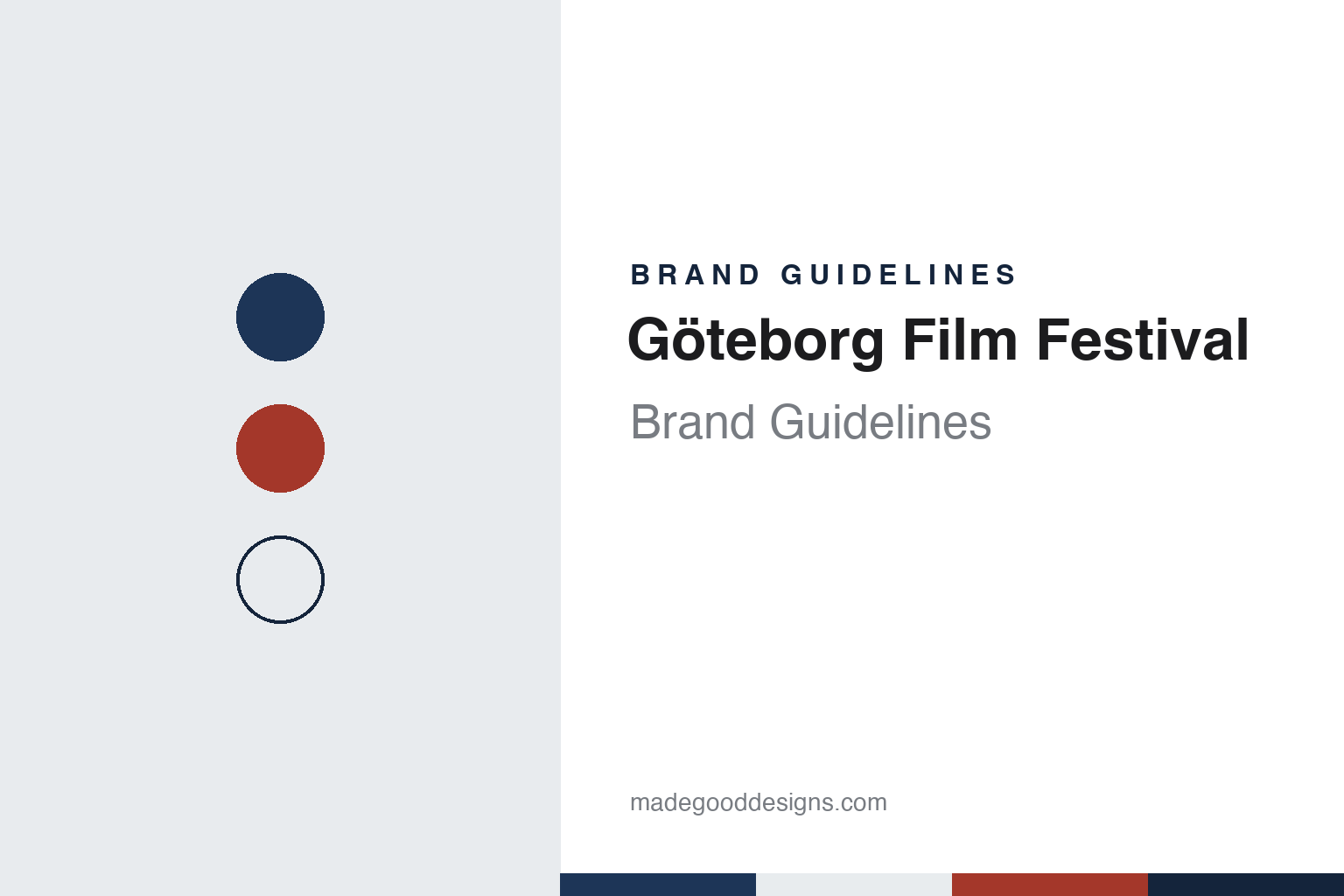
Two constants: a harbour blue, sea mist and brick red palette and a grotesque sans register. Abstract homage — not a Göteborg Film Festival poster or mark; no logo, trailer or still is reproduced.
Seventeen films, three cinemas
Two film enthusiasts and a February weekend in 1979.
The Göteborg Film Festival began in Gothenburg, on Sweden’s west coast, in February 1979. Swedish Wikipedia says the film enthusiasts Gunnar Carlsson and Göran Bjelkendal started planning it in 1978, after a visit to a film festival in Greenwich, because they wanted to show films that reached neither the cinemas nor the two television channels of the time. The opening edition ran from 8 to 11 February 1979 in three cinemas, with 17 films and an audience of about 3,000, according to both the English and the Swedish encyclopedia entries.
The festival grew through the 1980s. Swedish Wikipedia says that for its tenth anniversary in 1988 the programme was widened, and that attendance rose from about 30,000 to about 60,000 that year. From 1989 it took a clearer focus on Nordic film, with the introduction of its own Nordic film prize, and in 1995 it signed a cooperation agreement with the Swedish Film Institute.
The name has shifted in English. From 2007 to 2014 the festival called itself Göteborg International Film Festival, or GIFF, Swedish Wikipedia says; it has since returned to Göteborg Film Festival, written with the Swedish spelling of the city, while English Wikipedia files it under the English form, Gothenburg Film Festival. Its numbering is unusual too: the 1991 edition was the thirteenth but was marketed as the fourteenth, and the count has stayed one ahead ever since, according to Swedish Wikipedia. The Nordic film fund Nordisk Film & TV Fond described the 2025 festival, in January 2025, as the 48th edition.
Colour
Draken, the Dragon Awards and a city of screens.
The festival is run as a non-profit association, Swedish Wikipedia says, with support from bodies including the City of Gothenburg, the Swedish Film Institute, the Västra Götaland Region, Nordisk Film & TV Fond and Scandinavian Films. Its centre is the Draken cinema at Järntorget in central Gothenburg. Other cinemas have varied from year to year; Swedish Wikipedia names Capitol, Hagabion, Bio Roy and Göta, along with theatres including Storan, Aftonstjärnan, Pusterviksteatern and Folkteatern.
The festival’s own website describes an event of eleven days at the turn of January and February, run as a hybrid: a selection of films plays in its cinemas and at the same time in a digital theatre, Göteborg Film Festival Online, for viewers across Sweden. It gives about 270,000 visits a year, in cinemas and online, and about 250 films from 80 countries. Its programming committee, the festival says, travels to festivals and markets including Cannes, Venice and Berlin, and reviews around a thousand submitted films a year.
The prizes carry the dragon in their names. English Wikipedia says the festival’s main award is the Dragon Award of its Nordic competition, for feature films from the Nordic countries; Swedish Wikipedia says the prize was formerly called Nordiska filmpriset and dates from 1989. The programme is split into sections, and English Wikipedia lists strands over the years that have included a Nordic competition, documentaries, debuts and a yearly regional or thematic focus.
The festival also builds around its main week. The festival says it runs Göteborg Film Festival Prisma, a children’s and youth festival, in October; Swedish Wikipedia dates the move to an October slot to 2019, when Prisma replaced an earlier young people’s festival begun in 2012. For the film trade it runs the Nordic Film Market and the TV Drama Vision conference for drama series, according to its website. Since 2014 it has also run Draken Film, a streaming service operated by a wholly owned subsidiary, Swedish Wikipedia says, which offers a few hundred films chosen by the festival’s programmers.
Typography
One form, one city.
A festival devoted to one form of cinema, or tied closely to one city, usually builds its identity from the name outward. The form or the place goes into the title — documentary, short film, fantastic film, or the name of the host city — and the title is then shortened until it works on a lanyard or a ticket. Amsterdam’s documentary festival is known by four letters, IDFA, and Copenhagen’s by a compound with a colon in the middle, CPH:DOX. Once a short name exists, it tends to spread to everything the festival runs: markets, funds, labs, online platforms and touring programmes.
The second layer changes every year. Festivals often commission a new poster, trailer or campaign for each edition, sometimes from an outside artist and sometimes from a studio that develops the look over several years. Each edition is often counted by number as well as by year, so the artwork, the edition number and the dates together mark one festival off from the next, while the name and the shortened form stay fixed.
Sections and strands give the programme a structure that visitors can learn. Competitions, non-competitive sections, thematic pathways, retrospectives and industry forums each carry a name of their own, and those names often follow a pattern — a shared prefix, a shared word, or shared punctuation — so that a schedule reads as one family rather than a list.
Then there are the places. A festival takes over cinemas, theatres, museums and halls for a week or two, and some set up a festival centre or keep a building of their own through the year. The practical design of a visit follows from that: programme books and printed schedules, online timetables, passes and accreditation, signage between venues, and a hub where audiences and professionals meet between screenings. This guide looks at how each festival handles those layers, using dated sources for each fact.
Aa
A plain grotesque sans for a festival that speaks in names: Draken, Dragon, Prisma. (Specimen set in Archivo, a sans STAND-IN; NOT the Göteborg Film Festival logo.)
Göteborg Film Festival
A festival staged as an experience.
In January 2021, Variety reported that the edition of that year was to go online for viewers in Sweden, and that the festival was also staging what it called The Isolated Cinema: one film enthusiast, chosen from applicants, would spend a week alone on the North Sea lighthouse island of Pater Noster, with no phone and not even a book, watching the festival’s 60 premieres. Alongside it, Variety reported, one-person screenings were planned at the Scandinavium arena and at the Draken cinema. The call for applicants came with its own promotional trailer, which Variety described: a young woman shipped to the island under storm clouds, a red carpet laid along the path to the lighthouse, and title cards reading “No phone. No friends. No family.”
Leadership is set out in dated steps. In November 2023, Deadline reported that Pia Lundberg, formerly head of international affairs at the Swedish Film Institute from 2007 to 2018 and before that a film journalist and editor of the Swedish magazine Cinema, had been appointed artistic director from 1 March 2024. Nordisk Film & TV Fond reported in January 2025 that she had just presented the programme for the 48th edition, her first in the role. Swedish Wikipedia lists the festival’s artistic directors in order from the founders onward.
Other side events have their own names. In 2017, Swedish Wikipedia says, the festival opened a free stage called Filmfönstret in the NK building on Östra Hamngatan, with interviews and a daily live concert, open without a ticket or festival wristband. The same encyclopedia gives yearly themes for later editions, such as “homecoming” in 2023.
For a design guide, the Göteborg Film Festival shows how a festival can carry a name across a hub cinema, a prize family and a streaming service, and how a single edition can be staged as an event in itself. Compare Cannes Film Festival and the Berlinale, two of the festivals its programming committee visits, according to the festival. For this guide we use harbour blue, sea mist and a brick red with a grotesque sans, an unofficial interpretation; no product or logo is reproduced.
Explore & save
Keep Göteborg Film Festival’s identity on hand — save it to a board in the Made Good inspiration library.
Göteborg Film Festival identity set
Pin the harbour blue, sea mist and brick red palette and the grotesque sans register to your own board.
Source & notes
Frequently Asked Questions
What font can I use to match the Göteborg Film Festival look?
This guide describes Göteborg Film Festival’s type as “A plain grotesque sans for a festival that speaks in names: Draken, Dragon, Prisma”. Its type specimen is set in Archivo from Google Fonts as a stand-in; Archivo is not Göteborg Film Festival’s own lettering.
What colours are in the Göteborg Film Festival palette?
This guide’s Göteborg Film Festival palette is Harbour blue #1D3557, Night ink #14243B, Sea mist #E8ECEE, Brick red #A4372A and Paper #F7F6F3. The tones are the guide’s own unofficial interpretation, not official Göteborg Film Festival hex codes.
When was Göteborg Film Festival founded?
Göteborg Film Festival was founded in February 1979, in Gothenburg, Sweden.
Who founded Göteborg Film Festival?
Göteborg Film Festival was founded by Gunnar Carlsson and Göran Bjelkendal in February 1979.


