Gustave Loiseau painted rivers, cliffs, village streets and Paris squares and he painted them in weather most people stay indoors for. The Museo Nacional Thyssen-Bornemisza in Madrid notes his preference for rain, frost, fog and overcast skies over bright sunlight. What makes him useful to designers is the surface. He built his pictures from a mesh of short crossing strokes, so that a river bank or a grey sky has a woven, almost textile grain.
Who was Gustave Loiseau?
The Thyssen-Bornemisza museum gives his birth as 3 October 1865 in Paris and his death as 1935, also in Paris. The Art Institute of Chicago and the Metropolitan Museum of Art both list him as French, 1865–1935.
He came to painting through a trade. The Museum Barberini in Potsdam says he was apprenticed as a decorative painter; the Thyssen says he worked with a decorator and painted the outskirts of Paris in his spare time. An inheritance changed that. According to the Thyssen it came from his grandmother and let him paint full time, and the Barberini says it allowed him to enrol at the École des Arts Décoratifs in Paris in 1887. Both the Thyssen and the dealer Stephen Ongpin Fine Art describe him as largely self-taught apart from one year at that school.
He moved to Montmartre, where, the Thyssen says, he met the painter Maxime Maufra, who became a lifelong friend. The Barberini adds that he lived in the studio building later known as the Bateau-Lavoir.
Pont-Aven, Durand-Ruel and a working routine
Brittany was the next step. The Thyssen dates his first visit to Pont-Aven to 1888, with Maufra, and says he met Henry Moret and Paul Gauguin there. The Museum Barberini, the Buffalo AKG Art Museum and Stephen Ongpin Fine Art all give 1890. The Barberini judges that the Pont-Aven School had little influence on him. The Thyssen records that Gauguin gave him a still life when they met again in Paris in 1894.
He showed at the Salon des Indépendants from 1893, according to the Thyssen; Ongpin specifies six paintings that year. The Thyssen says he exhibited at the Galerie Durand-Ruel after 1895, and Ongpin’s biography dates a contract with the gallery to 1897, under which it agreed to buy most of his paintings. Durand-Ruel was the dealer who had backed the painters of Impressionism, so the arrangement placed Loiseau in their commercial line a generation later.
With an income secured, he settled into a routine of travel and return. The Thyssen lists the Seine at Paris, Herblay, Marly-le-Roi and Triel, its tributaries and especially the Yonne, and trips to Étretat, Fécamp and Dieppe between 1902 and 1904. Pontoise appears in his titles as well: the Barberini holds Hoarfrost at Pontoise from 1906. Ongpin quotes him as saying, “I only acknowledge one quality, that of being sincere.”
En treillis: the trellis brushstroke
The Museum Barberini says Loiseau developed a particular hatching technique known as en treillis, and that Divisionism influenced his late Impressionist manner, which he kept into the 1920s. The Buffalo AKG Art Museum describes the technique as a cross-hatched, trellis-like texture that adds depth to his surfaces, and compares his soft palette and methodical brushwork to the late work of Camille Pissarro and Georges Seurat.
In practice the stroke works like this. Short, dry dabs are laid in one direction, and a second set crosses them at an angle. Neither layer fully covers the other. Colours mix in the eye, as they do in Pointillism, but the unit is a small bar instead of a dot, and the crossing gives the surface a direction and a weave. The grid is loose: tighter on walls and roofs, more open in skies.
For a designer the useful point is that the texture is systematic. One mark, repeated at two angles and varied in length, describes stone, foliage, mist and water. A good pattern or icon system behaves the same way.
What to look at in Loiseau’s pictures
Weather as the subject
Titles in museum collections tell you what he was after: Hoarfrost at Pontoise at the Barberini, House in Winter at the Met. The Thyssen says he avoided the bright light of the Impressionists. Frost and fog compress the range of tones, and a compressed range is what lets his broken strokes sit together without flickering.
Rivers, poplars and cliffs as structure
A river bank gives him a diagonal, a row of trees gives verticals, and their reflections repeat the verticals upside down. On the Channel coast the cliff supplies one large shape against sea and sky. Plain compositions leave room for a busy surface.
High viewpoints in town
The Thyssen’s View of Notre-Dame, Paris (1911), on a nearly square canvas of 60 × 60.3 cm, was painted, the museum suggests, from a slightly raised position on the left bank. The museum reads the composition as a set of horizontals and verticals that stress the bulk of the cathedral, and relates it to the Rouen Cathedral series of Claude Monet. In the 1920s, the Thyssen adds, he also turned to still lifes of flowers and fish; the Met’s La Place de la Bastille is dated 1922.
Repetition
He went back to the same places in different seasons. Museum holdings show the pattern: Fécamp appears in the Barberini’s The Beach at Fécamp (about 1910) and again in the Met’s Le Grand Quai, Fécamp (1925). Among his contemporaries, Maximilien Luce offers a useful comparison for how a painter adapted divided brushwork to city and river subjects.
Reading View From an Attic Room
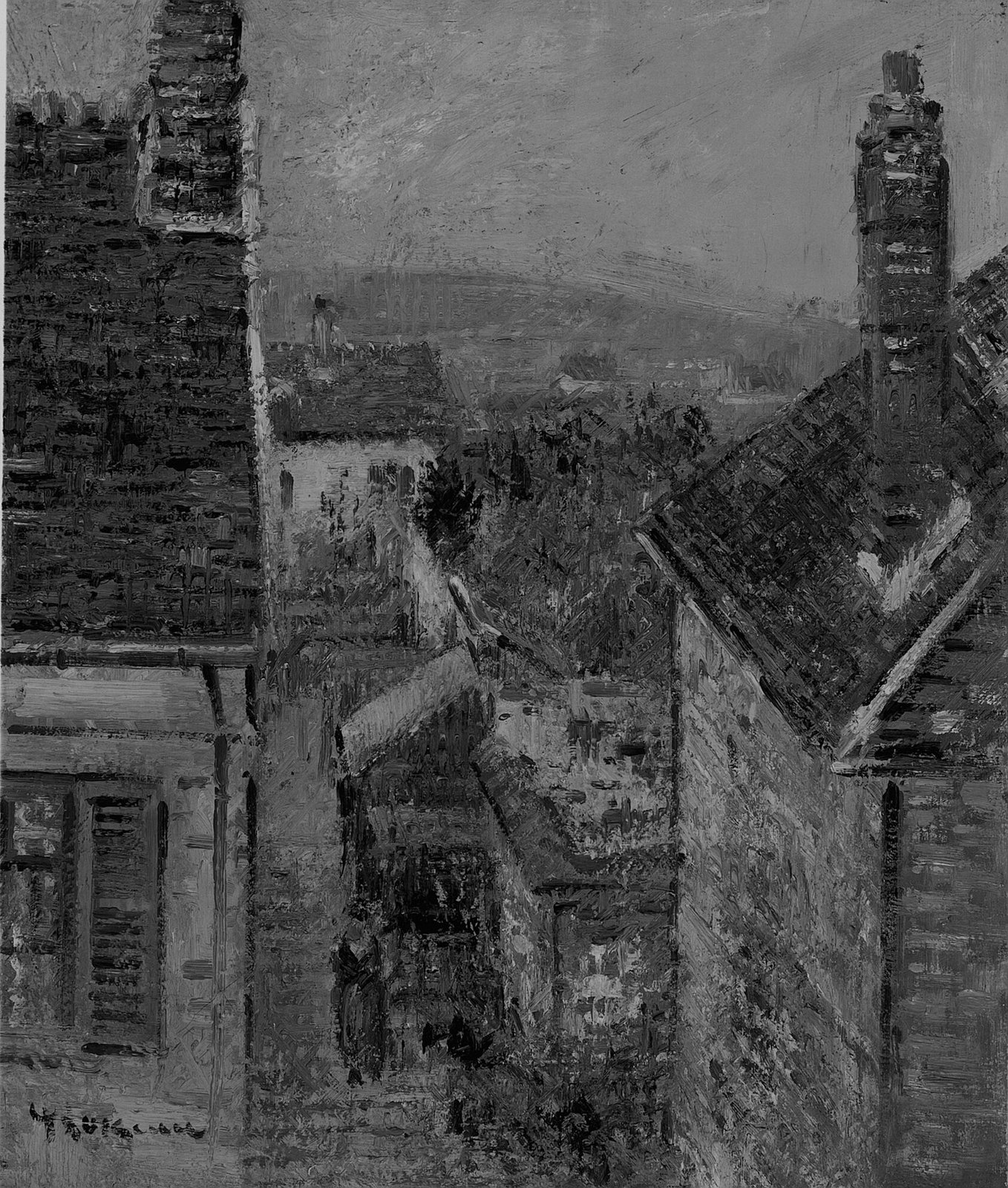
The Art Institute of Chicago holds View From an Attic Room, an oil on canvas of 55.2 × 46.4 cm that the museum dates to about 1890, early in his career. The museum’s published scan is black and white, which removes colour from the discussion and leaves composition, value and touch.
The viewpoint is a high window. Two tall chimney stacks rise at the left and right edges like the sides of a frame. Between them the picture drops through a jumble of tiled roofs, gables and a pale house front, then lifts to a soft line of hill under a blank sky. A shuttered window sits in the lower left corner, with the signature below it.
The brushwork already sorts itself by surface. Roofs and chimneys are built from short horizontal dabs stacked like courses of brick. The sky is brushed in long diagonal sweeps. The distant hill is hardly marked at all. Measured from the museum’s scan of this painting, the tones run from a near-black of #1c1c1c in the deepest roof shadows to mid greys of #737373 and #838383 in the sky and the lit wall, with few values lighter than that. A narrow band of greys carries the whole picture.
How to borrow from Gustave Loiseau today
- Design one mark and cross it. Build a texture from a single short stroke laid at two angles. Vary the length and spacing for different areas and keep the mark itself constant.
- Narrow the value range. Pick a weather condition and limit your palette to the tones it allows. A foggy scheme of mid greys with one slightly warmer note holds dense texture without noise.
- Keep the layout simple when the surface is busy. One diagonal, one row of verticals, one large shape. Save complexity for the fill.
- Frame with edges. The chimneys in the Chicago picture act as side rails. Tall elements at the margins of a poster or hero image hold the eye inside.
- Work in sets. Take one motif through four seasons or four times of day and present the results together. A series reads as a system.
- Test in greyscale. The Chicago scan shows how much of a picture survives without colour. Convert your layout to grey and check that the structure still reads.
To sample tones from a scan, use the image colour picker. The background to his generation is covered in our guide to Post-Impressionism, and more public-domain museum images are collected in the MGD museum collection.
Frequently asked questions
What is Gustave Loiseau known for?
Landscapes of the Seine valley, Normandy and Brittany painted in a late Impressionist manner, and a cross-hatched brushstroke known as en treillis. The Museum Barberini and the Buffalo AKG Art Museum both single out that technique.
What does en treillis mean?
It is French for “in a trellis” or lattice. The Buffalo AKG Art Museum describes it as a cross-hatched, trellis-like texture: short strokes laid across one another so the paint surface looks woven.
Was Gustave Loiseau an Impressionist?
He belongs to the generation after the original group. He was born in 1865, began exhibiting in the 1890s and is usually described as a Post-Impressionist or late Impressionist. The Museum Barberini says he adapted Impressionist motifs and kept to a late Impressionist manner into the 1920s.
Where can I see paintings by Gustave Loiseau?
Museums that list his work include the Museo Nacional Thyssen-Bornemisza in Madrid, the Museum Barberini in Potsdam, the Art Institute of Chicago, the Metropolitan Museum of Art in New York and the Buffalo AKG Art Museum. The Chicago painting shown here is flagged public domain by the Art Institute; check each museum’s rights statement before reusing any other image.