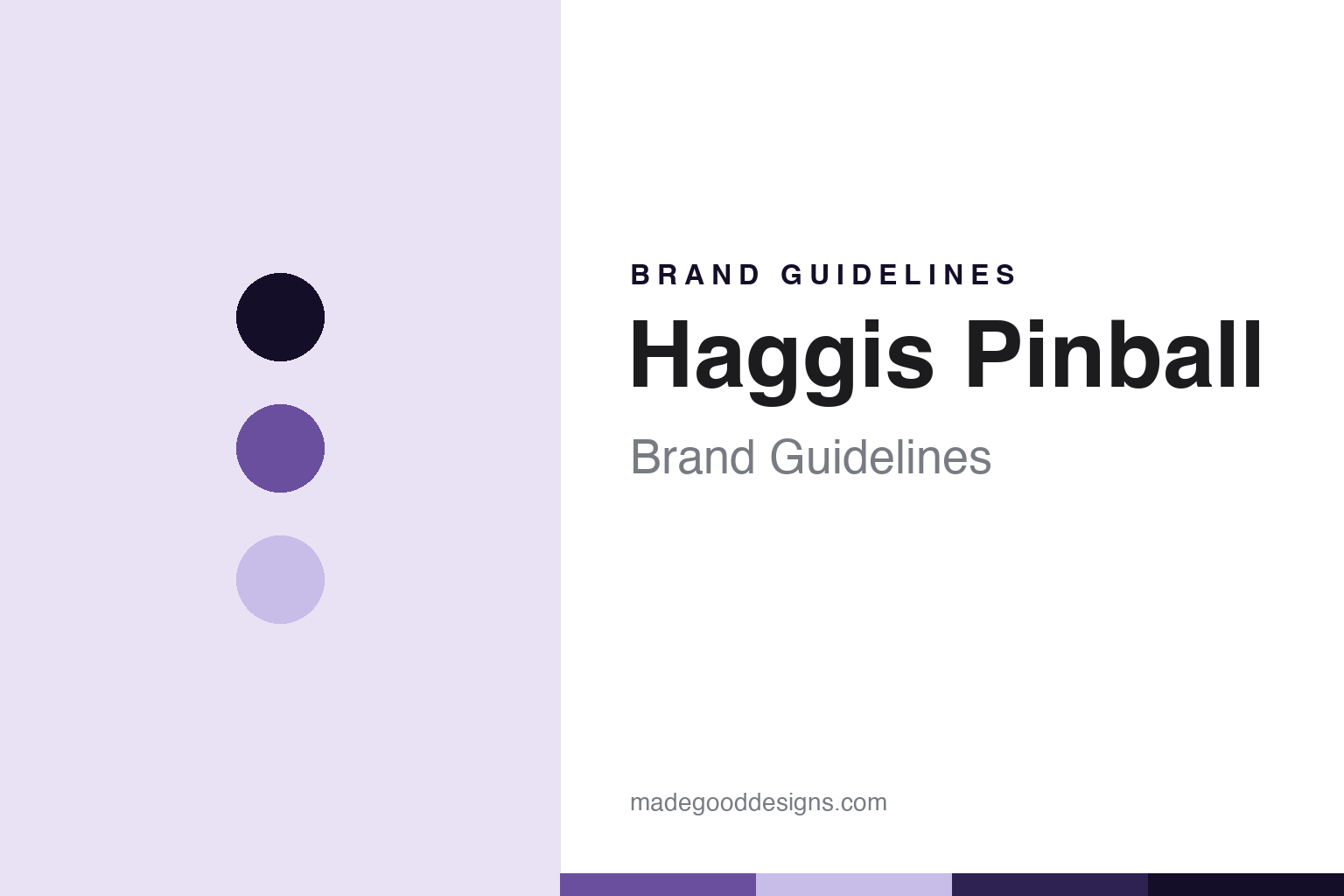
Haggis Pinball Brand Guidelines
The Australian remaker that went under.
Aa
Two constants: a Haggis-violet palette and a legacy-sans register. Abstract homage — not a Haggis product or mark; no pinball, lane or logo is reproduced.
The Australian remaker that went under
Haggis Pinball is the Melbourne boutique (Damian Hartin) that brought back Bally’s Fathom and Centaur before going into liquidation in 2024.
Haggis closes the pinball round as its wound-down node — the international boutique that revived two classics and then, like a number of small makers, could not stay open. Its answer to a round about who makes the machines is a cautionary one: the remaker that went under.
Its identity is the Australian remaker that went under. The Melbourne origin, the Bally remakes and the 2024 liquidation are the story here. The casualty. The Australian remaker that went under.
(Honest notes, so the origin, the status, the products and a trap are framed accurately, especially because this company has wound down. Haggis sold pinball machines as its heroes; we report its language as the brand’s own. On origin: Haggis Pinball was an Australian boutique maker in Melbourne, founded and solely owned by Damian Hartin. On the status: the company went into liquidation in 2024, with liquidators appointed on 18 July 2024, so we say plainly that Haggis ceased operations and entered liquidation in 2024, and we do not describe it as a going concern. On the products: Celts, an original design and its first commercial release, Wraith, an original design left unreleased, and two remakes of classic Bally titles, Fathom Revisited in 2021, after Bally’s Fathom of 1981, and Centaur Revisited in 2023, after Bally’s Centaur of 1981, which we attribute as remakes without asserting a formal licence. On a trap: the pinball company Haggis is not the Scottish food. On the making: Melbourne, Australia, where its factory shut at liquidation. Its designs and the Haggis name are IP we describe but do not reproduce; there is no official brand hex; these tones are an unofficial interpretation.)
Colour
Haggis lives in a Haggis violet. Click a swatch to copy the hex.
Haggis’ identity is reviving, international and wound-down — a Haggis violet, an ink, a pale violet, a deep violet, and a paper. The palette leans Haggis violet and deep violet: a distinctive, considered register that stands in for an international boutique rather than a loud logo colour. It signals the Australian remaker that went under — reviving, international and wound-down. The honest caveat: with no official brand hex, these values are a considered, unofficial interpretation, not first-party colours.
The lesson is a Haggis violet signals a reviving, international identity. Haggis’ world was the classic Bally table brought back under a Southern-Hemisphere roof. For designers, it is a reminder that a distinctive violet and a pale violet can carry a reviving, international brand — a considered tone held as an accent, not a product shot. Because a mid hue can fail as small text, keep type dark and let the colour live in the accents, palette and band. The takeaways: place the origin in Melbourne and name Damian Hartin; state honestly that the company went into liquidation in 2024; credit Celts and the Fathom and Centaur remakes; and keep the name distinct from the food.
Typography
The register is a legacy sans — reviving, international, wound-down.
Haggis’ identity carries a reviving, international spirit — a boutique that brought classics back before closing. A legacy sans captures the mood: clean, plain and honest, the register of a brand whose story is told fairly. Set in a Haggis-violet palette, the legacy sans feels considered and grounded — exactly the personality the name carries now. It behaves like a made, remembered thing rather than a loud logo, mirroring a lane-line and a target-ring. (Haggis’ real products and the name are things we describe but do not reproduce, and the exact typeface is not ours to use.) Because it is not ours to use, the honest description is “a legacy-sans brand,” shown here in a stand-in. The type behaves like the story: reviving, international and wound-down.
Aa
A legacy-sans brand — considered and grounded. (Specimen set in Space Grotesk, a legacy-sans STAND-IN; NOT the Haggis logo or products.)
The pinball node
Haggis stands for the Australian remaker that went under.
Haggis closes the round as its wound-down node. A Haggis-violet palette, a legacy sans and a Melbourne origin make one thing — the Australian remaker that went under — the whole identity: reviving, international and wound-down. The Melbourne origin is the pitch, the Bally remakes are the substance, and the 2024 liquidation is the frame. The point is the boutique that revived classics and could not stay open, closing a round about who makes the machines.
Put to work, the identity is the brand told straight, the status stated honestly and the remakes credited. A brand in this spirit would place the origin in Melbourne and name Damian Hartin, state honestly that the company went into liquidation in 2024, credit Celts and the Fathom and Centaur remakes, and keep the name distinct from the food. A reader in this spirit would keep the facts right: Haggis made pinball machines; it was of Melbourne; it went into liquidation in 2024; and it remade Bally’s Fathom and Centaur. Haggis closes the round, after Multimorphic. The honest editorial moves are to place the origin, to state the status, to credit the remakes, and to keep the name distinct.
For designers and brand-builders, Haggis closes the pinball node: the boom had casualties, and their story is told fairly. The lessons: a reviving industry can lose boutique makers, here Haggis in 2024; an origin is placed in Melbourne, Australia, the company founded and solely owned by Damian Hartin; a status is stated honestly, that Haggis went into liquidation in 2024, liquidators appointed on 18 July 2024, so it ceased operations and is not a going concern; products are credited, Celts, its original first release, Wraith, an unreleased original, and the remakes of classic Bally titles, Fathom Revisited in 2021 and Centaur Revisited in 2023, after Bally’s 1981 machines, attributed as remakes without asserting a formal licence; and a trap is cleared, that the pinball company Haggis is not the Scottish food, its factory in Melbourne having shut at liquidation. It is also a reminder to stay precise and fair to a wound-down brand: Haggis is the international remaker of pinball that went under — with the palette here an unofficial interpretation, and no suggestion that the company still trades. The hook is that fate: Haggis Pinball is the Australian remaker that went under, the Melbourne boutique from Damian Hartin that brought back Bally’s Fathom and Centaur before going into liquidation in 2024. Read that way, Haggis is less a single machine than the Australian remaker that went under: reviving, international, wound-down. The lesson for a brand is that the boom had casualties and their story is told fairly, and stating the status honestly keeps it earned. Haggis made the-Australian-remaker-that-went-under the identity — proof that a wound-down brand can close a round.
Explore & save
Keep Haggis Pinball’s identity on hand — save it to a board in the Made Good inspiration library.
Haggis identity set
Pin the Haggis-violet palette and the legacy-sans register to your own board.