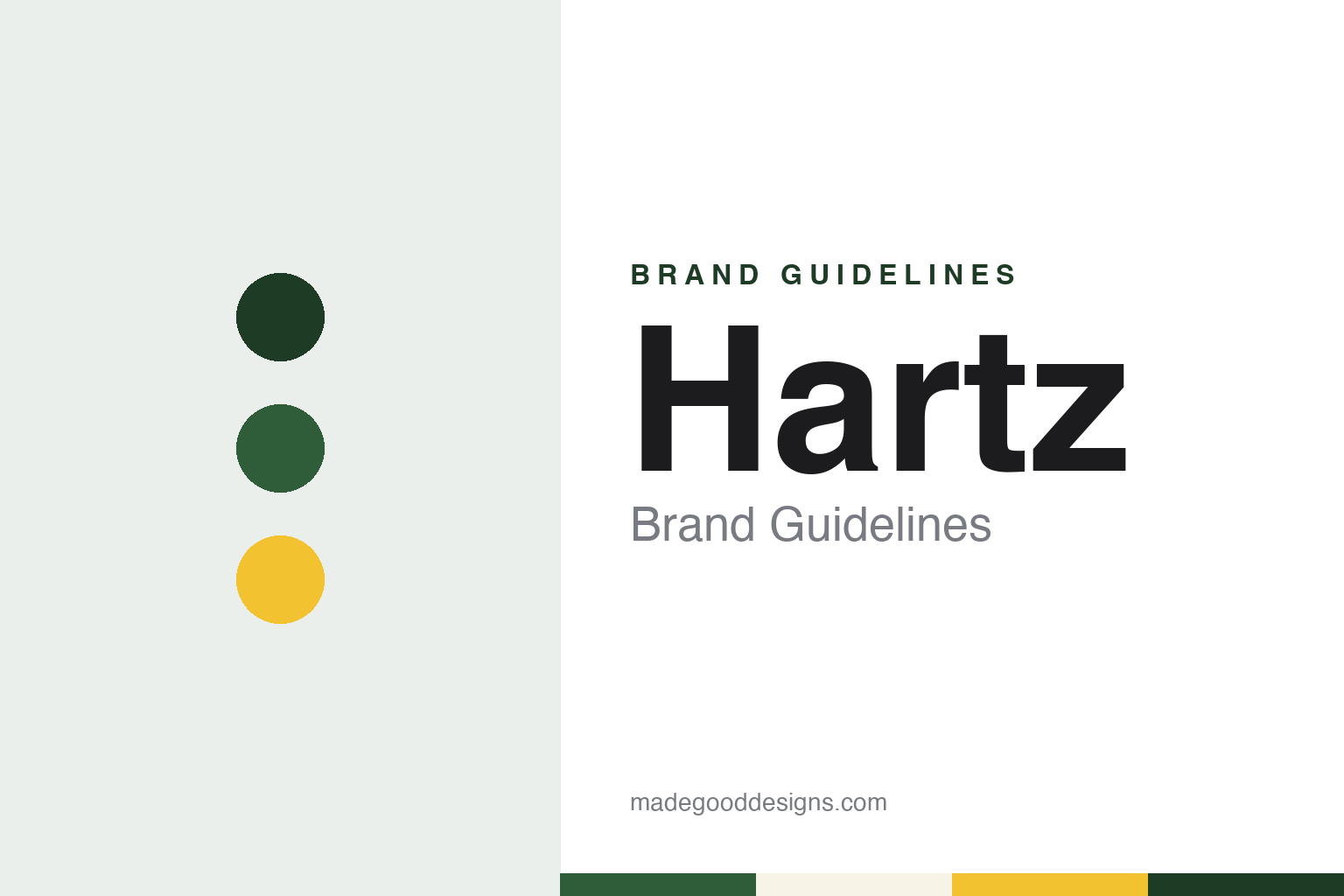
Hartz Brand Guidelines
The pet-care name that began with a shipment of singing canaries.
Aa
Two constants: a Harz pine, canary yellow and seed cream palette and a rounded shelf sans register. Abstract homage — not a Hartz product or mark; no pack, bird or logo is reproduced.
Singing canaries
A debt paid in birds, and a mountain range respelled.
Hartz begins with Max Stern, a businessman from Fulda in the German state of Hesse. A biographical essay by Stacey Patton for Immigrant Entrepreneurship, a project of the German Historical Institute published in 2012, says Stern left Fulda after failing in the textile business and sailed to the United States in 1926, bringing with him a consignment of singing canaries that he had received as payment for a debt. The company tells the same story in its own history: it says a childhood friend of Stern’s, a local pet dealer, could repay a loan only in canaries, and that Stern accepted the birds and decided to sell them in New York.
The company says Stern negotiated free passage on the Hamburg American steamship line and arrived in New York without speaking English. Both sources say he sold the birds to the John Wanamaker department store in Manhattan; the company places that store at Astor Place and says Stern soon set up his business nearby at Cooper Square. He then went back to Germany again and again, returning each time with more birds. Patton names R.H. Macy, F.W. Woolworth and Sears Roebuck among the stores that came to sell his canaries, and the company adds W.T. Grant and S.S. Kresge to the list. Patton describes Stern’s idea as selling live birds in volume through large variety and department-store chains rather than through small local pet dealers.
The name came from home. Patton writes that Stern called the business after the Harz mountain area of Germany and Americanized the spelling by adding a “t”. English Wikipedia’s article on Hartz Mountain Industries links the name to the Harz Roller, a canary associated with the region, and names Gustav Stern alongside Max as a founder of the pet business.
Birds led to bird food. English Wikipedia dates the start of bird-food manufacturing under the Hartz Mountain brand to 1932, and the company says that in 1932 Stern decided to expand into packaged bird foods, the moment it describes as the birth of the Hartz Mountain line of pet products. Patton adds that he moved into bird cages as well, and that the company encouraged retailers to name canaries after singing stars, while the birds themselves sang on radio programmes, accompanied by organ music. The company’s website still carries the line “Caring for pets since 1926.”
Colour
A family business, a sale and two Japanese owners.
The second generation took over in 1959. English Wikipedia and Patton both say that Max Stern’s son Leonard N. Stern took over the family business that year; both say he bought out the shares held by his brother and sister, which English Wikipedia places in the years up to the early 1960s. The company says the product range then widened into goldfish, tropical fish and a full line of aquarium supplies, and that dog and cat products followed in the 1960s. Patton quotes Leonard Stern telling Fortune in 1973 that he had taken Hartz “from canaries into pet supplies”, and records that the company was later joined by Sternco Industries, another pet-supply business controlled by the family.
Patton also traces the company’s years on the stock market: Hartz was taken public in 1972 and taken private again seven years later, when it was folded into the family’s privately held real-estate business. That property side grew into Hartz Mountain Industries, which English Wikipedia says began construction of a speculative industrial building in Bayonne, New Jersey, in 1966 before turning to land in the New Jersey Meadowlands. The company says the 1990s brought the Wardley brand of fish food and supplies, the L/M Animal Farms brand, and rawhide and natural-treat plants in the United States and Brazil.
Max Stern, founder and chairman of the Hartz Mountain Corporation, died in May 1982, the Jewish Telegraphic Agency reported on 21 May 1982; its notice also recorded his long service as a leader of Yeshiva University, where Stern College for Women carries his family’s name.
The pet business left the family in 2000. The company and English Wikipedia both say The Hartz Mountain Corporation was sold that year to the private-equity firm J.W. Childs Associates, together with members of its management. Four years later it changed hands again: Private Equity International reported on 23 August 2004 that J.W. Childs had agreed to sell Hartz to the Japanese trading house Sumitomo Corporation, and Latin Lawyer reported on 24 September 2004 that an acquisition subsidiary of Sumitomo Corporation of America had merged with the Hartz holding company. In a news release of 17 December 2015, Sumitomo Corporation said it had entered the US pet-care business in 2004 by acquiring Hartz, and that it later launched Summit VetPharm as a spin-off from the company.
In December 2011 the Japanese consumer-goods group Unicharm acquired a majority stake in Hartz from Sumitomo, according to Unicharm’s own corporate history and English Wikipedia. The company describes the result as a joint venture of Sumitomo and Unicharm, and says Unicharm entered the pet-care business in 1986. Unicharm’s annual securities report for the year to December 2023 lists The Hartz Mountain Corporation as a consolidated subsidiary in its pet-care segment. The terms of use on the Hartz website name Secaucus, New Jersey, as the company’s principal place of business — the same Meadowlands town where the Stern family’s separate real-estate company, Hartz Mountain Industries, is based.
Typography
Design and documentation.
The brands in this group all sell food for cats, dogs and other household pets. Pet food reaches its buyer through a small set of familiar formats: the printed paper or plastic bag of dry kibble, the steel or aluminium can of wet food, the foil pouch and the cardboard multipack, each stacked in long rows on a supermarket or pet-shop shelf where many rival names sit side by side.
On a crowded aisle, a pet-food brand’s identity is carried mostly by its pack. The front panel usually pairs a wordmark with a photograph or illustration of an animal, a band of colour that separates one recipe or life stage from another, and a short line naming the flavour. The same logo may be adapted for a tall bag, a squat can lid and a small pouch, so its shape, colour and lettering have to hold together at very different sizes and on different materials.
Each guide separates what independent sources record from what the company says about itself — who started the name, who owns it now, and how its labels and advertising have changed — and marks plainly what rests only on the company’s own word.
Aa
A rounded shelf sans — the register of a seed box and a pet-aisle header. (Specimen set in Rubik, a sans-serif STAND-IN; NOT the Hartz logo.)
Hartz
A place name, a bird and a long shelf life.
The Hartz identity starts with the name itself. Patton’s account has Max Stern taking the Harz region of Germany and adding a single letter to make it read more easily in America, and for decades the company traded as Hartz Mountain. The legal entity is still The Hartz Mountain Corporation, the name used in the terms of use on its website, while the consumer pages and the line “Caring for pets since 1926” use the shorter Hartz.
Its early publicity was built around birds and sound. Patton writes that retailers were encouraged to name canaries after singing stars and that the birds performed on radio shows, and she quotes one of the company’s advertising lines, “Perk up your parakeet with Hartz Mountain Parakeet Seed.” She says heavy radio and television advertising spread the name from bird care to products for dogs, cats, rabbits, gerbils and turtles, and that the company sold through mass retail outlets rather than only through local pet shops. The company’s own history names the department and variety stores that sold Stern’s canaries.
The brand now spans several product names. The company’s website groups its range under headings for dogs and cats, covering toys, grooming, chews and pads, and lists brands such as Groomer’s Best, Dura Play, Chew ’n Clean and Nature’s Shield under the Hartz umbrella. The company says its range caters to dogs, cats, parakeets, canaries, parrots, finches, goldfish, tropical fish, reptiles and small animals such as hamsters and rabbits.
For a design guide, Hartz shows how a name taken from a German mountain range, once attached to imported songbirds and boxes of packaged seed, has stayed on pet-shop and supermarket shelves through decades of family ownership, a private-equity sale and two Japanese owners. Compare it with 9Lives and Alpo, two other American pet-food names in this group. For this guide we use Harz pine, canary yellow and seed cream with a sans, an unofficial interpretation; no product or logo is reproduced.
Explore & save
Keep Hartz’s identity on hand — save it to a board in the Made Good inspiration library.
Hartz identity set
Pin the Hartz pine, canary yellow and seed cream palette and the rounded shelf sans register to your own board.