Hashimoto Gaho drew like a classical Kanō painter and composed like someone who had seen a lot of fog. Rocks, pines and roofs are set down with firm, dark strokes; everything around them dissolves into graded silk. That split between a hard edge and a soft field is what makes his small album leaves at the Metropolitan Museum of Art feel so modern, and it is the part designers can use most directly: how much can you leave blurred, and where do you put the one sharp line?
Who was Hashimoto Gaho?
Gahō was born in Edo, today’s Tokyo, in 1835 and died in Tokyo in 1908. Britannica gives the full dates as 21 August 1835 and 13 January 1908, and Japan’s Agency for Cultural Affairs art platform gives the same. His father, Hashimoto Osakuni, was a painter, and both the Fuji Art Museum and the Agency’s biography say Gahō first learned from him before training in the Kanō school under Kanō Shōsen’in Tadanobu. The Agency adds that he was accepted in 1845 by Tadanobu’s father, Kanō Seisen’in Osanobu, who died the same year.
The Meiji period was hard on painters trained for samurai patrons. According to the Agency’s biography, Gahō took a post at the naval academy in 1871 and left it in 1886. His career changed through contact with the American scholar Ernest Fenollosa and the critic Okakura Tenshin (Kakuzō). Britannica describes Fenollosa as encouraging painters such as Gahō and his fellow Kanō artist Kano Hogai in a movement to revive Japanese painting.
When the Tokyo Fine Arts School (Tokyo Bijutsu Gakkō) opened, Gahō taught painting there; Britannica dates his professorship to the school’s opening in 1889, while the Agency’s biography says he taught from 1889 and became a professor in 1890. In 1898 he left the school with Okakura and helped found the Japan Art Institute (Nihon Bijutsuin), as both the Fuji Art Museum and the Agency record. His students included Yokoyama Taikan, named by Britannica and the Fuji Art Museum; our guide to Yokoyama Taikan follows that next generation.
Key works and dates
- White Clouds and Autumn Leaves, 1890, the University Art Museum, Tokyo University of the Arts. A hanging scroll in colour on paper, 265.8 × 159.3 cm, designated an Important Cultural Property in 1955, according to the Agency for Cultural Affairs. The museum’s record notes that it was shown at the Third National Industrial Exposition.
- Album leaves, ca. 1885–89, the Metropolitan Museum of Art (14.76.61). Small landscapes in ink and colour on silk, each about 36 × 26 cm, from the Charles Stewart Smith Collection, given in 1914.
- Cherry Blossoms and Autumn Leaves, about 1893, a pair of hanging scrolls in colour on silk, and Mount Fuji, 1903, ink and light colour on paper, both listed by the Fuji Art Museum.
What to look at in Hashimoto Gaho’s paintings
Hard edges inside soft space
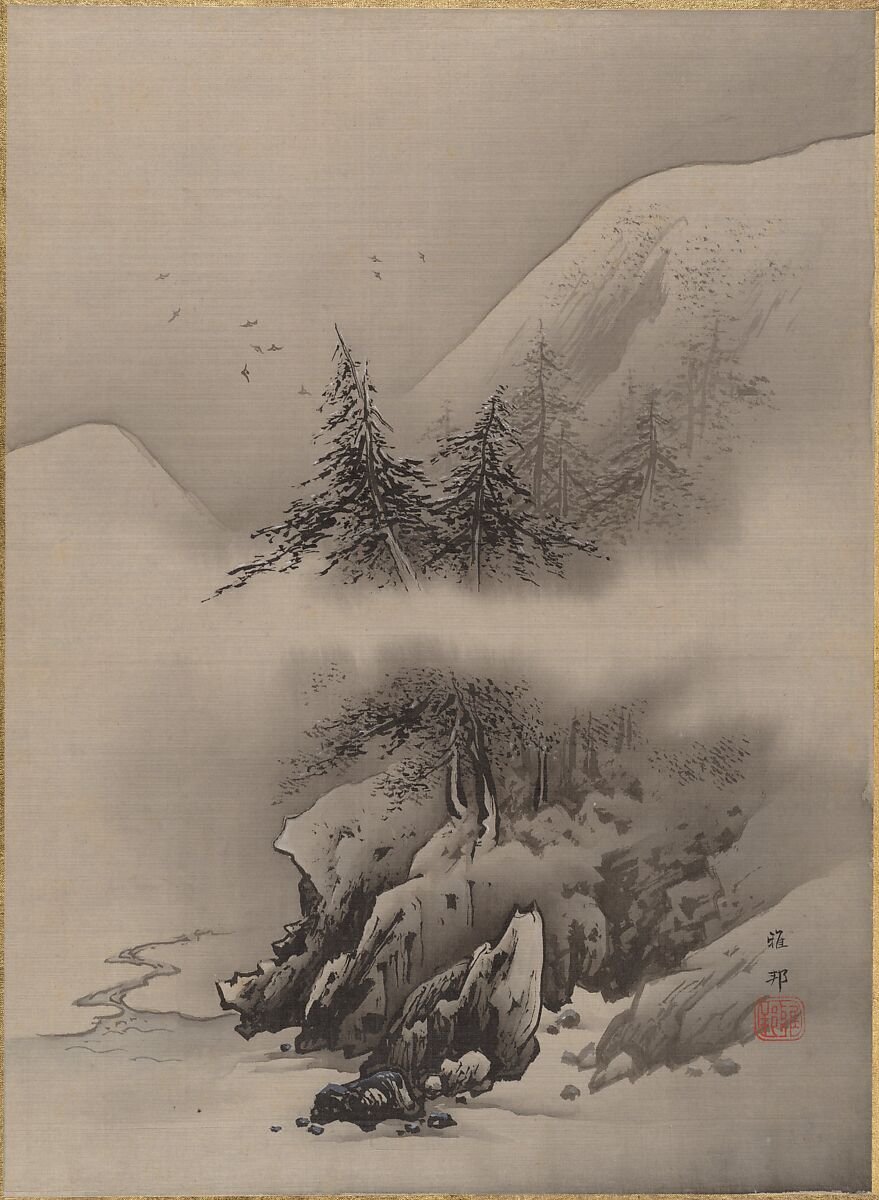
In Snow Landscape, the pines and boulders are the only firm marks. Snow is simply unpainted silk, and the mist is a wash that thins out until it disappears. The result is depth without any perspective lines: the sharper and darker a shape is, the closer it feels. Measured from the museum’s scan of this leaf, the silk reads around #b1a190, the mist around #938578 and the darkest ink near #61564d.
Mountains as silhouettes
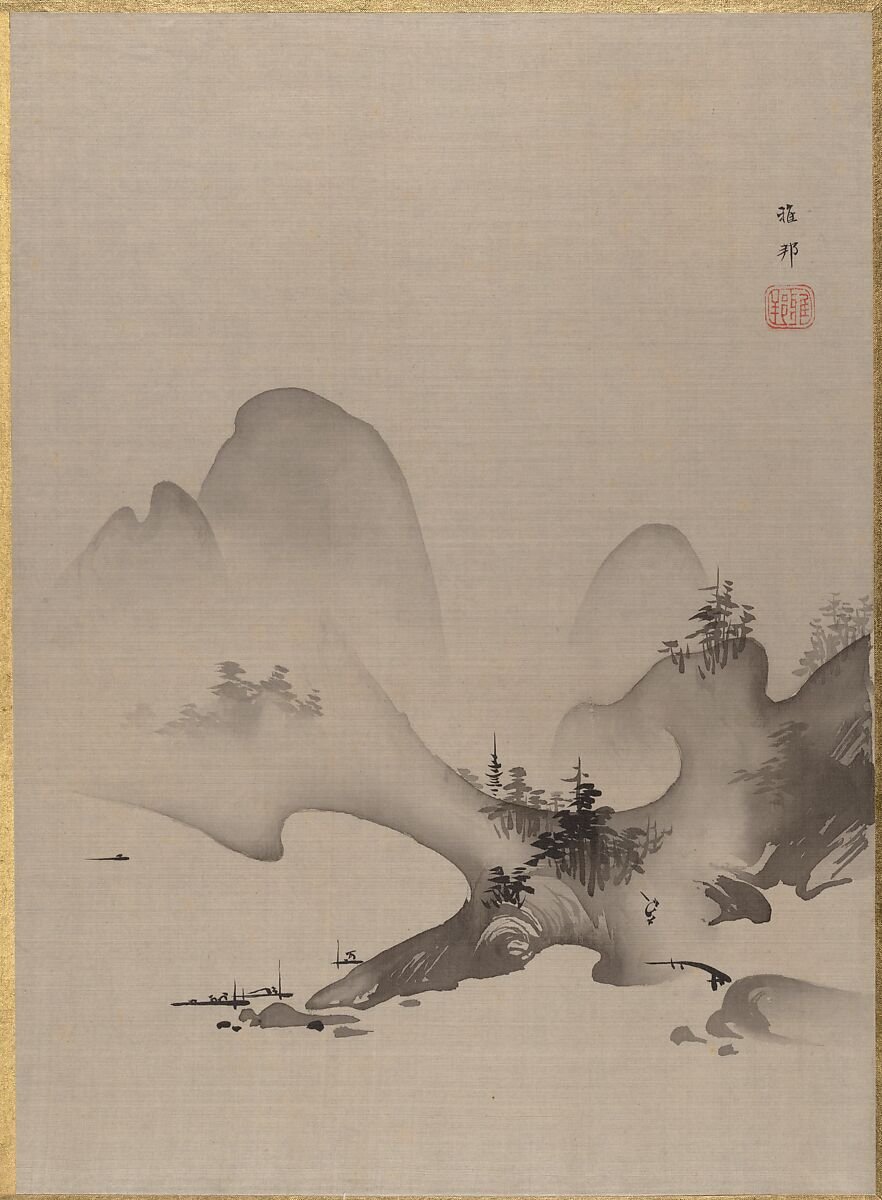
Lake and Mountains reduces the peaks to pale grey shapes with no outlines at all. Only the rocky spit in the lower centre gets real drawing. It reads almost like a layered vector illustration: three or four flat tonal planes stacked from back to front, with detail kept for the nearest one.
Signature and seal as a full stop
Each Met leaf carries a short brush signature, the two characters of “Gahō”, with a small red seal beneath. They sit in an empty patch of silk, sometimes a top corner, sometimes beside the lowest rocks, and act as the only saturated colour on the page. The same signature with a double-bordered seal is recorded on White Clouds and Autumn Leaves by the Agency for Cultural Affairs.
Light that comes from tone, not colour
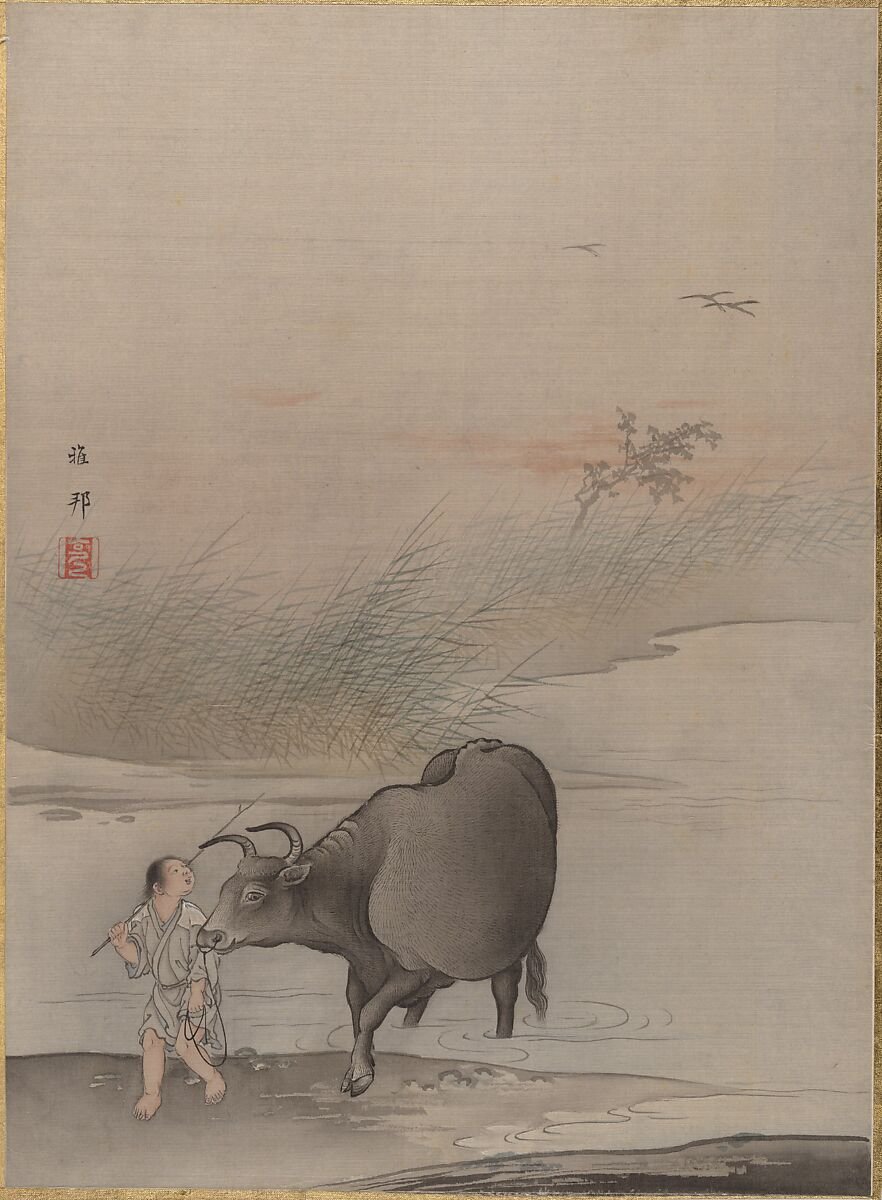
In Boy with Cow at the River’s Edge, the animal is a dense, modelled mass of grey, while the reeds behind are fine, quick strokes and the sky has the faintest warm flush. The light is suggested by how the wash fades, not by bright pigment. The Tokyo University of the Arts museum, in its text on White Clouds and Autumn Leaves, describes Gahō combining traditional technique with Western perspective and light and shade; these leaves show a gentler version of the same thinking.
Technique: Kanō brushwork, new space
The Tokyo University of the Arts museum describes the lower half of White Clouds and Autumn Leaves as a waterfall, rocks and trees in ink, reflecting his Kanō training, and the upper half as a deep ravine with white clouds touched with gold paint and gold powder. That is a useful key to his method: the classical vocabulary of rocks and trees stays, but it is placed in a deeper, more atmospheric space.
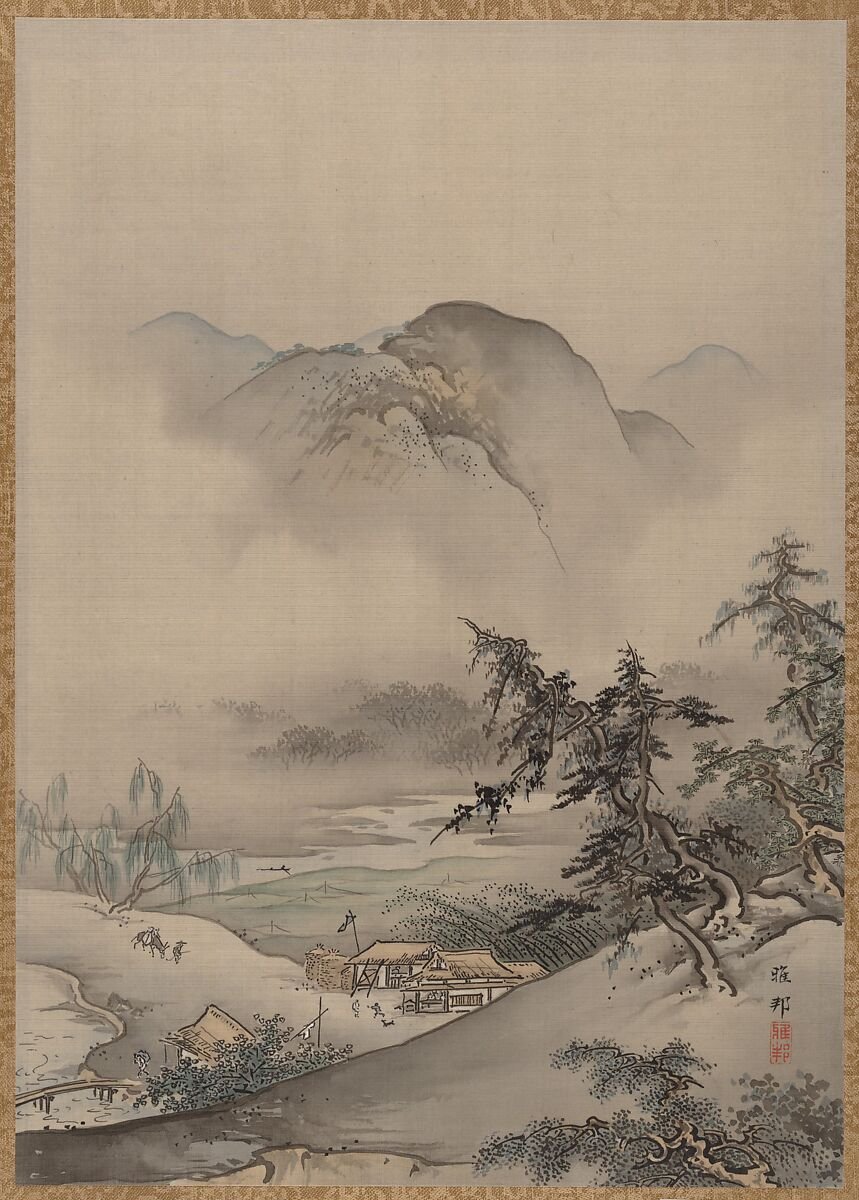
The Met leaves are on silk, which takes wash smoothly and gives the mist its even gradients. Look closely at Landscape below. The village roofs and the gnarled pines in front are drawn with a dry, broken stroke; the far hills are touched with blue-green; and a wide band of fog separates near and far. Measured from the museum’s scan, the silk sits near #baa992, the mid ink near #6c6154 and the deepest accents close to #31281e.
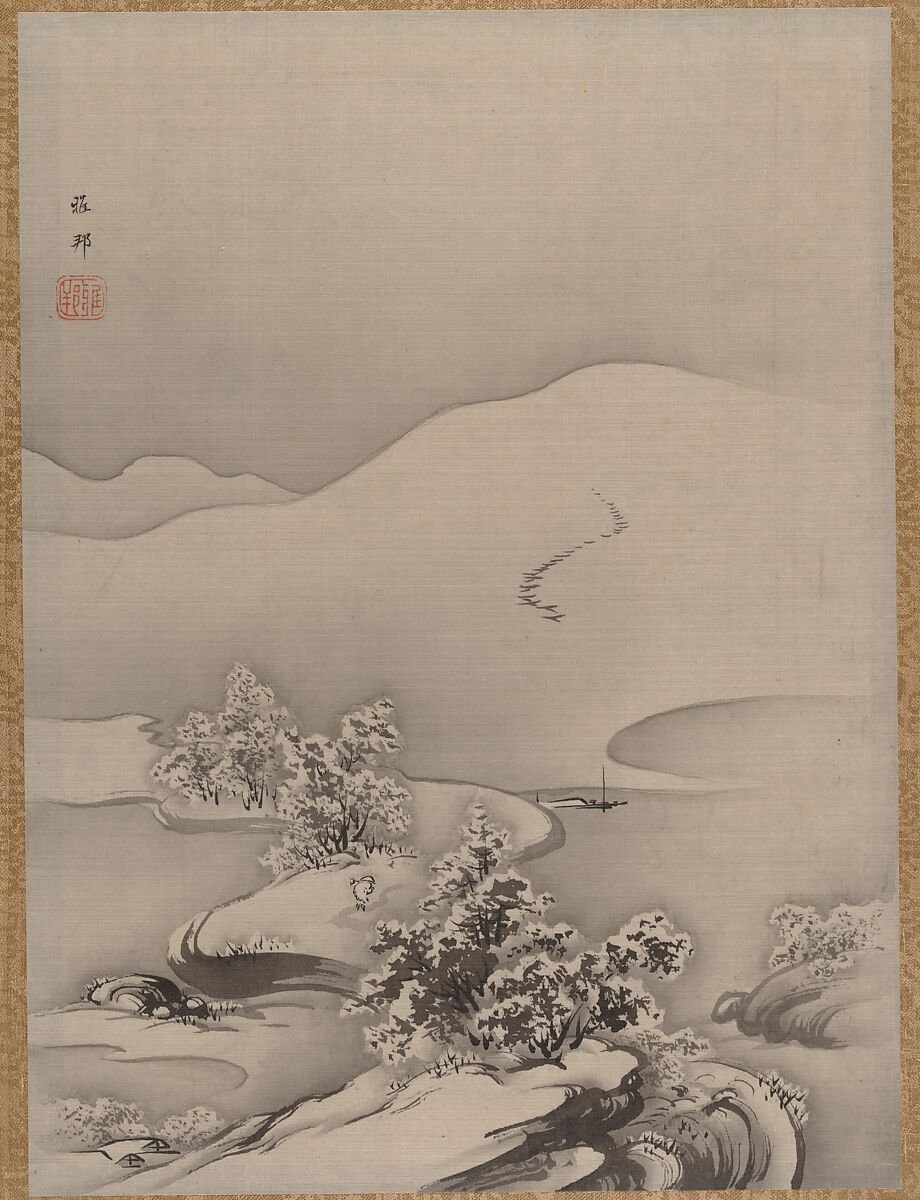
In Lake and Causeway, he goes further still. Snow-laden trees and a winding causeway occupy the lower half; above them, white hills and sky merge into the same pale silk, with only a thin dark wisp to mark a path in the distance. Most of the picture is the ground colour itself.
How designers can borrow from Hashimoto Gaho
- Build depth from contrast, not perspective. Put your sharpest, darkest element nearest the viewer and let each layer behind lose contrast and edge. It works for hero images, layered landscape illustration and parallax web sections.
- Let the ground do the work. In several leaves, unpainted silk stands for snow, water and sky. Treat your background colour as an active part of the image rather than empty space to fill.
- Keep one saturated accent. Gahō’s red seal is the only strong colour on a grey page. A single brand-colour mark on a muted layout can carry the same authority.
- Pair two drawing languages. Crisp outline for the subject, soft gradient for the setting. In UI or editorial illustration, mixing a line style with a blurred or gradient field keeps hierarchy clear.
- Start from a warm-grey palette. Try the silk, mist and ink values above in our colour palette generator, then add one red.
For the wider story of Japanese painting from the Kanō school onward, see our overview of Japanese art.
Where to see Hashimoto Gaho’s work
The Metropolitan Museum of Art holds the album leaves shown here, which its open-access data flags as public domain. In Japan, White Clouds and Autumn Leaves belongs to the University Art Museum, Tokyo University of the Arts, and the Fuji Art Museum in Tokyo holds several scrolls, screens and an album; check each owner’s rights statement before reproducing those images. For more cleared works from Japan and elsewhere, browse the MGD museum inspiration collection.
Frequently asked questions
Who was Hashimoto Gaho?
Hashimoto Gaho (1835–1908) was a Japanese painter trained in the Kanō school who taught at the Tokyo Fine Arts School and helped found the Japan Art Institute in 1898. He is closely associated with the rise of Nihonga, Japanese-style painting of the Meiji era.
What is Hashimoto Gaho’s key work?
White Clouds and Autumn Leaves (1890), a large hanging scroll at the University Art Museum, Tokyo University of the Arts, is designated an Important Cultural Property of Japan.
Who studied with Hashimoto Gaho?
Britannica and the Fuji Art Museum name Yokoyama Taikan among his students; Britannica also names Kawai Gyokudō.
Are Hashimoto Gaho’s paintings in the public domain?
The Met album leaves shown here are flagged public domain in the museum’s open-access data. Works held by Japanese museums are subject to each owner’s own image rules.