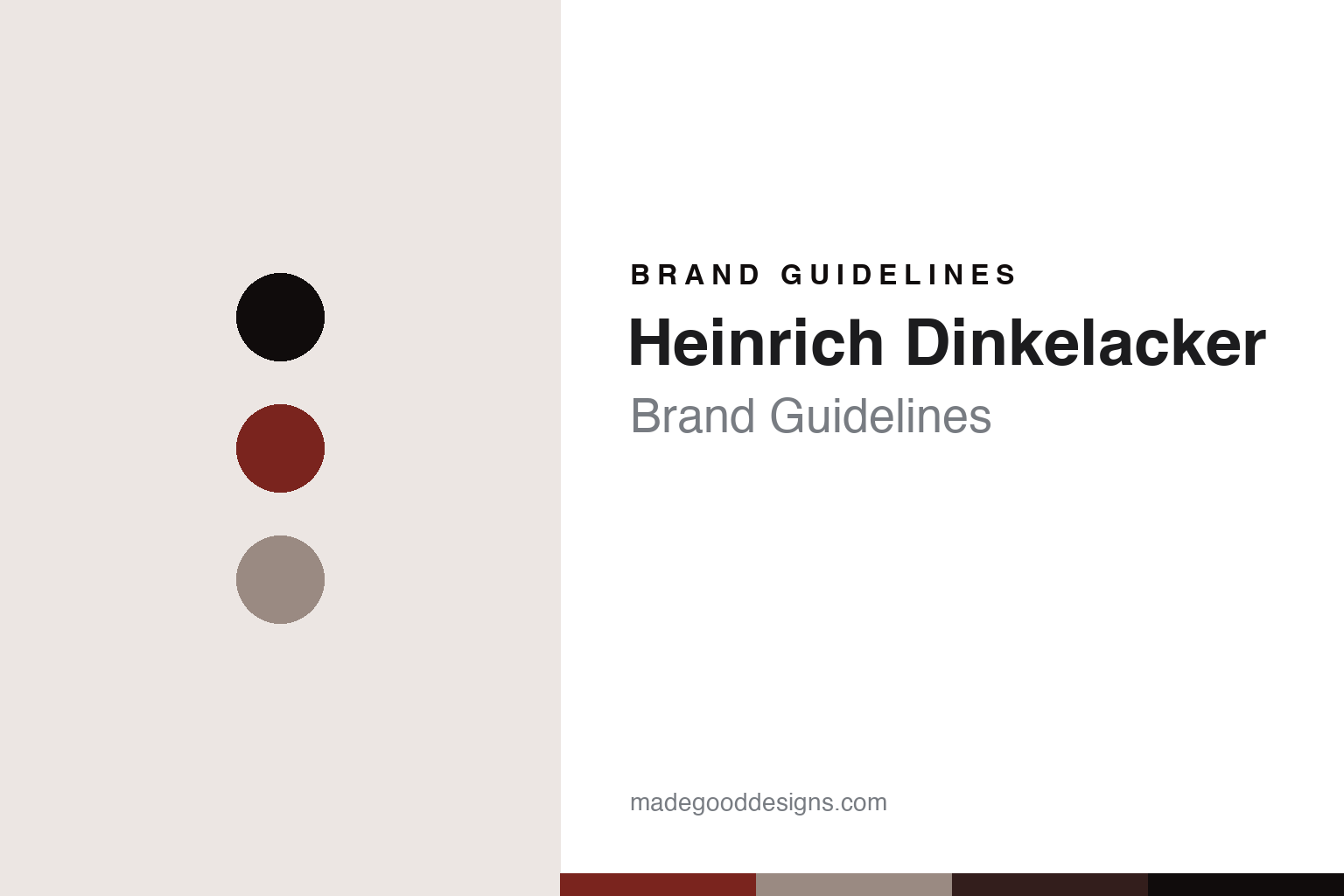
Heinrich Dinkelacker Brand Guidelines
The German Budapester.
Aa
Two constants: a Budapester-red palette and a heritage-sans register. Abstract homage — not a Heinrich Dinkelacker shoe, last or wordmark.
The German Budapester
Heinrich Dinkelacker is a German Budapester brand, made in Europe, whose geography and ownership have moved over time.
Heinrich Dinkelacker is a lesson in a construction style as the identity — with an honest, moving geography. It is a German brand built on the heavy Budapester: a broad-toed, robustly welted shoe with substantial soles and extensive hand-work. Its answer to how a welted shoe is made, around the world, is unusually literal — the making itself has travelled — and that is exactly why it is worth telling straight. A German name whose shoes have been made in more than one country.
Its identity is the German Budapester, made across Europe. Heinrich Dinkelacker’s Budapester build, its heavy welted soles and its extensive handwork are the work it is known for. A style, made a signature — with a geography that has changed. A brand whose story is where it has been made.
(Honest notes, so the story stays precise, because the geography is the point. Heinrich Dinkelacker was founded in 1879 by Heinrich Dinkelacker in Sindelfingen, in Germany’s Württemberg region — not Stuttgart. It is a German brand, but it has not been made in Germany in the modern era: production moved to Budapest, Hungary in the 1960s for roughly half a century, and, per public reporting, moved again to Almansa, Spain around 2020, with some elaborate models made in Italy. Its current site markets “100% European production” and the “Budapester construction,” and notably does not claim a Budapest address — so we say made in Europe, and describe its Budapest era in the past, rather than asserting a present Budapest workshop. On ownership, it is not an independent family firm today: it has been owned by Berlin-based Shoepassion since 2016. It is a welted, Budapester specialist with extensive handwork; the “Budapester” itself is a general style, not something this brand owns. Its designs and marks are its IP, described but never reproduced, and there is no official brand hex — these tones are an unofficial interpretation. This is design commentary and does not promote any product.)
Colour
Heinrich Dinkelacker lives in a Budapester-red palette. Click a swatch to copy the hex.
Heinrich Dinkelacker’s identity is heavy, robust and Central-European — a Budapester red, an ink, a calf grey, an umber, and a chalk. The palette leans Budapester red and calf grey: the register of a deep-red, broad-toed welted shoe and a robust build. It signals substance and heft over delicacy. The honest caveat: with no published brand hex, these values are an original, unofficial interpretation, not first-party colours.
The lesson is a Budapester-red palette signals a heavy welted identity — wherever it is made. Heinrich Dinkelacker’s world is a robust, hand-worked, Budapester-style object, now made across Europe. For designers, it is a reminder that a deep oxblood red and a soft calf grey can carry a brand built on a heavy construction — the red of a substantial shoe and the grey of the last. Because these tones can fail as small text, keep type dark and let the colour live in the accents, palette and band. The takeaways: own the style; be honest about where you make; be clear about ownership; and treat any single hex as unofficial.
Typography
The register is a heritage sans — solid, plain, Germanic.
Heinrich Dinkelacker’s identity carries a solid, plain, Germanic spirit — a heavy heritage brand, not a delicate one. A heritage sans captures the mood: even, sturdy and unornamented, the register of a robust Budapester maker. Set in a Budapester-red palette, the heritage sans feels solid and plain — exactly the personality the brand carries. It is substantial rather than refined, mirroring a heavy welted shoe. (Heinrich Dinkelacker’s real designs and marks are things we describe but do not reproduce, and the exact typeface is not ours to use.) Because it is not ours to use, the honest description is “a heritage-sans spirit,” shown here in a stand-in. The type behaves like the maker: solid, plain and Germanic.
Aa
A heritage-sans spirit — solid and plain. (Specimen set in Work Sans, a heritage-sans STAND-IN; NOT the Heinrich Dinkelacker wordmark or any shoe design.)
The dress shoe around the world
Heinrich Dinkelacker stands for the Budapester — honestly located.
Heinrich Dinkelacker is a lesson in making a construction style the identity — and telling its geography honestly. A Budapester-red palette, a heritage sans and a heavy welted shoe make one thing — the robust Budapester — the whole brand: heavy, robust and Central-European. The Budapester build is the differentiator, and the moving geography is the honest complication. The point is a genuinely heavy welted object whose making has travelled — Germany by name, Budapest for decades, Europe today — a story better told straight than smoothed over.
Put to work, the identity is honest geography as design. A maker in this position would be candid that its nationality, its heritage-making place and its current making can all differ, rather than implying a single tidy origin. It would market the construction it actually makes — the Budapester style — without claiming to own a general category, and would be clear about who owns it now. A brand learning from it would see that provenance honesty is itself trust-building — that “a German brand, long made in Budapest, now made in Europe under new ownership” is more credible than a false “made in Germany” — and that a construction style can anchor an identity even when the address changes. A brand learning from it would also treat a generic style name as shared heritage, not private property. The lesson Heinrich Dinkelacker teaches is that a construction can hold an identity while its geography moves: the Budapester build gives it substance, and honesty about location gives it integrity. The style is the personality, and the heavy welted shoe is the proof.
For designers and brand-builders, Heinrich Dinkelacker holds the honest-geography pole in this round about the dress shoe around the world: anchor on the construction, and tell the where-and-who straight. The lessons: own the style, not the category; state where you actually make; disclose the owner; and never reproduce a protected design. It is also a reminder to stay precise: Heinrich Dinkelacker is a German Budapester brand founded in 1879 in Sindelfingen, made in Budapest for decades and now across Europe (reported Almansa, Spain, with some models in Italy), owned by Berlin-based Shoepassion — with the palette here an unofficial interpretation. Heinrich Dinkelacker made the Budapester the identity — proof that a construction can be the difference, even as the geography moves.
Explore & save
Keep Heinrich Dinkelacker’s identity on hand — save it to a board in the Made Good inspiration library.
Heinrich Dinkelacker identity set
Pin the Budapester-red palette and the heritage-sans register to your own board.