Hendrik Willem Mesdag spent most of his working life looking at one line: where the North Sea meets the sky off Scheveningen. He came to painting late, after years in his father’s bank, and turned that subject into seascapes, etchings, crayon notes and, in 1881, a panorama that wraps right around the viewer. That makes him a useful reference for layouts built on a strong baseline, a limited palette and texture. Two works flagged CC0 or public domain by Cleveland and Chicago are shown below; the rest is described in text.
What to look at in Hendrik Willem Mesdag’s seascapes
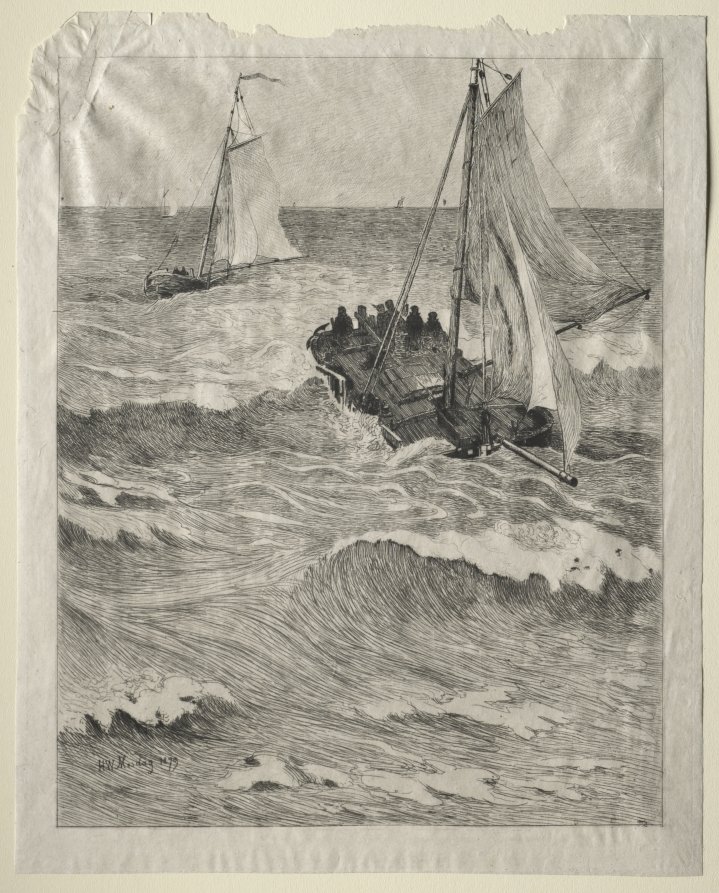
Start with the horizon. In Marine Scene, the etching of 1879 in Cleveland, the line of the sea sits about a quarter of the way down the sheet. The two boats ride across that boundary, their masts breaking into the pale sky.
Next, look at the direction of the marks. The foreground waves are drawn with long, curving lines that sweep from left to right and then curl over into white crests. Further back, the lines grow shorter and flatter until the sea at the horizon is a band of fine horizontal strokes. That change in mark length does the work of perspective without any vanishing lines.
Then look at the white. The crests of the breaking wave in the foreground and the sails are left as bare paper. The dark hulls sit right next to those whites, which is where the eye lands first.
Finally, look at the signature. On the museum’s scan, “HW Mesdag 1879” is scratched into the plate at the lower left, inside the image, small enough to read as part of the sea.
Palette: measured greys from the North Sea
Measured from the Cleveland Museum of Art’s scan of this impression of Marine Scene, the plate area quantises to a slate grey #6e6b60, a mid grey #969185, lighter greys #afaa9c and #bfb9aa, and a pale paper tone #cbc5b7. These are scan measurements, not the original ink and paper, but they show how close together the values sit: five steps of warm grey are enough for sea, sky and boats.
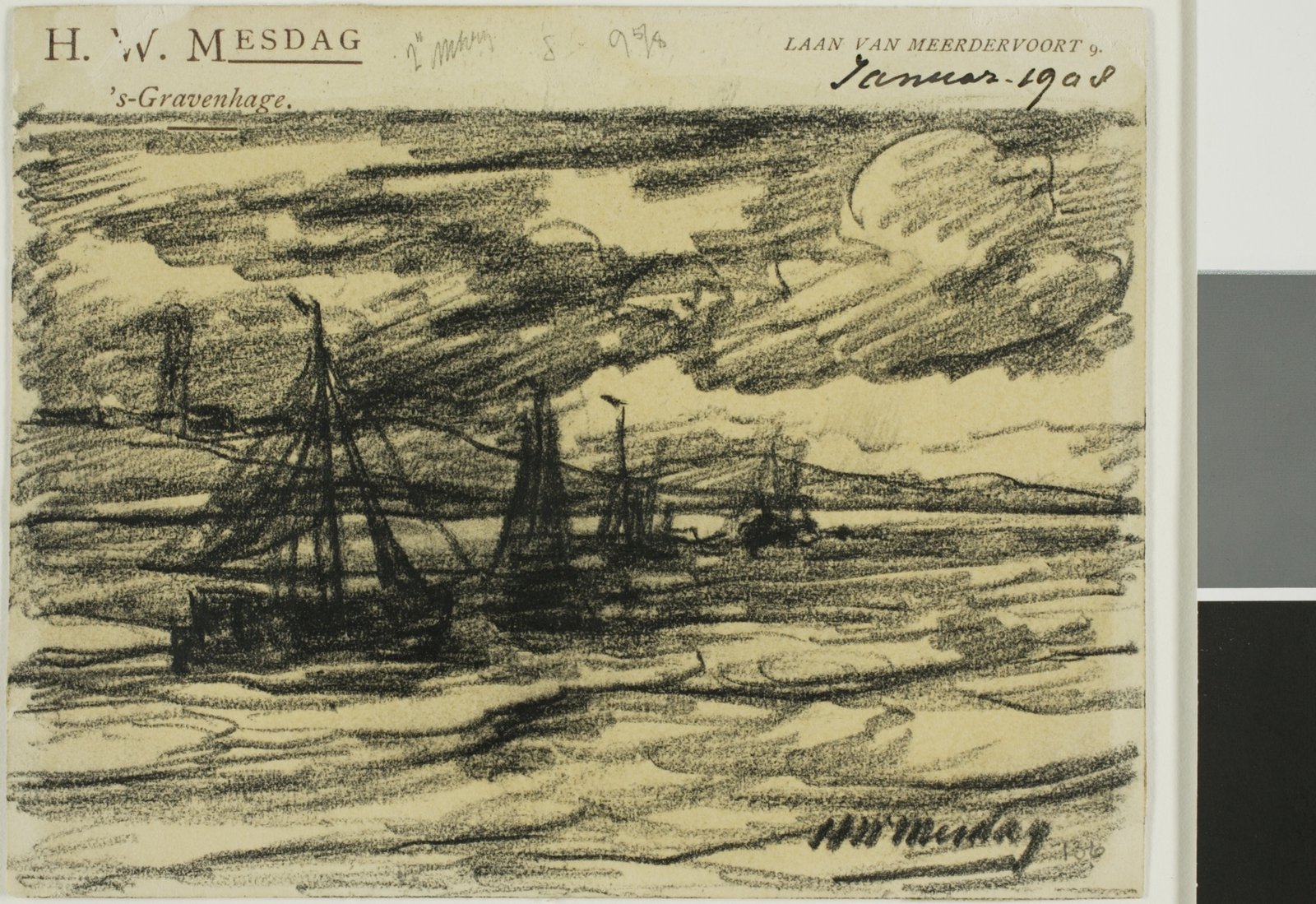
The crayon sketch Sails of 1908, in the Art Institute of Chicago, has a warmer range. Measured from the museum’s scan of this sheet, the drawing area gives a near-black olive #3d3c2c for the crayon, a mid khaki #767053, a sand #a39b74 and two cream tones, #c0b689 and #cac094, for the card. You can sample tones like these from a reference you have the right to use with the image colour picker.
Lettering and format: a sketch on a letterhead
Sails is small. The Art Institute records it as black crayon on cream card, 9.4 by 13.5 centimetres. What makes it interesting for designers is the card itself. Across the top runs a printed heading: “H. W. MESDAG” in capitals at the left, with “’s-Gravenhage” in italic beneath, and “LAAN VAN MEERDERVOORT 9” in small capitals at the right. Below that, a handwritten date gives January 1908, and the drawing fills the rest of the card, signed “HW Mesdag” at the lower right.
The address is the street where, according to the Van Gogh Museum Journal and Museum Boijmans Van Beuningen, Mesdag lived and built his own museum beside his house in 1887. The card shows a working artist using his stationery as a sketch pad, and it shows a clean hierarchy: name, city and address set in type, the date in script, the drawing as the main event.
The crayon itself is quick: broad sideways strokes for a sky that fills more than half the card, a few hard verticals for the boats and a dark band of scribbles for the sea.
Career outline: from banker to marine painter
Mesdag was born in Groningen on 23 February 1831, according to the University of Glasgow’s Whistler catalogue and the record of his 1856 civil marriage. Museum Boijmans Van Beuningen notes that he worked in his father’s banking business until 1866, when he committed to art at the age of 35. Boijmans, the Glasgow catalogue and Museum Panorama Mesdag all record that he then trained in Brussels with the landscape painter Willem Roelofs.
In the spring of 1869 he moved to The Hague, as both Boijmans and Museum Panorama Mesdag record, and the sea at nearby Scheveningen became his main subject. In 1870 a seascape won him a medal at the Paris Salon; the Glasgow catalogue names it as Breakers in the North Sea and describes the medal as gold. He became a central figure in the Hague School of painters, and the Glasgow catalogue and Museum Panorama Mesdag both describe him as a long-serving chairman of Pulchri Studio, the Hague artists’ society.
He worked alongside his wife, the painter Sientje Mesdag-van Houten (1834–1909). Together they collected Hague School and French Barbizon paintings and, in 1887, opened a museum next to their house on the Laan van Meerdervoort. According to Ronald de Leeuw’s history of the museum in the Van Gogh Museum Journal, they gave the collection and the building to the Dutch state on 14 May 1903; the Glasgow catalogue also dates the gift to 1903. It is now known as The Mesdag Collection. Mesdag died in The Hague on 10 July 1915, as both sources record.
The Panorama of Scheveningen
The work Mesdag is known for is the Panorama of Scheveningen. Museum Panorama Mesdag records that Brussels entrepreneurs commissioned it in 1880 and that it opened on 1 August 1881. The museum gives its size as 14.6 metres high and 114.5 metres in circumference, and says it was painted in about four months. Sientje Mesdag-van Houten, Bernard Blommers, George Hendrik Breitner and Théophile de Bock helped with the painting, according to both the museum and the Glasgow catalogue.
The painting hangs in a circle around a central viewing platform raised over an artificial dune, so that, as the museum describes it, visitors seem to stand on the Seinpost dune. From there the scene runs right round: the sea and the beach with fishing boats drawn up on the sand, bathing carriages, cavalry on the beach, a steam tram in the dunes and the old village of Scheveningen, with the church towers of The Hague in the distance.
For designers, the panorama is a lesson in continuous layout. With no frame edge, the horizon carries the whole image, and boats, dunes and village are spaced along it like items on a timeline. The same thinking suits scrolling pages, long banners and wraparound packaging.
Technique: oil, etching and quick crayon notes
Mesdag worked in several media. The Cleveland Museum of Art catalogues Marine Scene as an etching, and the Art Institute catalogues Sails as black crayon. Museum Panorama Mesdag says that from 1870 he spent almost every day on Scheveningen beach, watching the fishermen and the changing light, and the Glasgow catalogue notes that he painted outdoors. For the printmaking side, the guide to etching explains the process.
His approach sits close to the realism of the period: coastal working life, observed directly. Among his Hague contemporaries, Jacob Maris worked with similar grey skies, and the Glasgow catalogue compares the mood of the panorama to his.
How designers can borrow Mesdag’s ideas today
Fix one horizon. Choose a single baseline and keep it constant across a page, a scroll or a series of panels. Let headlines and images cross it, as Mesdag’s masts cross the sea line, rather than sit on random heights.
Use mark length as depth. Long, curved strokes in the foreground and short, flat strokes in the distance create space in a pattern, an illustration or a textured background without any shading.
Work in five greys. A palette of near-neutral greys and sands, like the ones measured above, gives a calm base for editorial, maritime or heritage brands. Add a single accent only where it is needed.
Let paper be the highlight. Leave the brightest areas empty, as Mesdag leaves wave crests and sails.
Treat stationery as a stage. Like the Sails card, set name and address small in type and leave the rest open.
More public-domain marine drawings and prints are gathered in the MGD museum collection.
Frequently asked questions
Who was Hendrik Willem Mesdag?
Hendrik Willem Mesdag (1831–1915) was a Dutch marine painter and collector, born in Groningen and active in The Hague from 1869.
What is the Panorama Mesdag?
It is Mesdag’s Panorama of Scheveningen, a 360-degree painting that opened in The Hague on 1 August 1881. Museum Panorama Mesdag gives its size as 14.6 metres high and 114.5 metres around, and it is still on view there.
What is The Mesdag Collection?
It is the museum that Mesdag and his wife, Sientje Mesdag-van Houten, opened beside their house on the Laan van Meerdervoort in 1887, holding Hague School and French Barbizon paintings. They gave it to the Dutch state in 1903.
Can I use Hendrik Willem Mesdag’s works in my designs?
The two works shown here are flagged CC0 by the Cleveland Museum of Art and public domain by the Art Institute of Chicago. Check the licence of any other image before using it; the design ideas themselves are free to apply in original work.