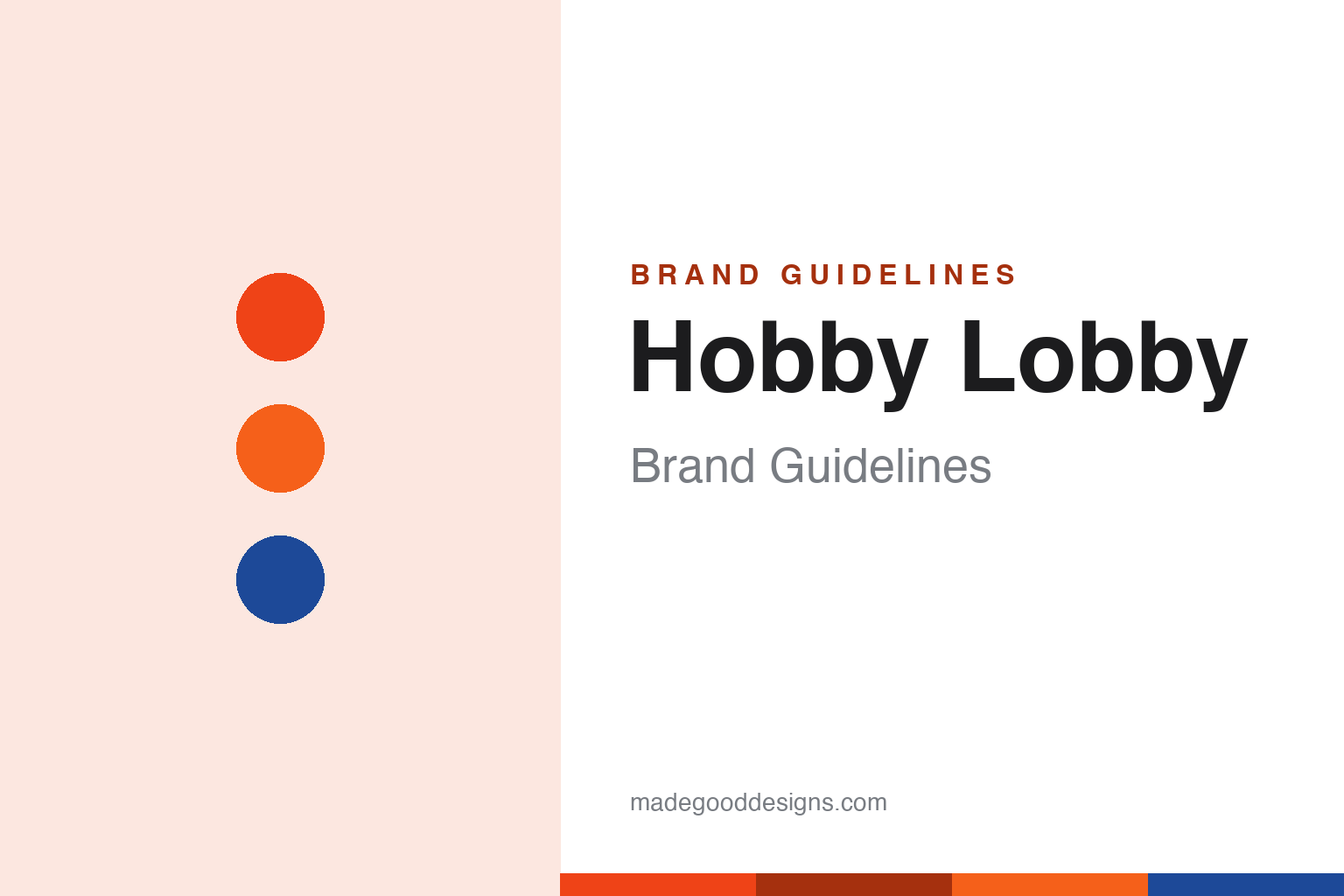
Hobby Lobby Brand Guidelines
A crafts superstore run on convictions — a red wordmark, closed Sundays, and a landmark court case.
Aa
Two constants: a red-orange palette and a bold sans. Abstract homage — not the Hobby Lobby wordmark.
A crafts chain run on convictions
Hobby Lobby grew from a garage business.
Hobby Lobby is a lesson in a brand defined by its owners’ convictions. It was founded by David Green in 1972 in Oklahoma City, growing out of Greco Products — a home-based business he started in 1970 with a $600 loan, assembling and selling miniature picture frames from his garage. The first Hobby Lobby store (about 300 square feet) opened in 1972, and it grew into a big-box arts, crafts, fabric, floral, framing, home-décor and seasonal-goods retailer with more than a thousand stores — a major rival to Michaels and the now-defunct JoAnn. (Honest caveats: no official brand hex or wordmark typeface is published, so the colours and type here are approximate.)
What sets Hobby Lobby apart is that it’s a private, family-run company operated on evangelical Christian principles. Most visibly, all its stores close on Sundays so employees can rest and worship — a policy estimated to cost the chain enormous annual sales — and stores also close early (8 p.m.), with weekly hours capped for employee family time. Reported factually and neutrally, these values-driven operating choices are central to how the company presents itself and are unusual for a national retailer.
Two documented legal chapters are part of the public record. In Burwell v. Hobby Lobby (2014), the US Supreme Court held, 5–4, that the Affordable Care Act’s contraception mandate violated the Religious Freedom Restoration Act as applied to closely-held for-profit corporations — a landmark ruling. Separately, in 2017 the company agreed to a $3 million federal fine and forfeited thousands of ancient artifacts smuggled from Iraq and mislabeled on customs forms. On ownership, in 2022 David Green announced he had moved 100% of the voting stock into a trust, describing the family as stewards. The identity is a bold red / red-orange wordmark (an important correction: it’s not black). A retailer where values shape the business.
Colour
Hobby Lobby lives in red-orange. Click a swatch to copy the hex.
Hobby Lobby’s palette centres on a bold red / red-orange (a correction worth noting — the current wordmark is not black, as sometimes assumed), often set in a red square with white letters, with a blue script accent for taglines. The red-orange reads as warm, energetic and inviting, matching a big-box crafts store where creativity and value meet, while the blue adds a friendly secondary note. It’s a bold, warm, high-recognition scheme that stands out on a large storefront and feels approachable and craft-friendly. The honest caveat: Hobby Lobby publishes no official public brand hex — the red-orange (community-cited near #EF4317) and blue here are observed approximations, not confirmed values.
The lesson is check the real mark, not the assumption. Hobby Lobby’s wordmark is red-orange, not the black many assume — a reminder to verify current brand assets. For designers, it’s also a case for a warm, inviting primary in a creative category. The takeaways: use a warm, energetic primary for a crafts/creative brand (the red-orange); add a friendly secondary accent (the blue); and treat specific hexes as approximate — and verify the current mark — when no official spec is published.
Typography
The wordmark is a bold, extra-heavy sans — confident and warm.
Hobby Lobby’s bold, extra-heavy sans wordmark — in red / red-orange, often reversed white in a red square — is confident and warm. The chunky, all-caps letters read as strong, dependable and approachable, matching a large, welcoming crafts store, and the warm red-orange keeps it inviting rather than corporate. It’s legible and no-nonsense, designed to be read clearly on a big-box storefront, with a friendly blue script sometimes used for taglines. (An honest note: the wordmark is red/red-orange, not black.) (Because the exact face is undocumented, the honest description is “a bold, extra-heavy sans,” not a named font.) The type behaves like the brand: confident, warm and approachable.
Aa
A bold, extra-heavy sans — confident and warm. (Specimen set in Anton, a heavy sans in the spirit of the Hobby Lobby wordmark; the real face is undocumented.)
When values define the brand
Hobby Lobby lets convictions shape operations.
Hobby Lobby is a lesson in a brand shaped, unusually, by its owners’ convictions. Most retailers optimise purely for sales; Hobby Lobby makes operating choices — closing on Sundays, capping hours — that reflect the family’s stated values, even at a significant financial cost. Whatever one thinks of those values, the consistency between belief and operation is itself a form of strong branding: the company is recognisably, distinctively itself. Its identity (the bold red-orange wordmark) is the visible surface, but the brand is really defined by how thoroughly its principles are woven into the business. It’s a reminder that a brand can be a direct expression of its founders’ worldview.
For designers and brand-builders, Hobby Lobby offers a clear takeaway (reported neutrally): consistency between stated values and actual operations is a powerful, distinctive form of branding. The lessons: when a brand stands for something, let it show in real decisions (the Sunday closures); keep the visual identity bold and consistent (the red-orange wordmark); and verify current brand assets rather than assuming (it’s red, not black). It’s also a reminder to keep the facts precise — Hobby Lobby was founded by David Green in 1972 (from a 1970 garage business), is a private, family-run, values-led chain that closes on Sundays, was the subject of the 2014 Supreme Court Burwell v. Hobby Lobby case and a 2017 artifacts-smuggling fine, and moved its voting stock into a trust in 2022. Hobby Lobby let values define the brand — proof that operational consistency with beliefs is itself a strong identity.
Explore & save
Keep Hobby Lobby’s identity on hand — save it to a board in the Made Good inspiration library.
Hobby Lobby identity set
Pin the red-orange palette and the bold-sans spirit to your own board.