Husqvarna Brand Guidelines
The robot-mower pioneer.
Aa
Two constants: a heritage-steel palette and a pioneer-serif register. Abstract homage — not a Husqvarna product or mark; no mower, blade or logo is reproduced.
The robot-mower pioneer
Husqvarna is the 330-year-old Swedish maker, listed on Nasdaq Stockholm, widely credited with inventing the robotic lawn mower.
Husqvarna opens the robot-mower round as its pioneer node — the company most credited with creating the whole category, and one of the oldest names in the round by centuries. It traces to 1689 in Huskvarna, Sweden, and it is a standalone public company. Husqvarna makes and sells the mowers, and its answer to a round about where robot mowers are made and who owns them is honest: a listed Swedish group, with its robotic mowers made in the UK and Sweden.
Its identity is the robot-mower pioneer. The category-creating Automower, the deep Swedish heritage and the market leadership are the story here. A maker, pioneering. The robot-mower pioneer.
(Honest notes, so the ownership, the origin and the pioneer claim are framed accurately. Husqvarna sells the mowers as its heroes — its Automower line, in both buried-boundary-wire models and newer wire-free EPOS models that use satellite RTK positioning — and we report its performance language as the brand’s own. On heritage: the company began in 1689 as a water-powered works making musket barrels for the Swedish crown, later moving through sewing machines, bicycles and more, and it markets a “330-year history.” On ownership: Husqvarna Group is a standalone public company listed on Nasdaq Stockholm, spun off from Electrolux in 2006, with large holders including Investor AB, the Lundberg sphere and Bosch, though the exact stakes shift and we do not cite a hard figure. On the pioneer claim: it is widely credited with the world’s first robotic mower — a Solar Mower in 1995 and the first commercial Automower in 1998 — which we frame as “widely credited” rather than an absolute. On where they are made: its robotic mowers come from the UK, at Newton Aycliffe, and Sweden, not from a single “made in Sweden” line. On the family: the group also owns Gardena, whose Sileno is a separate consumer robot-mower line. One important trap: Husqvarna Motorcycles is a separate company, split off in 1987 and now on the KTM side, and we do not conflate the two. Its designs, the Husqvarna name and the orange-and-grey livery are IP we describe but do not reproduce; there is no official brand hex; these tones are an unofficial interpretation.)
Colour
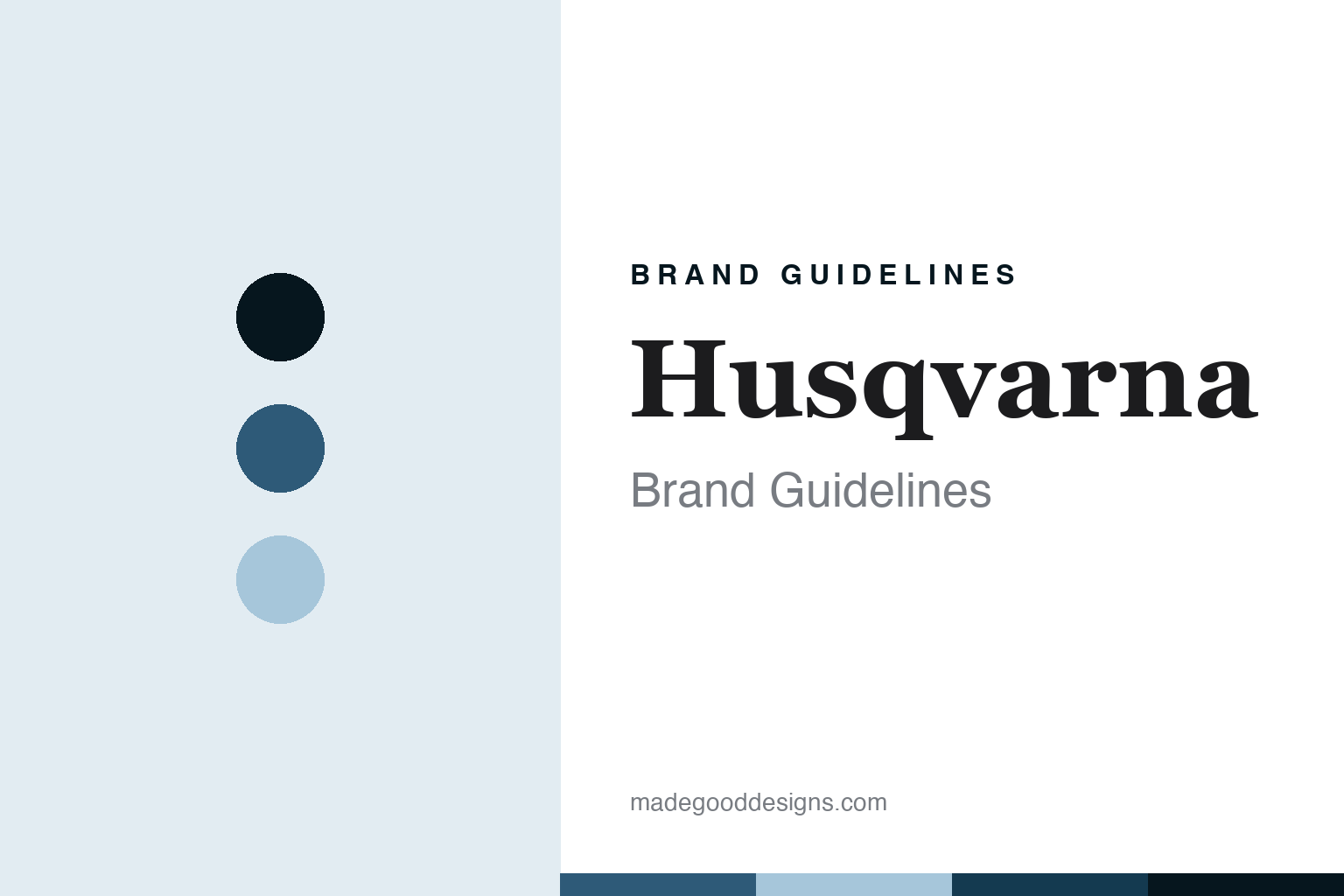
Husqvarna lives in a heritage steel. Click a swatch to copy the hex.
Husqvarna’s identity is pioneering, engineered and long-established — a heritage steel, an ink, a pale sky, a deep marine, and a paper. The palette leans heritage steel and pale sky: a cool, industrial register that nods to precision engineering and Swedish steel rather than a loud logo colour, and deliberately not to the brand’s own orange-and-grey livery. It signals the robot-mower pioneer — first, engineered and enduring. The honest caveat: with no published brand hex, and with the orange-and-grey treated as protected trade dress, these values are an original, unofficial interpretation, not first-party colours.
The lesson is a heritage steel signals a pioneering, engineered identity. Husqvarna’s world is a robot quietly cutting a lawn on its own. For designers, it is a reminder that a cool heritage steel and a soft pale sky can carry a maker brand — an engineered tone held as colour, never the signature orange-and-grey. Because these tones can fail as small text, keep type dark and let the colour live in the accents, palette and band. The takeaways: date the company to 1689; name the Stockholm listing; hedge the “first” with “widely credited”; place the mowers in the UK and Sweden; and treat any single hex as unofficial.
Typography
The register is a pioneer serif — first, engineered, enduring.
Husqvarna’s identity carries a first, engineered, enduring spirit — a category creator with centuries behind it, not a follower. A pioneer serif captures the mood: confident, precise and established, the register of the brand that set the standard. Set in a heritage-steel palette, the pioneer serif feels first and enduring — exactly the personality Husqvarna carries. It behaves like an established engineering name rather than a loud logo, mirroring a cut-grass stripe and a satellite signal. (Husqvarna’s real mowers, the orange-and-grey and the Automower name are things we describe but do not reproduce, and the exact typeface is not ours to use.) Because it is not ours to use, the honest description is “a pioneer-serif brand,” shown here in a stand-in. The type behaves like the brand: first, engineered and enduring.
Aa
A pioneer-serif brand — first and engineered. (Specimen set in Playfair Display, a pioneer-serif STAND-IN; NOT the Husqvarna logo or its orange-and-grey livery.)
The robot mower
Husqvarna stands for the robot-mower pioneer.
Husqvarna opens the robot-mower round as its pioneer node. A heritage-steel palette, a pioneer serif and a 1689 founding make one thing — the robot-mower pioneer — the whole identity: pioneering, engineered and long-established. The category-creating Automower is the pitch, and the market leadership is the proof. The point is the brand that created the robotic mower, in a round about where these machines are made and who owns them.
Put to work, the identity is the brand told straight, ownership named and the “first” hedged. A maker in this spirit would date the company to 1689, name the Stockholm listing, and hedge the first-mower claim as “widely credited.” A reader in this spirit would keep the facts right: Husqvarna sells the mowers as its heroes, led by the Automower; the company traces to 1689 in Sweden; it is a public company listed on Nasdaq Stockholm, spun off from Electrolux in 2006; its robotic mowers are made in the UK and Sweden; and it is widely credited with the first robotic mower, the Solar Mower of 1995. Husqvarna opens the round, before Stihl. The honest editorial moves are to date it to 1689, to name the listing, to hedge the “first,” to place the mowers in the UK and Sweden, and to keep the motorcycle company separate.
For designers and brand-builders, Husqvarna opens the robot mower: own a genuine category first — and be honest about ownership, where it is made and the limits of the claim. The lessons: claim a real first with a hedge; name a public listing plainly; separate a shared brand name from an unrelated company; place manufacturing precisely rather than in a flattering single country; and never reproduce a logo or a protected colour. It is also a reminder to stay precise: Husqvarna is the 330-year-old Swedish maker, listed on Nasdaq Stockholm, widely credited with inventing the robotic lawn mower — with the palette here an unofficial interpretation. The hook is that span: a works that began making musket barrels for the Swedish crown in 1689 is the same company that, three centuries later, sent the first robot out to cut a lawn by itself — and still leads the category it created. Read that way, Husqvarna is less a mower than a category it created: first, engineered, enduring. The lesson for a brand is that a genuine first and honest framing reinforce each other, and hedging the claim keeps the story earned. Husqvarna made the-robot-mower-pioneer the identity — proof that a first can open a round.
Explore & save
Keep Husqvarna’s identity on hand — save it to a board in the Made Good inspiration library.
Husqvarna identity set
Pin the heritage-steel palette and the pioneer-serif register to your own board.