Inoue Yasuji spent only about a decade making prints, yet his views of Tokyo in the 1880s record the city at the moment gas lamps, brick banks and iron bridges arrived. The National Diet Library of Japan describes his landscapes as made using Western printmaking techniques and notes that he did not adopt the blurring effects of his teacher, Kobayashi Kiyochika, preferring to render light as delicately as he could. That restraint is what makes his work useful to a designer today: it shows how much mood a few flat colours and a careful horizon can carry.
The four images reproduced here are colour woodblock triptychs in the Metropolitan Museum of Art, which flags each as public domain.
What to look at in Inoue Yasuji’s prints
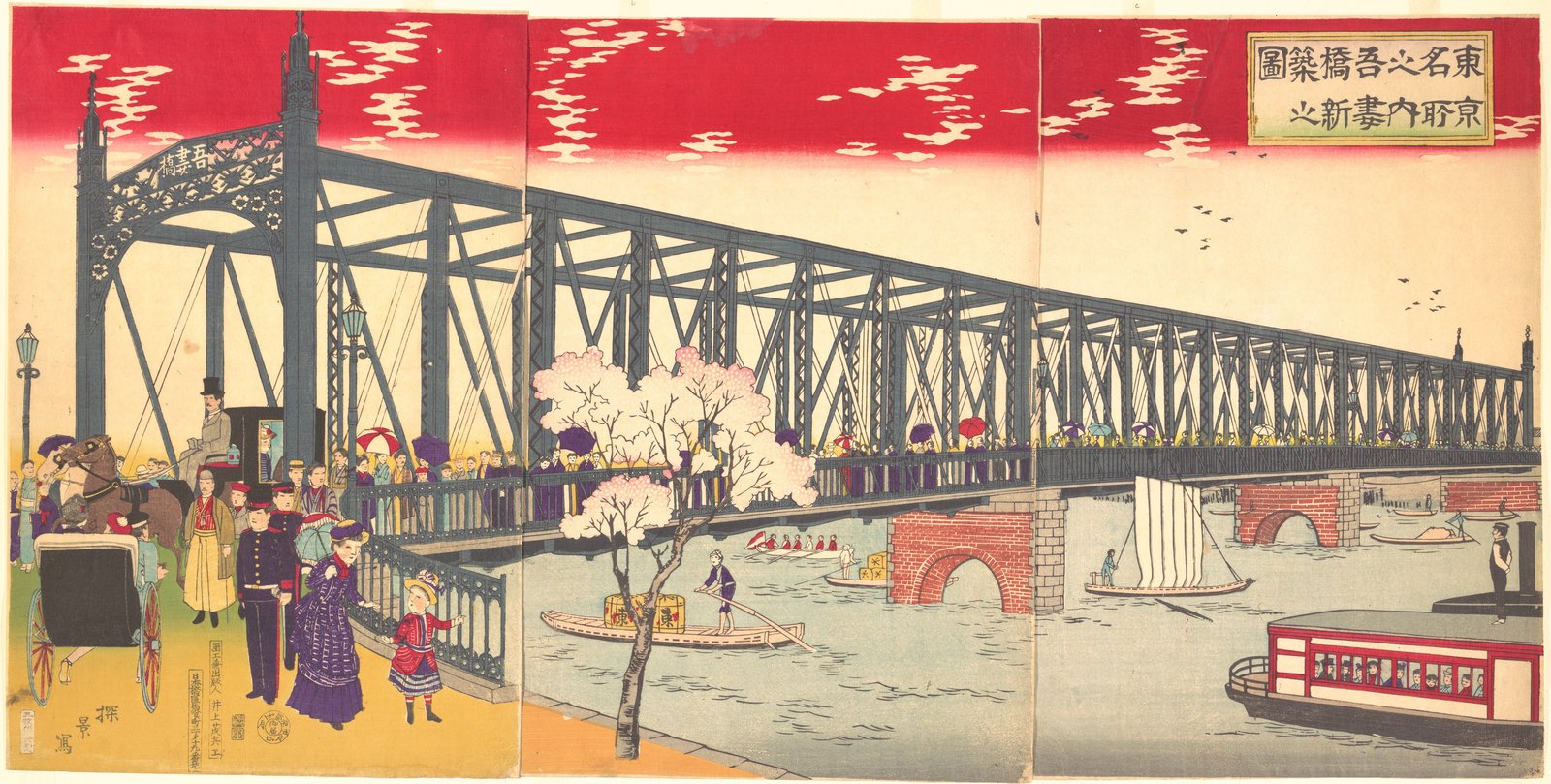
The long diagonal. In Illustration of the Opening of Azuma Bridge in Tokyo, 1887, the iron truss enters at full height on the left panel and shrinks steadily across all three sheets toward the right. The bridge is the composition. Crowds, rickshaws and a carriage gather at the near end; boats and a small steamer fill the water below. One strong receding line does the work of a perspective grid, and it ties the three separate sheets into a single picture.
Graded sky. The same print uses a band of saturated red across the top that fades into pale paper toward the horizon, broken by white cloud shapes. Graded colour at the edge of the block was a standard woodblock device, but here it sets the time of day and the mood without any drawn detail.
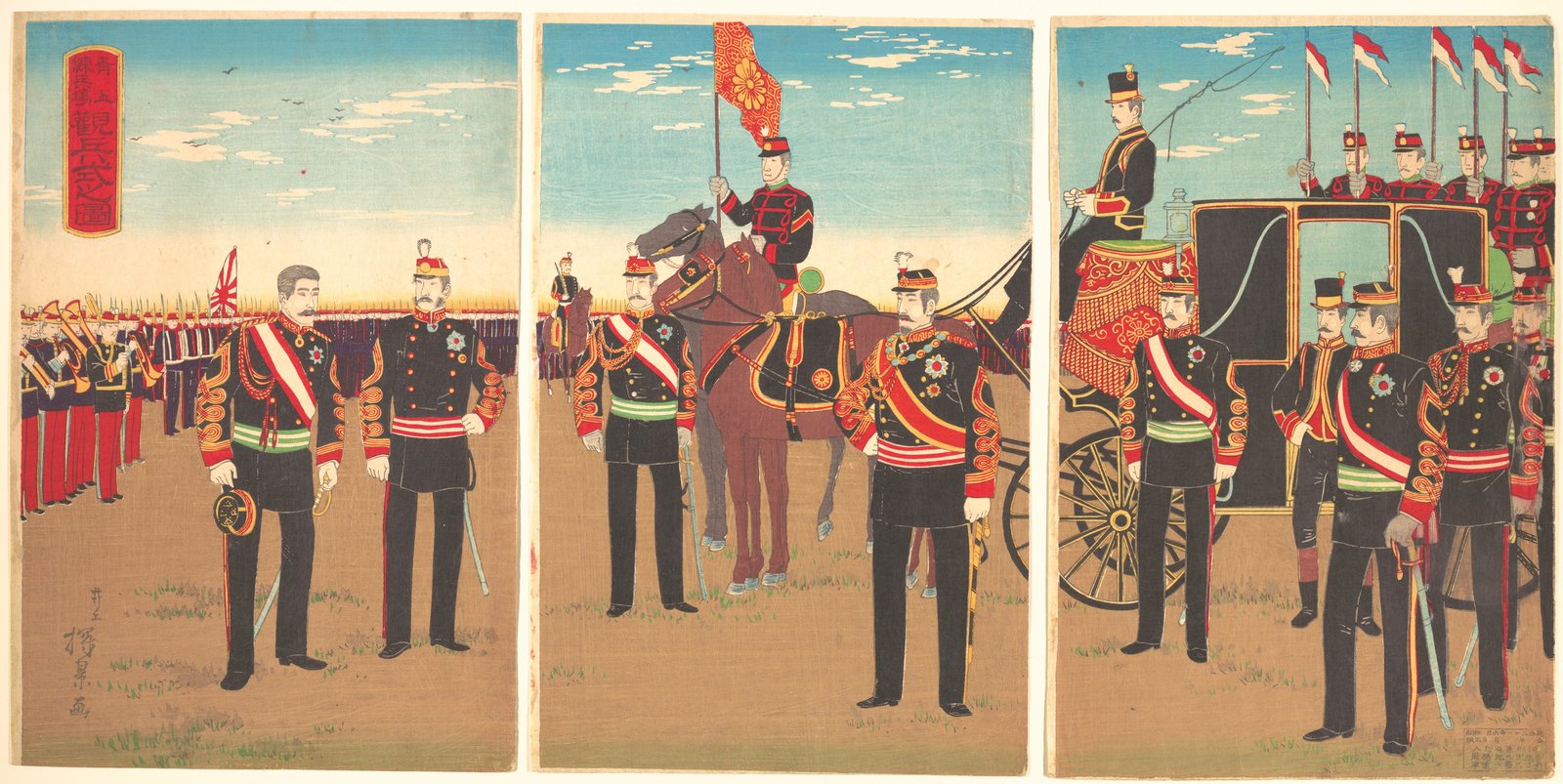
Open ground. In Review of Troops at the Aoyama Parade Grounds, June 1888, nearly half of each sheet is flat, sandy ground with a few tufts of grass. The figures in dark uniforms stand against it like cut-out shapes. Empty space is not wasted; it gives the busy uniforms room to read.
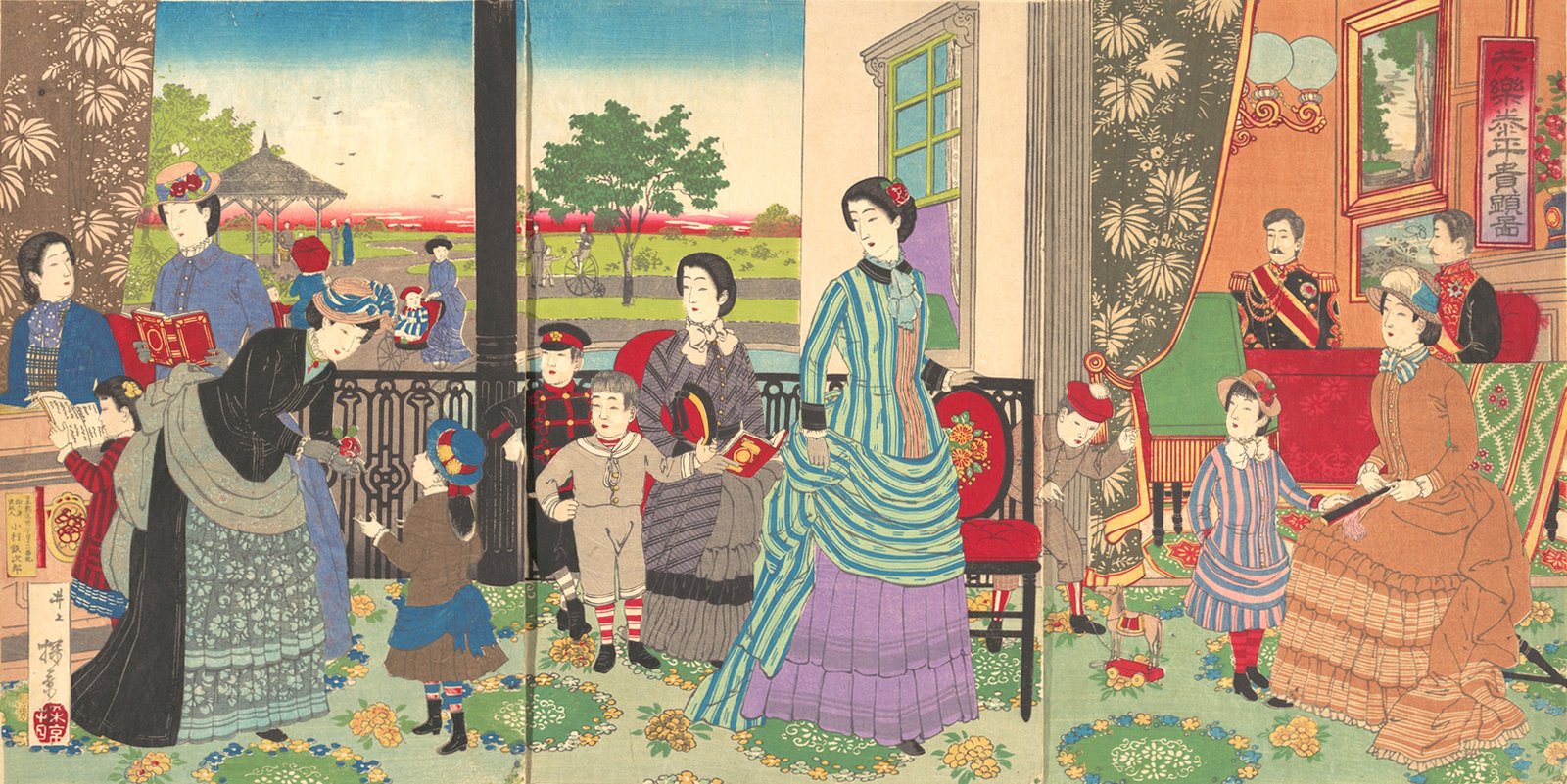
The cartouche. Each of the Met triptychs places a title cartouche in an upper corner, framed in a coloured border. It is a small block of lettering set into the sky, in the way a modern editorial layout parks a headline in negative space.
Career outline and key works
The Metropolitan Museum of Art gives his dates as 1864–1889. A 2024 exhibition at the Gas Museum in Kodaira, marking 160 years since his birth and reported by Bijutsu Techō, gives his birthplace as Namikichō in Asakusa, Tokyo, and says he became a pupil of Kobayashi Kiyochika at fifteen. The National Diet Library likewise records that he studied under Kiyochika as a young man.
Both the Gas Museum exhibition text and the Ota Memorial Museum of Art, in its 2022 exhibition Darkness and Light: Kiyochika, Yasuji, Ryūson as reported by Museum Information Japan, identify his debut print as Evening View of Asakusa Bridge, made in 1880, when he was seventeen by the traditional count. The Ota museum calls it a work in which Kiyochika’s influence shows strongly.
His main project was a long series of small Tokyo views, usually known as Famous Places in Tokyo (Tokyo meisho). The National Diet Library dates the start of the series to 1881. The Gas Museum exhibition text gives the series as 134 prints made between 1881 and his death in 1889. The Ota museum notes that many of these were in the yotsugiri format, a quarter of a standard ōban sheet, and that many were based on larger light-ray prints by Kiyochika or by Inoue himself, sometimes with changes. Dated examples shown in Tokyo include View of the Fujimi Ferry, March 1881, and Night View of Shops in Ginza, July 1882, held by the Ota Memorial Museum of Art.
From 1884, according to the Gas Museum exhibition text, he also used the art name Tankei for triptychs of modern life and for sumo prints. The Ota museum likewise notes that he took the name Inoue Tankei and produced other ukiyo-e alongside the light-ray work. The four Met triptychs, dated 1887 and 1888, belong to this side of his output, and their signatures read Tankei.
Inoue died in 1889. The National Diet Library and the Ota Memorial Museum of Art both give his age as twenty-six; the Ota museum specifies the traditional count.
Technique: light-ray pictures without hard outlines
Kōsenga, or “light-ray pictures,” is the name given to the landscape prints Kiyochika began making around 1876, according to the Ota Memorial Museum of Art, which adds that the vogue for them lasted only about five years. The National Diet Library describes kōsenga as an approach to woodblock printing that tries to depict shadow and light. The Ota Memorial Museum of Art explains the core method: instead of relying on the key block, the black outline block that structures most ukiyo-e, the light-ray prints build people and landscape from areas of colour, observed under particular light.
That matters for anyone designing with flat colour. Without an outline, edges are formed where two colours meet, so value and hue must be planned with care. Inoue’s small views, according to the National Diet Library, stay closer to gentle, even light than Kiyochika’s more dramatic blurred effects. In the Met triptychs, which follow the conventions of brightly printed commercial nishiki-e, outlines return, but the graded skies and the soft horizon bands carry over from the light-ray manner.
The colours below were measured from the museum’s scan of this impression of Illustration of the Opening of Azuma Bridge, not from original pigments: sky red #d53744, iron grey #726f69 and warm paper #fde8b9. From the scan of Review of Troops: uniform dark #4d4741, parade-ground sand #c8966a and pale horizon #c1cfb7. You can test similar sets with the image colour picker.
Format: small sheets and wide triptychs
Inoue worked at two scales. The yotsugiri views were small enough to collect in quantity, which suits a long, consistent series of places. The triptychs join three ōban sheets side by side; the Met lists Review of Troops at about 36.8 by 73 centimetres. Each sheet can stand alone, but the scene runs across the joins, so figures, horizon and bridge must line up.
That is the same problem a designer faces with a three-panel brochure, a carousel post or a gatefold. Look at how the Azuma Bridge truss crosses both joins at a steady angle, and how the parade print keeps the horizon at one height on all three sheets. Consistent horizontals are what let separate panels read as one view.
How designers can borrow Inoue Yasuji’s ideas today
Let one line carry the layout. A bridge, road or railing that recedes across the whole format gives depth and direction at once. In a web hero or a poster, a single strong diagonal can replace a busy perspective scene.
Use graded colour as atmosphere. A top-edge gradient into paper tone sets time and temperature before the viewer reads any detail. In print or on screen, a short gradient from a saturated hue into a warm neutral does the same job.
Design without the outline. Try building an illustration from colour areas only, as the light-ray prints do. It forces clear value steps and tends to produce calmer, more atmospheric images than line-and-fill.
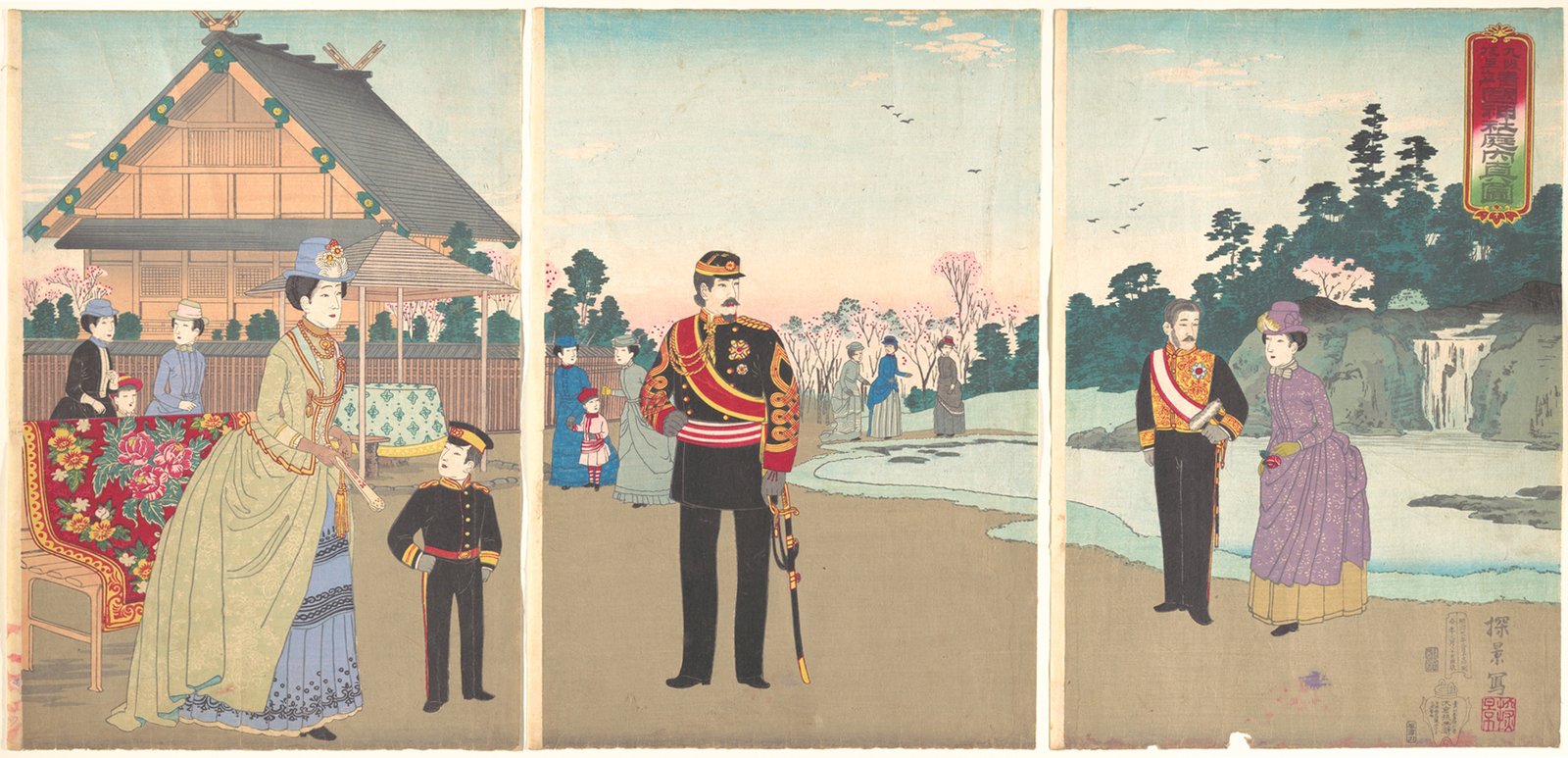
Give pattern room. In Peaceful Pleasures of the Highest Nobility, 1887, striped dresses, a floral carpet and leafy wall panels crowd the interior, yet the open veranda view in the centre panel gives the eye somewhere to rest. Busy pattern needs a quiet field beside it.
Treat the title as an object. A framed cartouche in a corner of sky is a reusable device for headers, labels and packaging.
Inoue Yasuji and the Meiji print world
Inoue sits between the older ukiyo-e tradition and the new pictures of a modern city. The guide to Kobayashi Kiyochika covers the teacher who developed the light-ray style, and the overview of ukiyo-e explains the print culture he grew out of. For more public-domain woodblock prints, browse the Japanese prints theme and the wider MGD museum collection.
Frequently asked questions
Who was Inoue Yasuji?
Inoue Yasuji (1864–1889) was a Tokyo woodblock print designer who trained under Kobayashi Kiyochika and continued his light-ray style in a long series of small Tokyo views from 1881. He also worked under the art name Tankei.
What are light-ray pictures (kōsenga)?
They are Meiji-period landscape prints that try to capture light and shadow. The Ota Memorial Museum of Art describes them as building forms from areas of colour rather than from the usual black outline block.
Why are some of his prints signed Tankei?
Tankei was an art name he used from 1884, according to the Gas Museum’s 2024 exhibition, for triptychs of modern life and other subjects. The Met triptychs shown here, from 1887 and 1888, carry that signature.
Can I use these images of Inoue Yasuji’s prints?
The four triptychs shown are flagged public domain in the Metropolitan Museum of Art’s collection API. Check the museum’s object page for its current terms before reuse.