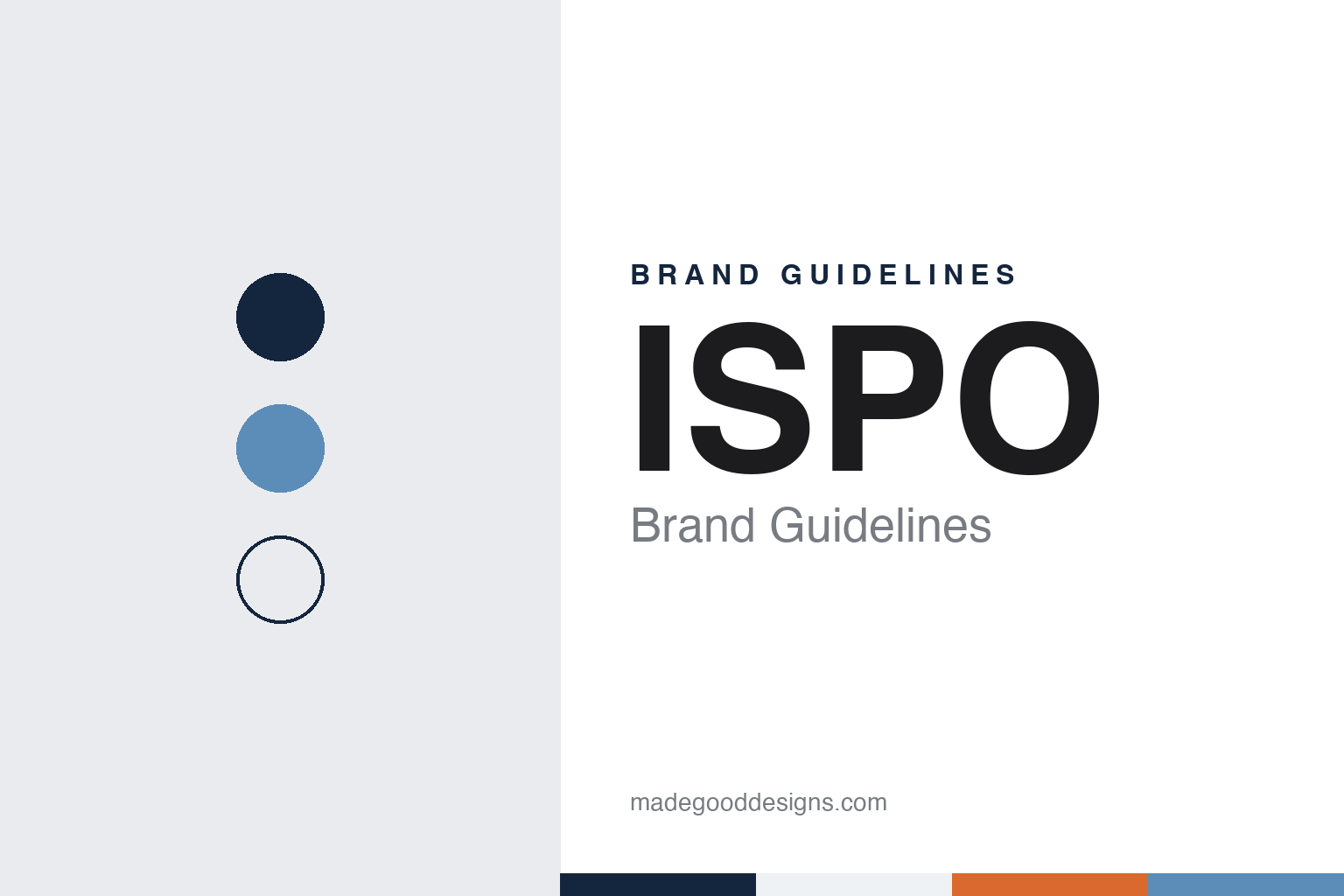
ISPO Brand Guidelines
The Munich sports trade fair of 1970 that moved to Amsterdam.
Aa
Two constants: a navy, glacier blue and summit orange palette and a sporty grotesque register. Abstract homage — not an ISPO asset; no logo, key visual or product is reproduced.
Munich, 1970
A sports-goods fair two years before the Munich Olympics.
ISPO began in Munich in 1970. German Wikipedia says the trade fair company Messe München founded it that year, and that the opening edition brought together 816 exhibitors from 25 countries and 10,777 trade visitors, with the broadcaster ZDF showing the event live. The name is an abbreviation of its original German title, Internationale Fachmesse für Sportartikel und Sportmode, the International Trade Fair for Sports Goods and Sports Fashion. The show’s own history page gives the same name and places the launch two years before the 1972 Olympic Games in Munich.
The fair grew quickly, according to German Wikipedia. In 1971 it ran for four days and added a textile centre for sports fashion. Between 1972 and 1978 it carried the nickname “Olympische Messe,” the Olympic fair, and its attractions included an artificial ice rink and a ski slope. A symposium was added in 1975. Between 1979 and 1984 an autumn edition joined the winter one, widening the range to summer and all-year sports, and in 1982 live ski-wear fashion shows became part of the programme.
In the second half of the 1980s, German Wikipedia says, the number of exhibitors from abroad rose and newer sports such as paragliding and snowboarding appeared in the halls. From 1990 to 1995 the organiser gave sports fashion more room with a trend forum and designer fashion shows, while carving skis, snowboards and recycling became recurring themes. In 1998 ISPO moved to Munich’s newly built trade-fair grounds, where it stayed for the rest of its Munich years.
Colour
A trade fair for the whole sporting-goods chain.
For most of its history ISPO was a fair for the industry rather than for the public: manufacturers, brands and suppliers came to meet retailers and buyers. German Wikipedia describes the later Munich show in three areas. Upstream & Supply covered materials, sourcing and logistics; Brands & Products showed new products and prototypes; and Commerce & Experience dealt with retail and the way products reach shoppers. Its categories ran from outdoor, skiing and snowboarding to running, team sports, racket sports, triathlon and cycling, with further areas for wearable technology and esports.
The programme kept adding layers. German Wikipedia lists ISPO Textrends, a materials and textile forum, from 2013, and a hall of its own for health and fitness from 2014. The 2010 fair was the 70th edition and coincided with the show’s 40th anniversary; in 2020 ISPO marked fifty years under the motto “50 years of tomorrow.” The same article puts attendance at 3,307 exhibitors and more than 80,000 visitors in 2018, and at more than 2,300 exhibitors from 50 countries and more than 55,000 trade visitors from 113 countries in 2024.
The name also travelled. German Wikipedia says an ISPO China edition began in 2005 and moved to Beijing in 2006. Messe München said in October 2025 that ISPO Beijing and ISPO Shanghai remain under its own responsibility, separate from the Munich show’s new arrangement.
In its last Munich years the fair sat at the end of November rather than in winter. German Wikipedia dates the 2023 edition to 28–30 November, and FashionUnited reported in October 2025 that the 2025 edition, the final one in Munich, was set for 30 November to 2 December.
Typography
Fairs for the sports, toy and music trades.
Trade fairs for toys, musical instruments and sporting goods tend to name themselves plainly. Most pair the product field with a city or with a single word such as fair, show or expo, so that the name alone tells a buyer what is on offer and where to go. Some keep a word in the language of their home city even when most visitors come from abroad; others have shortened longer official titles to the form people already used.
Many of these events are built for the trade rather than the public. Trade days are usually reserved for retailers, buyers, distributors, manufacturers and press, and some fairs check credentials or set a minimum age at the door. Others are open to the public, either throughout or on particular days, and present themselves more like festivals for players, musicians or riders.
Behind the fairs stand different kinds of organiser: trade associations representing an industry, cooperatives owned by the exhibitors themselves, and exhibition companies that run the halls and sell the space. Dates matter as much as names. A fair tied to the buying calendar may move between seasons when the industry’s order cycle changes, and the month becomes part of how the event is known.
Inside, the halls are usually arranged by product group, so that a visitor can walk from one category to the next. Demonstration areas, play areas, sound booths and test tracks let products be tried rather than only seen. The visual identity often follows a simple pattern: a wordmark or emblem kept from year to year, set beside a key visual, edition number and dates that change with each edition. This guide describes those identities from dated sources and uses colours and type of our own choosing.
Aa
A sporty grotesque for an event wordmark. (Specimen set in Archivo, a sans STAND-IN; NOT the ISPO logo.)
ISPO
From Munich to the RAI.
On 28 October 2025 Messe München announced a joint venture with the British events company Raccoon Media Group to run ISPO. In its press release the trade fair company said that changes in the market, including a shift by sporting-goods makers towards selling directly to consumers, had affected the Munich show, and that the new set-up came with a new date in early November and a change of venue. Its chief executives, Stefan Rummel and Reinhard Pfeiffer, called the joint venture a new beginning for the event.
FashionUnited reported the same month that the venue would be the RAI Amsterdam convention centre. Raccoon Media Group, the magazine said, was founded in 2018 with the National Running Show in Birmingham and already ran The International Running Expo at the RAI. In a written interview with FashionUnited in November 2025, Raccoon’s chief executive, Mike Seaman, said the earlier date avoided a clash with Thanksgiving in the United States, and described the format as a one-day conference for senior executives followed by a two-day exhibition. The organisers set the first Amsterdam edition for 3–5 November 2026, with the ISPO Leaders’ Summit on the opening day; the RAI said the show would take eight halls.
The RAI, announcing the move in December 2025, said ISPO 2026 would cover 45,000 square metres and run alongside The International Running Expo, so that visitors could reach both events. In the Munich years the show’s own figures had moved with the market: German Wikipedia records more than 1,700 exhibitors and more than 40,000 visitors from 117 countries in 2022, and more than 2,400 exhibitors from 54 countries for the 28–30 November edition of 2023.
Across these changes the four capital letters stayed in use. The show’s website, Messe München and the RAI all write ISPO on its own, without the long German title it abbreviates, and the Beijing and Shanghai shows add only a city to it.
For a design guide, ISPO shows how a trade-fair brand can rest on a short abbreviation that keeps its meaning after the full name is dropped and the city changes. Compare Messe München, which founded the fair, and Eurobike, another fair for the sports trade that changed city. For this guide we use night-slope navy, glacier blue and summit orange with a sans, an unofficial interpretation; no product or logo is reproduced.
Explore & save
Keep ISPO’s identity on hand — save it to a board in the Made Good inspiration library.
ISPO identity set
Pin the navy, glacier blue and summit orange palette and the sporty grotesque register to your own board.
Source & notes
Frequently Asked Questions
What font can I use to match the ISPO look?
This guide describes ISPO’s type as “A sporty grotesque for an event wordmark”. Its type specimen is set in Archivo from Google Fonts as a stand-in; Archivo is not ISPO’s own lettering.
What colours are in the ISPO palette?
This guide’s ISPO palette is Night slope navy #14263D, Fair blue #1F3A5C, Glacier blue #5B8DB8, Piste white #EEF2F5 and Summit orange #D9692E. The tones are the guide’s own unofficial interpretation, not official ISPO hex codes.
When was ISPO founded?
ISPO was founded in 1970, in Munich, Germany.