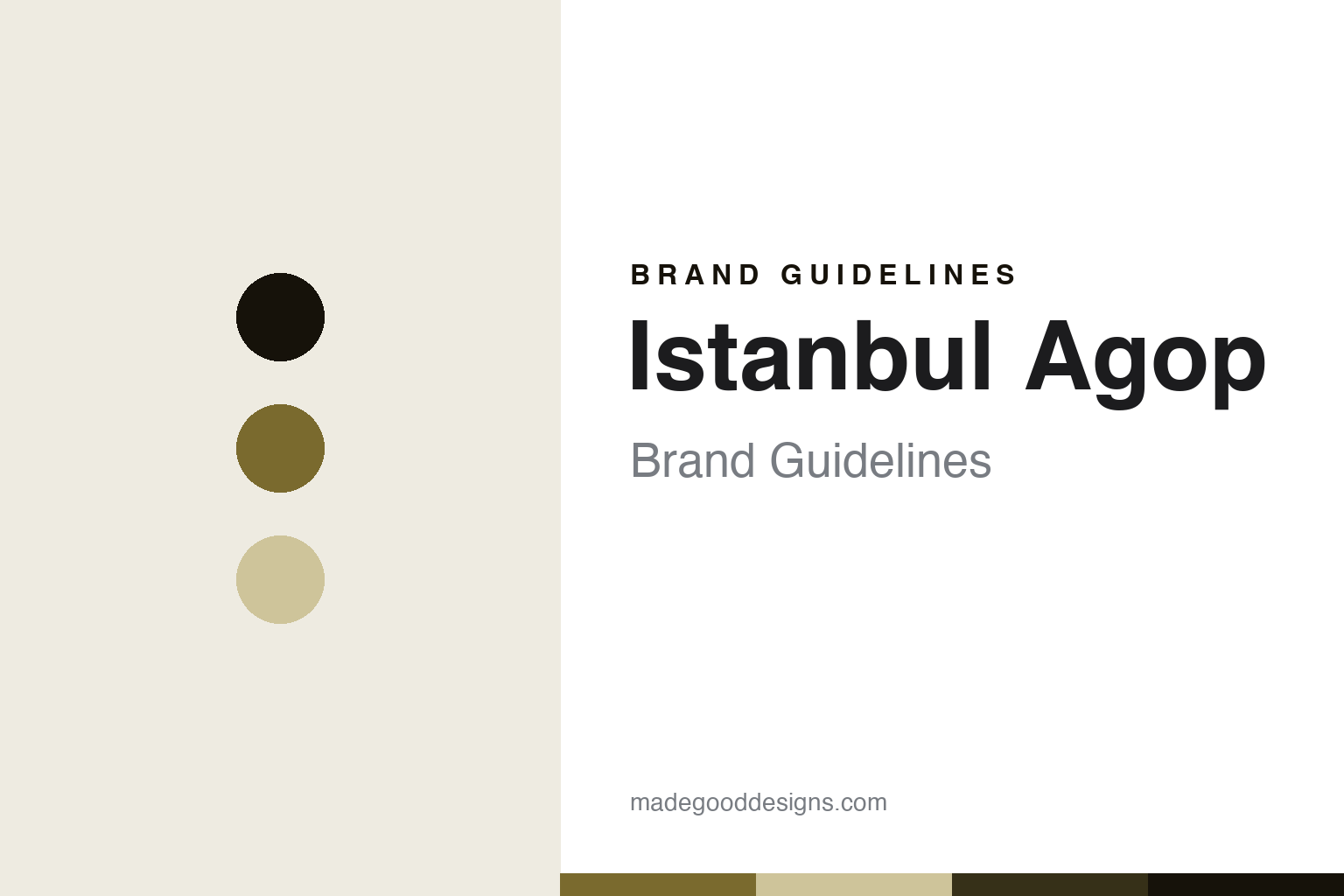
Istanbul Agop Brand Guidelines
The Istanbul cymbal house.
Aa
Two constants: a bronze palette and a hammered-sans register. Abstract homage — not an Istanbul Agop cymbal or mark.
The Istanbul cymbal house
Istanbul Agop is the Turkish cymbal maker founded in Istanbul in 1980, hand-hammering its cymbals in the city that is the historic home of the craft.
Istanbul Agop is the round’s cymbal maker, and it works where the craft was born. From Istanbul, it makes hand-hammered cymbals in the traditional Turkish method — the same city that has made cymbals for centuries. Its answer to how a house becomes a name is place and hand-work: hammer the bronze by hand, in Istanbul, the way it has always been done. A Turkish cymbal, hammered in the city of cymbals.
Its identity is the Istanbul cymbal house. Istanbul Agop’s hand-hammered cymbals, its Istanbul making and its place in a centuries-old tradition are the work it is known for. A cymbal, from Istanbul. A single craft, done by hand.
(Honest notes, so the story stays precise. Istanbul Agop was founded in 1980 in Istanbul by Agop Tomurcuk, with Mehmet Tamdeğer as partner; after Agop Tomurcuk died in 1996, the operation divided into two separate companies, Istanbul Agop — continued by Agop’s sons — and Istanbul Mehmet, which we keep clearly distinct. On what it makes, it is a single-focus cymbal house making hand-hammered cymbals (its lines include the Traditional series and the more accessible XIST); the brand states its cymbals, including the value line, are made in Turkey, and we found no offshore line — so we say “made in Turkey,” not that any line is made abroad. Its bronze is the traditional Turkish cast bronze widely described as a roughly 80/20 copper-tin (B20) alloy, though the firm treats its exact recipe as proprietary, so we attribute the alloy as the traditional one rather than an official published spec. On heritage: Istanbul is the historic home of cymbal-making — the same centuries-old tradition from which the Ottoman-Armenian family behind the old Zildjian company emerged before it moved to America — and we present that as a shared geographic craft tradition, not a corporate or family link between the two companies. It is family-owned, run by the Tomurcuk sons. Its name and marks are IP, described but never reproduced, and there is no official brand hex; these tones are an unofficial interpretation. This is design commentary and does not promote any product.)
Colour
Istanbul Agop lives in a bronze palette. Click a swatch to copy the hex.
Istanbul Agop’s identity is traditional, Turkish and hand-made — a bronze, an ink, a brass, a deep bronze, and a paper. The palette leans bronze and brass: the register of hammered cast bronze and a hot workshop. It signals hand-work over machinery. The honest caveat: with no published brand hex, these values are an original, unofficial interpretation, not first-party colours.
The lesson is a bronze palette signals a hand-hammered, made-in-Istanbul identity. Istanbul Agop’s world is a traditional, metal, Turkish object. For designers, it is a reminder that a warm bronze and a pale brass can carry a house built on hand-hammering — the colour of cast bronze and the sheen of a lathed cymbal. Because these tones can fail as small text, keep type dark and let the colour live in the accents, palette and band. The takeaways: hammer by hand; keep the work in the craft’s home city; attribute the alloy honestly; and treat any single hex as unofficial.
Typography
The register is a hammered sans — plain, sturdy, made.
Istanbul Agop’s identity carries a plain, sturdy, made spirit — a single-craft cymbal house, not a fashion label. A hammered sans captures the mood: even, solid and unadorned, the register of a workshop that hammers bronze by hand. Set in a bronze palette, the hammered sans feels plain and made — exactly the personality Istanbul Agop carries. It is a traditional craft rather than a marketing wall, mirroring a hand-hammered cymbal. (Istanbul Agop’s real logo and wordmark are things we describe but do not reproduce, and the exact typeface is not ours to use.) Because it is not ours to use, the honest description is “a hammered-sans spirit,” shown here in a stand-in. The type behaves like the house: plain, sturdy and made.
Aa
A hammered-sans spirit — plain and made. (Specimen set in Space Grotesk, a hammered-sans STAND-IN; NOT the Istanbul Agop logo or any mark.)
The instrument makers
Istanbul Agop stands for the cymbal hand-hammered where the craft began.
Istanbul Agop is a lesson in how place and hand-work can be an identity. A bronze palette, a hammered sans and a hand-hammered cymbal make one thing — the Istanbul cymbal house — the whole identity: traditional, Turkish and hand-made. The Istanbul making is the differentiator, and the centuries-old craft tradition is the meaning. The point is a house that hammers bronze by hand, in the city that has made cymbals for as long as anyone, and builds its whole identity on that place and that method.
Put to work, the identity is a single craft, honestly told, as design. A house in this spirit would hammer by hand, keep the work in the craft’s home, and be candid about the material — hand-hammered cymbals, made in Istanbul, a traditional cast bronze whose exact recipe stays in-house. A brand learning from it would see that place plus hand-work is a durable identity — that a cymbal hammered by hand in Istanbul carries a tradition a machine-pressed disc cannot — and that being precise, founded 1980 by Agop Tomurcuk, made in Turkey, is what keeps the story honest. Istanbul Agop joins Petrof and José Ramírez as one of the round’s family, made-at-home houses — and it carries the round’s one purely place-based story: the value of the object is inseparable from the city it is made in. There is care in how the heritage is framed: Istanbul is genuinely the historic home of cymbal-making, the same tradition the old Zildjian family came from before America, but that is a shared craft lineage, not a corporate link — and saying it that way is what keeps the claim honest. There is discipline, too, in the material: attributing the bronze as the traditional Turkish alloy rather than printing a recipe the firm keeps proprietary. The lesson Istanbul Agop teaches is that place can hold an identity: the Istanbul hand-work gives it substance, and the honest framing of the tradition keeps it credible. The place is the personality, and the hand-hammered cymbal is the proof.
For designers and brand-builders, Istanbul Agop holds the Turkey pole in the instrument makers: keep the craft in its home, and let the hand-work speak. The lessons: make by hand; stay in the craft’s home city; attribute the material honestly; frame shared heritage as tradition, not ownership; and never reproduce a logo or cultural motif. It is also a reminder to stay precise: Istanbul Agop is the Turkish cymbal maker founded in Istanbul in 1980, hand-hammering its cymbals in the city that is the historic home of the craft — with the palette here an unofficial interpretation. Istanbul Agop made place-and-hand-work the identity — proof that a cymbal hammered where the craft began, honestly told, can be the difference.
Explore & save
Keep Istanbul Agop’s identity on hand — save it to a board in the Made Good inspiration library.
Istanbul Agop identity set
Pin the bronze palette and the hammered-sans register to your own board.